load_diabetes#
- sklearn.datasets.load_diabetes(*, return_X_y=False, as_frame=False, scaled=True)[source]#
Load and return the diabetes dataset (regression).
Samples total
442
Dimensionality
10
Features
real, -.2 < x < .2
Targets
integer 25 - 346
Note
The meaning of each feature (i.e.
feature_names) might be unclear (especially forltg) as the documentation of the original dataset is not explicit. We provide information that seems correct in regard with the scientific literature in this field of research.Read more in the User Guide.
- Parameters:
- return_X_ybool, default=False
If True, returns
(data, target)instead of a Bunch object. See below for more information about thedataandtargetobjects.- as_framebool, default=False
If True, the data is a pandas DataFrame including columns with appropriate dtypes (numeric). The target is a pandas DataFrame or Series depending on the number of target columns. If
return_X_yis True, then (data,target) will be pandas DataFrames or Series as described below.- scaledbool, default=True
If True, the feature variables are mean centered and scaled by the standard deviation times the square root of
n_samples. If False, raw data is returned for the feature variables.Added in version 1.1.
- Returns:
- data
Bunch Dictionary-like object, with the following attributes.
- data{ndarray, dataframe} of shape (442, 10)
The data matrix. If
as_frame=True,datawill be a pandas DataFrame.- target: {ndarray, Series} of shape (442,)
The regression target. If
as_frame=True,targetwill be a pandas Series.- feature_names: list
The names of the dataset columns.
- frame: DataFrame of shape (442, 11)
Only present when
as_frame=True. DataFrame withdataandtarget.- DESCR: str
The full description of the dataset.
- data_filename: str
The path to the location of the data.
- target_filename: str
The path to the location of the target.
- (data, target)tuple if
return_X_yis True A tuple of two ndarrays. The first contains a 2D ndarray of shape (442, 10) with each row representing one sample and the columns representing the features. The second ndarray of shape (442,) contains the target samples. If
as_frame=True, both arrays are pandas objects, i.e.Xa dataframe andya series.
- data
Examples
>>> from sklearn.datasets import load_diabetes
>>> diabetes = load_diabetes()
>>> diabetes.target[:3]
array([151.,  75., 141.])
>>> diabetes.data.shape
(442, 10)
Gallery examples#
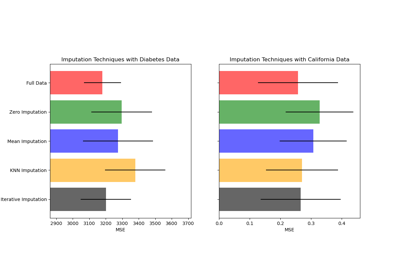
Imputing missing values before building an estimator