Ctrl+K
scikit-learn homepage scikit-learn homepage
  • Install
  • User Guide
  • API
  • Examples
  • Community
    • Getting Started
    • Release History
    • Glossary
    • Development
    • FAQ
    • Support
    • Related Projects
    • Roadmap
    • Governance
    • About us
  • GitHub
  • Install
  • User Guide
  • API
  • Examples
  • Community
  • Getting Started
  • Release History
  • Glossary
  • Development
  • FAQ
  • Support
  • Related Projects
  • Roadmap
  • Governance
  • About us
  • GitHub

Section Navigation

  • Release Highlights
    • Release Highlights for scikit-learn 1.8
    • Release Highlights for scikit-learn 1.7
    • Release Highlights for scikit-learn 1.6
    • Release Highlights for scikit-learn 1.5
    • Release Highlights for scikit-learn 1.4
    • Release Highlights for scikit-learn 1.3
    • Release Highlights for scikit-learn 1.2
    • Release Highlights for scikit-learn 1.1
    • Release Highlights for scikit-learn 1.0
    • Release Highlights for scikit-learn 0.24
    • Release Highlights for scikit-learn 0.23
    • Release Highlights for scikit-learn 0.22
  • Biclustering
    • A demo of the Spectral Biclustering algorithm
    • A demo of the Spectral Co-Clustering algorithm
    • Biclustering documents with the Spectral Co-clustering algorithm
  • Calibration
    • Comparison of Calibration of Classifiers
    • Probability Calibration curves
    • Probability Calibration for 3-class classification
    • Probability calibration of classifiers
  • Classification
    • Classifier comparison
    • Linear and Quadratic Discriminant Analysis with covariance ellipsoid
    • Normal, Ledoit-Wolf and OAS Linear Discriminant Analysis for classification
    • Plot classification probability
    • Recognizing hand-written digits
  • Clustering
    • A demo of K-Means clustering on the handwritten digits data
    • A demo of structured Ward hierarchical clustering on an image of coins
    • A demo of the mean-shift clustering algorithm
    • Adjustment for chance in clustering performance evaluation
    • Agglomerative clustering with different metrics
    • An example of K-Means++ initialization
    • Bisecting K-Means and Regular K-Means Performance Comparison
    • Compare BIRCH and MiniBatchKMeans
    • Comparing different clustering algorithms on toy datasets
    • Comparing different hierarchical linkage methods on toy datasets
    • Comparison of the K-Means and MiniBatchKMeans clustering algorithms
    • Demo of DBSCAN clustering algorithm
    • Demo of HDBSCAN clustering algorithm
    • Demo of OPTICS clustering algorithm
    • Demo of affinity propagation clustering algorithm
    • Demonstration of k-means assumptions
    • Empirical evaluation of the impact of k-means initialization
    • Feature agglomeration
    • Feature agglomeration vs. univariate selection
    • Hierarchical clustering with and without structure
    • Inductive Clustering
    • Online learning of a dictionary of parts of faces
    • Plot Hierarchical Clustering Dendrogram
    • Segmenting the picture of greek coins in regions
    • Selecting the number of clusters with silhouette analysis on KMeans clustering
    • Spectral clustering for image segmentation
    • Various Agglomerative Clustering on a 2D embedding of digits
    • Vector Quantization Example
  • Covariance estimation
    • Ledoit-Wolf vs OAS estimation
    • Robust covariance estimation and Mahalanobis distances relevance
    • Robust vs Empirical covariance estimate
    • Shrinkage covariance estimation: LedoitWolf vs OAS and max-likelihood
    • Sparse inverse covariance estimation
  • Cross decomposition
    • Compare cross decomposition methods
    • Principal Component Regression vs Partial Least Squares Regression
  • Dataset examples
    • Plot randomly generated multilabel dataset
  • Decision Trees
    • Decision Tree Regression
    • Plot the decision surface of decision trees trained on the iris dataset
    • Post pruning decision trees with cost complexity pruning
    • Understanding the decision tree structure
  • Decomposition
    • Blind source separation using FastICA
    • Comparison of LDA and PCA 2D projection of Iris dataset
    • Faces dataset decompositions
    • Factor Analysis (with rotation) to visualize patterns
    • FastICA on 2D point clouds
    • Image denoising using dictionary learning
    • Incremental PCA
    • Kernel PCA
    • Model selection with Probabilistic PCA and Factor Analysis (FA)
    • Principal Component Analysis (PCA) on Iris Dataset
    • Sparse coding with a precomputed dictionary
  • Developing Estimators
    • __sklearn_is_fitted__ as Developer API
  • Ensemble methods
    • Categorical Feature Support in Gradient Boosting
    • Combine predictors using stacking
    • Comparing Random Forests and Histogram Gradient Boosting models
    • Comparing random forests and the multi-output meta estimator
    • Decision Tree Regression with AdaBoost
    • Early stopping in Gradient Boosting
    • Feature importances with a forest of trees
    • Feature transformations with ensembles of trees
    • Features in Histogram Gradient Boosting Trees
    • Gradient Boosting Out-of-Bag estimates
    • Gradient Boosting regression
    • Gradient Boosting regularization
    • Hashing feature transformation using Totally Random Trees
    • IsolationForest example
    • Monotonic Constraints
    • Multi-class AdaBoosted Decision Trees
    • OOB Errors for Random Forests
    • Plot individual and voting regression predictions
    • Plot the decision surfaces of ensembles of trees on the iris dataset
    • Prediction Intervals for Gradient Boosting Regression
    • Single estimator versus bagging: bias-variance decomposition
    • Two-class AdaBoost
    • Visualizing the probabilistic predictions of a VotingClassifier
  • Examples based on real world datasets
    • Compressive sensing: tomography reconstruction with L1 prior (Lasso)
    • Faces recognition example using eigenfaces and SVMs
    • Image denoising using kernel PCA
    • Lagged features for time series forecasting
    • Model Complexity Influence
    • Out-of-core classification of text documents
    • Outlier detection on a real data set
    • Prediction Latency
    • Species distribution modeling
    • Time-related feature engineering
    • Topic extraction with Non-negative Matrix Factorization and Latent Dirichlet Allocation
    • Visualizing the stock market structure
    • Wikipedia principal eigenvector
  • Feature Selection
    • Comparison of F-test and mutual information
    • Model-based and sequential feature selection
    • Pipeline ANOVA SVM
    • Recursive feature elimination
    • Recursive feature elimination with cross-validation
    • Univariate Feature Selection
  • Frozen Estimators
    • Examples of Using FrozenEstimator
  • Gaussian Mixture Models
    • Concentration Prior Type Analysis of Variation Bayesian Gaussian Mixture
    • Density Estimation for a Gaussian mixture
    • GMM Initialization Methods
    • GMM covariances
    • Gaussian Mixture Model Ellipsoids
    • Gaussian Mixture Model Selection
    • Gaussian Mixture Model Sine Curve
  • Gaussian Process for Machine Learning
    • Ability of Gaussian process regression (GPR) to estimate data noise-level
    • Comparison of kernel ridge and Gaussian process regression
    • Forecasting of CO2 level on Mona Loa dataset using Gaussian process regression (GPR)
    • Gaussian Processes regression: basic introductory example
    • Gaussian process classification (GPC) on iris dataset
    • Gaussian processes on discrete data structures
    • Illustration of Gaussian process classification (GPC) on the XOR dataset
    • Illustration of prior and posterior Gaussian process for different kernels
    • Iso-probability lines for Gaussian Processes classification (GPC)
    • Probabilistic predictions with Gaussian process classification (GPC)
  • Generalized Linear Models
    • Comparing Linear Bayesian Regressors
    • Curve Fitting with Bayesian Ridge Regression
    • Decision Boundaries of Multinomial and One-vs-Rest Logistic Regression
    • Early stopping of Stochastic Gradient Descent
    • Fitting an Elastic Net with a precomputed Gram Matrix and Weighted Samples
    • HuberRegressor vs Ridge on dataset with strong outliers
    • Joint feature selection with multi-task Lasso
    • L1 Penalty and Sparsity in Logistic Regression
    • L1-based models for Sparse Signals
    • Lasso model selection via information criteria
    • Lasso model selection: AIC-BIC / cross-validation
    • Lasso on dense and sparse data
    • Lasso, Lasso-LARS, and Elastic Net paths
    • MNIST classification using multinomial logistic + L1
    • Multiclass sparse logistic regression on 20newgroups
    • Non-negative least squares
    • One-Class SVM versus One-Class SVM using Stochastic Gradient Descent
    • Ordinary Least Squares and Ridge Regression
    • Orthogonal Matching Pursuit
    • Plot Ridge coefficients as a function of the regularization
    • Plot multi-class SGD on the iris dataset
    • Poisson regression and non-normal loss
    • Polynomial and Spline interpolation
    • Quantile regression
    • Regularization path of L1- Logistic Regression
    • Ridge coefficients as a function of the L2 Regularization
    • Robust linear estimator fitting
    • Robust linear model estimation using RANSAC
    • SGD: Maximum margin separating hyperplane
    • SGD: Penalties
    • SGD: Weighted samples
    • SGD: convex loss functions
    • Theil-Sen Regression
    • Tweedie regression on insurance claims
  • Inspection
    • Advanced Plotting With Partial Dependence
    • Common pitfalls in the interpretation of coefficients of linear models
    • Failure of Machine Learning to infer causal effects
    • Partial Dependence and Individual Conditional Expectation Plots
    • Permutation Importance vs Random Forest Feature Importance (MDI)
    • Permutation Importance with Multicollinear or Correlated Features
  • Kernel Approximation
    • Scalable learning with polynomial kernel approximation
  • Manifold learning
    • Comparison of Manifold Learning methods
    • Manifold Learning methods on a severed sphere
    • Manifold learning on handwritten digits: Locally Linear Embedding, Isomap…
    • Multi-dimensional scaling
    • Swiss Roll And Swiss-Hole Reduction
    • t-SNE: The effect of various perplexity values on the shape
  • Miscellaneous
    • Comparing anomaly detection algorithms for outlier detection on toy datasets
    • Comparison of kernel ridge regression and SVR
    • Developing Estimators Compliant with Metadata Routing
    • Displaying Pipelines
    • Displaying estimators and complex pipelines
    • Evaluation of outlier detection estimators
    • Explicit feature map approximation for RBF kernels
    • Face completion with a multi-output estimators
    • Introducing the set_output API
    • Isotonic Regression
    • Multilabel classification
    • ROC Curve with Visualization API
    • The Johnson-Lindenstrauss bound for embedding with random projections
    • Visualizations with Display Objects
  • Missing Value Imputation
    • Imputing missing values before building an estimator
    • Imputing missing values with variants of IterativeImputer
  • Model Selection
    • Balance model complexity and cross-validated score
    • Class Likelihood Ratios to measure classification performance
    • Comparing randomized search and grid search for hyperparameter estimation
    • Comparison between grid search and successive halving
    • Custom refit strategy of a grid search with cross-validation
    • Demonstration of multi-metric evaluation on cross_val_score and GridSearchCV
    • Detection error tradeoff (DET) curve
    • Effect of model regularization on training and test error
    • Evaluate the performance of a classifier with Confusion Matrix
    • Multiclass Receiver Operating Characteristic (ROC)
    • Nested versus non-nested cross-validation
    • Plotting Cross-Validated Predictions
    • Plotting Learning Curves and Checking Models’ Scalability
    • Post-hoc tuning the cut-off point of decision function
    • Post-tuning the decision threshold for cost-sensitive learning
    • Precision-Recall
    • Receiver Operating Characteristic (ROC) with cross validation
    • Sample pipeline for text feature extraction and evaluation
    • Statistical comparison of models using grid search
    • Successive Halving Iterations
    • Test with permutations the significance of a classification score
    • Underfitting vs. Overfitting
    • Visualizing cross-validation behavior in scikit-learn
  • Multiclass methods
    • Overview of multiclass training meta-estimators
  • Multioutput methods
    • Multilabel classification using a classifier chain
  • Nearest Neighbors
    • Approximate nearest neighbors in TSNE
    • Caching nearest neighbors
    • Comparing Nearest Neighbors with and without Neighborhood Components Analysis
    • Dimensionality Reduction with Neighborhood Components Analysis
    • Kernel Density Estimate of Species Distributions
    • Kernel Density Estimation
    • Nearest Centroid Classification
    • Nearest Neighbors Classification
    • Nearest Neighbors regression
    • Neighborhood Components Analysis Illustration
    • Novelty detection with Local Outlier Factor (LOF)
    • Outlier detection with Local Outlier Factor (LOF)
    • Simple 1D Kernel Density Estimation
  • Neural Networks
    • Compare Stochastic learning strategies for MLPClassifier
    • Restricted Boltzmann Machine features for digit classification
    • Varying regularization in Multi-layer Perceptron
    • Visualization of MLP weights on MNIST
  • Pipelines and composite estimators
    • Column Transformer with Heterogeneous Data Sources
    • Column Transformer with Mixed Types
    • Concatenating multiple feature extraction methods
    • Effect of transforming the targets in regression model
    • Pipelining: chaining a PCA and a logistic regression
    • Selecting dimensionality reduction with Pipeline and GridSearchCV
  • Preprocessing
    • Compare the effect of different scalers on data with outliers
    • Comparing Target Encoder with Other Encoders
    • Demonstrating the different strategies of KBinsDiscretizer
    • Feature discretization
    • Importance of Feature Scaling
    • Map data to a normal distribution
    • Target Encoder’s Internal Cross fitting
    • Using KBinsDiscretizer to discretize continuous features
  • Semi Supervised Classification
    • Decision boundary of semi-supervised classifiers versus SVM on the Iris dataset
    • Effect of varying threshold for self-training
    • Label Propagation circles: Learning a complex structure
    • Label Propagation digits: Active learning
    • Label Propagation digits: Demonstrating performance
    • Semi-supervised Classification on a Text Dataset
  • Support Vector Machines
    • One-class SVM with non-linear kernel (RBF)
    • Plot classification boundaries with different SVM Kernels
    • Plot different SVM classifiers in the iris dataset
    • Plot the support vectors in LinearSVC
    • RBF SVM parameters
    • SVM Margins Example
    • SVM Tie Breaking Example
    • SVM with custom kernel
    • SVM-Anova: SVM with univariate feature selection
    • SVM: Maximum margin separating hyperplane
    • SVM: Separating hyperplane for unbalanced classes
    • SVM: Weighted samples
    • Scaling the regularization parameter for SVCs
    • Support Vector Regression (SVR) using linear and non-linear kernels
  • Working with text documents
    • Classification of text documents using sparse features
    • Clustering text documents using k-means
    • FeatureHasher and DictVectorizer Comparison
  • Examples
  • Examples based on real world datasets
  • Time-related feature engineering

Note

Go to the end to download the full example code or to run this example in your browser via JupyterLite or Binder.

Time-related feature engineering#

This notebook introduces different strategies to leverage time-related features for a bike sharing demand regression task that is highly dependent on business cycles (days, weeks, months) and yearly season cycles.

In the process, we introduce how to perform periodic feature engineering using the sklearn.preprocessing.SplineTransformer class and its extrapolation="periodic" option.

# Authors: The scikit-learn developers
# SPDX-License-Identifier: BSD-3-Clause

Data exploration on the Bike Sharing Demand dataset#

We start by loading the data from the OpenML repository.

from sklearn.datasets import fetch_openml

bike_sharing = fetch_openml("Bike_Sharing_Demand", version=2, as_frame=True)
df = bike_sharing.frame

To get a quick understanding of the periodic patterns of the data, let us have a look at the average demand per hour during a week.

Note that the week starts on a Sunday, during the weekend. We can clearly distinguish the commute patterns in the morning and evenings of the work days and the leisure use of the bikes on the weekends with a more spread peak demand around the middle of the days:

import matplotlib.pyplot as plt

fig, ax = plt.subplots(figsize=(12, 4))
average_week_demand = df.groupby(["weekday", "hour"])["count"].mean()
average_week_demand.plot(ax=ax)
_ = ax.set(
    title="Average hourly bike demand during the week",
    xticks=[i * 24 for i in range(7)],
    xticklabels=["Sun", "Mon", "Tue", "Wed", "Thu", "Fri", "Sat"],
    xlabel="Time of the week",
    ylabel="Number of bike rentals",
)
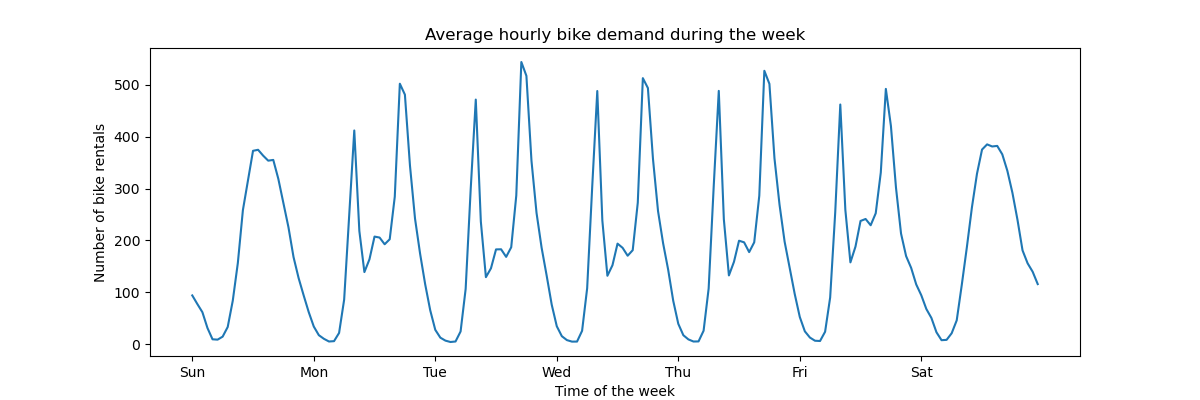
Average hourly bike demand during the week

The target of the prediction problem is the absolute count of bike rentals on an hourly basis:

df["count"].max()
np.int64(977)

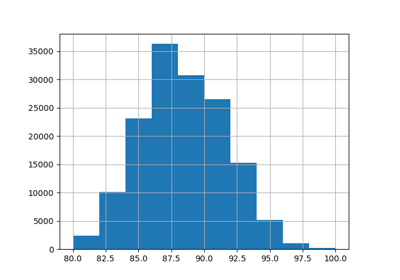
Let us rescale the target variable (number of hourly bike rentals) to predict a relative demand so that the mean absolute error is more easily interpreted as a fraction of the maximum demand.

Note

The fit method of the models used in this notebook all minimizes the mean squared error to estimate the conditional mean. The absolute error, however, would estimate the conditional median.

Nevertheless, when reporting performance measures on the test set in the discussion, we choose to focus on the mean absolute error instead of the (root) mean squared error because it is more intuitive to interpret. Note, however, that in this study the best models for one metric are also the best ones in terms of the other metric.

y = df["count"] / df["count"].max()
fig, ax = plt.subplots(figsize=(12, 4))
y.hist(bins=30, ax=ax)
_ = ax.set(
    xlabel="Fraction of rented fleet demand",
    ylabel="Number of hours",
)
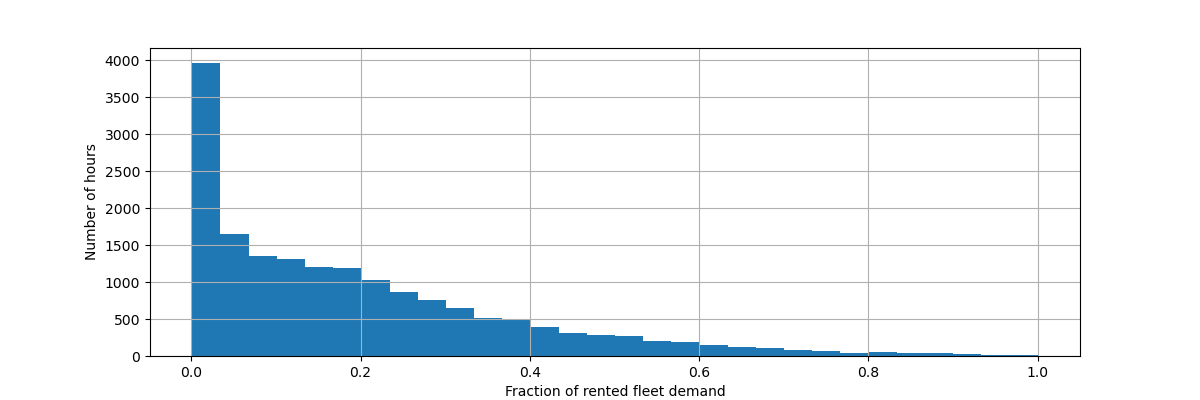
plot cyclical feature engineering

The input feature data frame is a time annotated hourly log of variables describing the weather conditions. It includes both numerical and categorical variables. Note that the time information has already been expanded into several complementary columns.

X = df.drop("count", axis="columns")
X
season year month hour holiday weekday workingday weather temp feel_temp humidity windspeed
0 spring 0 1 0 False 6 False clear 9.84 14.395 0.81 0.0000
1 spring 0 1 1 False 6 False clear 9.02 13.635 0.80 0.0000
2 spring 0 1 2 False 6 False clear 9.02 13.635 0.80 0.0000
3 spring 0 1 3 False 6 False clear 9.84 14.395 0.75 0.0000
4 spring 0 1 4 False 6 False clear 9.84 14.395 0.75 0.0000
... ... ... ... ... ... ... ... ... ... ... ... ...
17374 spring 1 12 19 False 1 True misty 10.66 12.880 0.60 11.0014
17375 spring 1 12 20 False 1 True misty 10.66 12.880 0.60 11.0014
17376 spring 1 12 21 False 1 True clear 10.66 12.880 0.60 11.0014
17377 spring 1 12 22 False 1 True clear 10.66 13.635 0.56 8.9981
17378 spring 1 12 23 False 1 True clear 10.66 13.635 0.65 8.9981

17379 rows × 12 columns


Note

If the time information was only present as a date or datetime column, we could have expanded it into hour-in-the-day, day-in-the-week, day-in-the-month, month-in-the-year using pandas: https://pandas.pydata.org/pandas-docs/stable/user_guide/timeseries.html#time-date-components

We now introspect the distribution of the categorical variables, starting with "weather":

X["weather"].value_counts()
weather
clear         11413
misty          4544
rain           1419
heavy_rain        3
Name: count, dtype: int64

Since there are only 3 "heavy_rain" events, we cannot use this category to train machine learning models with cross validation. Instead, we simplify the representation by collapsing those into the "rain" category.

X["weather"] = (
    X["weather"]
    .astype(object)
    .replace(to_replace="heavy_rain", value="rain")
    .astype("category")
)
X["weather"].value_counts()
weather
clear    11413
misty     4544
rain      1422
Name: count, dtype: int64

As expected, the "season" variable is well balanced:

X["season"].value_counts()
season
fall      4496
summer    4409
spring    4242
winter    4232
Name: count, dtype: int64

Time-based cross-validation#

Since the dataset is a time-ordered event log (hourly demand), we will use a time-sensitive cross-validation splitter to evaluate our demand forecasting model as realistically as possible. We use a gap of 2 days between the train and test side of the splits. We also limit the training set size to make the performance of the CV folds more stable.

1000 test datapoints should be enough to quantify the performance of the model. This represents a bit less than a month and a half of contiguous test data:

from sklearn.model_selection import TimeSeriesSplit

ts_cv = TimeSeriesSplit(
    n_splits=5,
    gap=48,
    max_train_size=10000,
    test_size=1000,
)

Let us manually inspect the various splits to check that the TimeSeriesSplit works as we expect, starting with the first split:

all_splits = list(ts_cv.split(X, y))
train_0, test_0 = all_splits[0]
X.iloc[test_0]
season year month hour holiday weekday workingday weather temp feel_temp humidity windspeed
12379 summer 1 6 0 False 2 True clear 22.14 25.760 0.68 27.9993
12380 summer 1 6 1 False 2 True misty 21.32 25.000 0.77 22.0028
12381 summer 1 6 2 False 2 True rain 21.32 25.000 0.72 19.9995
12382 summer 1 6 3 False 2 True rain 20.50 24.240 0.82 12.9980
12383 summer 1 6 4 False 2 True rain 20.50 24.240 0.82 12.9980
... ... ... ... ... ... ... ... ... ... ... ... ...
13374 fall 1 7 11 False 1 True clear 34.44 40.150 0.53 15.0013
13375 fall 1 7 12 False 1 True clear 34.44 39.395 0.49 8.9981
13376 fall 1 7 13 False 1 True clear 34.44 39.395 0.49 19.0012
13377 fall 1 7 14 False 1 True clear 36.08 40.910 0.42 7.0015
13378 fall 1 7 15 False 1 True clear 35.26 40.150 0.47 16.9979

1000 rows × 12 columns


X.iloc[train_0]
season year month hour holiday weekday workingday weather temp feel_temp humidity windspeed
2331 summer 0 4 1 False 2 True misty 25.42 31.060 0.50 6.0032
2332 summer 0 4 2 False 2 True misty 24.60 31.060 0.53 8.9981
2333 summer 0 4 3 False 2 True misty 23.78 27.275 0.56 8.9981
2334 summer 0 4 4 False 2 True misty 22.96 26.515 0.64 8.9981
2335 summer 0 4 5 False 2 True misty 22.14 25.760 0.68 8.9981
... ... ... ... ... ... ... ... ... ... ... ... ...
12326 summer 1 6 19 False 6 False clear 26.24 31.060 0.36 11.0014
12327 summer 1 6 20 False 6 False clear 25.42 31.060 0.35 19.0012
12328 summer 1 6 21 False 6 False clear 24.60 31.060 0.40 7.0015
12329 summer 1 6 22 False 6 False clear 23.78 27.275 0.46 8.9981
12330 summer 1 6 23 False 6 False clear 22.96 26.515 0.52 7.0015

10000 rows × 12 columns


We now inspect the last split:

train_4, test_4 = all_splits[4]
X.iloc[test_4]
season year month hour holiday weekday workingday weather temp feel_temp humidity windspeed
16379 winter 1 11 5 False 2 True misty 13.94 16.665 0.66 8.9981
16380 winter 1 11 6 False 2 True misty 13.94 16.665 0.71 11.0014
16381 winter 1 11 7 False 2 True clear 13.12 16.665 0.76 6.0032
16382 winter 1 11 8 False 2 True clear 13.94 16.665 0.71 8.9981
16383 winter 1 11 9 False 2 True misty 14.76 18.940 0.71 0.0000
... ... ... ... ... ... ... ... ... ... ... ... ...
17374 spring 1 12 19 False 1 True misty 10.66 12.880 0.60 11.0014
17375 spring 1 12 20 False 1 True misty 10.66 12.880 0.60 11.0014
17376 spring 1 12 21 False 1 True clear 10.66 12.880 0.60 11.0014
17377 spring 1 12 22 False 1 True clear 10.66 13.635 0.56 8.9981
17378 spring 1 12 23 False 1 True clear 10.66 13.635 0.65 8.9981

1000 rows × 12 columns


X.iloc[train_4]
season year month hour holiday weekday workingday weather temp feel_temp humidity windspeed
6331 winter 0 9 9 False 1 True misty 26.24 28.790 0.89 12.9980
6332 winter 0 9 10 False 1 True misty 26.24 28.790 0.89 12.9980
6333 winter 0 9 11 False 1 True clear 27.88 31.820 0.79 15.0013
6334 winter 0 9 12 False 1 True misty 27.88 31.820 0.79 11.0014
6335 winter 0 9 13 False 1 True misty 28.70 33.335 0.74 11.0014
... ... ... ... ... ... ... ... ... ... ... ... ...
16326 winter 1 11 0 False 0 False misty 12.30 15.150 0.70 11.0014
16327 winter 1 11 1 False 0 False clear 12.30 14.395 0.70 12.9980
16328 winter 1 11 2 False 0 False clear 11.48 14.395 0.81 7.0015
16329 winter 1 11 3 False 0 False misty 12.30 15.150 0.81 11.0014
16330 winter 1 11 4 False 0 False misty 12.30 14.395 0.81 12.9980

10000 rows × 12 columns


All is well. We are now ready to do some predictive modeling!

Gradient Boosting#

Gradient Boosting Regression with decision trees is often flexible enough to efficiently handle heterogeneous tabular data with a mix of categorical and numerical features as long as the number of samples is large enough.

Here, we use the modern HistGradientBoostingRegressor with native support for categorical features. Therefore, we only need to set categorical_features="from_dtype" such that features with categorical dtype are considered categorical features. For reference, we extract the categorical features from the dataframe based on the dtype. The internal trees use a dedicated tree splitting rule for these features.

The numerical variables need no preprocessing and, for the sake of simplicity, we only try the default hyper-parameters for this model:

from sklearn.compose import ColumnTransformer
from sklearn.ensemble import HistGradientBoostingRegressor
from sklearn.model_selection import cross_validate
from sklearn.pipeline import make_pipeline

gbrt = HistGradientBoostingRegressor(categorical_features="from_dtype", random_state=42)
categorical_columns = X.columns[X.dtypes == "category"]
print("Categorical features:", categorical_columns.tolist())
Categorical features: ['season', 'holiday', 'workingday', 'weather']

Let’s evaluate our gradient boosting model with the mean absolute error of the relative demand averaged across our 5 time-based cross-validation splits:

import numpy as np


def evaluate(model, X, y, cv, model_prop=None, model_step=None):
    cv_results = cross_validate(
        model,
        X,
        y,
        cv=cv,
        scoring=["neg_mean_absolute_error", "neg_root_mean_squared_error"],
        return_estimator=True,
    )
    if model_prop is not None:
        if model_step is not None:
            values = [
                getattr(m[model_step], model_prop) for m in cv_results["estimator"]
            ]
        else:
            values = [getattr(m, model_prop) for m in cv_results["estimator"]]
        print(f"Mean model.{model_prop} = {np.mean(values)}")
    mae = -cv_results["test_neg_mean_absolute_error"]
    rmse = -cv_results["test_neg_root_mean_squared_error"]
    print(
        f"Mean Absolute Error:     {mae.mean():.3f} +/- {mae.std():.3f}\n"
        f"Root Mean Squared Error: {rmse.mean():.3f} +/- {rmse.std():.3f}"
    )
    # To display the fitted estimator diagrams in the notebook.
    return cv_results["estimator"][0]


evaluate(gbrt, X, y, cv=ts_cv, model_prop="n_iter_")
Mean model.n_iter_ = 100.0
Mean Absolute Error:     0.044 +/- 0.003
Root Mean Squared Error: 0.068 +/- 0.005
HistGradientBoostingRegressor(random_state=42)
In a Jupyter environment, please rerun this cell to show the HTML representation or trust the notebook.
On GitHub, the HTML representation is unable to render, please try loading this page with nbviewer.org.
Parameters
random_state random_state: int, RandomState instance or None, default=None

Pseudo-random number generator to control the subsampling in the
binning process, and the train/validation data split if early stopping
is enabled.
Pass an int for reproducible output across multiple function calls.
See :term:`Glossary <random_state>`.
42
loss loss: {'squared_error', 'absolute_error', 'gamma', 'poisson', 'quantile'}, default='squared_error'

The loss function to use in the boosting process. Note that the
"squared error", "gamma" and "poisson" losses actually implement
"half least squares loss", "half gamma deviance" and "half poisson
deviance" to simplify the computation of the gradient. Furthermore,
"gamma" and "poisson" losses internally use a log-link, "gamma"
requires ``y > 0`` and "poisson" requires ``y >= 0``.
"quantile" uses the pinball loss.

.. versionchanged:: 0.23
Added option 'poisson'.

.. versionchanged:: 1.1
Added option 'quantile'.

.. versionchanged:: 1.3
Added option 'gamma'.
'squared_error'
quantile quantile: float, default=None

If loss is "quantile", this parameter specifies which quantile to be estimated
and must be between 0 and 1.
None
learning_rate learning_rate: float, default=0.1

The learning rate, also known as *shrinkage*. This is used as a
multiplicative factor for the leaves values. Use ``1`` for no
shrinkage.
0.1
max_iter max_iter: int, default=100

The maximum number of iterations of the boosting process, i.e. the
maximum number of trees.
100
max_leaf_nodes max_leaf_nodes: int or None, default=31

The maximum number of leaves for each tree. Must be strictly greater
than 1. If None, there is no maximum limit.
31
max_depth max_depth: int or None, default=None

The maximum depth of each tree. The depth of a tree is the number of
edges to go from the root to the deepest leaf.
Depth isn't constrained by default.
None
min_samples_leaf min_samples_leaf: int, default=20

The minimum number of samples per leaf. For small datasets with less
than a few hundred samples, it is recommended to lower this value
since only very shallow trees would be built.
20
l2_regularization l2_regularization: float, default=0

The L2 regularization parameter penalizing leaves with small hessians.
Use ``0`` for no regularization (default).
0.0
max_features max_features: float, default=1.0

Proportion of randomly chosen features in each and every node split.
This is a form of regularization, smaller values make the trees weaker
learners and might prevent overfitting.
If interaction constraints from `interaction_cst` are present, only allowed
features are taken into account for the subsampling.

.. versionadded:: 1.4
1.0
max_bins max_bins: int, default=255

The maximum number of bins to use for non-missing values. Before
training, each feature of the input array `X` is binned into
integer-valued bins, which allows for a much faster training stage.
Features with a small number of unique values may use less than
``max_bins`` bins. In addition to the ``max_bins`` bins, one more bin
is always reserved for missing values. Must be no larger than 255.
255
categorical_features categorical_features: array-like of {bool, int, str} of shape (n_features) or shape (n_categorical_features,), default='from_dtype'

Indicates the categorical features.

- None : no feature will be considered categorical.
- boolean array-like : boolean mask indicating categorical features.
- integer array-like : integer indices indicating categorical
features.
- str array-like: names of categorical features (assuming the training
data has feature names).
- `"from_dtype"`: dataframe columns with dtype "category" are
considered to be categorical features. The input must be an object
exposing a ``__dataframe__`` method such as pandas or polars
DataFrames to use this feature.

For each categorical feature, there must be at most `max_bins` unique
categories. Negative values for categorical features encoded as numeric
dtypes are treated as missing values. All categorical values are
converted to floating point numbers. This means that categorical values
of 1.0 and 1 are treated as the same category.

Read more in the :ref:`User Guide <categorical_support_gbdt>` and
:ref:`sphx_glr_auto_examples_ensemble_plot_gradient_boosting_categorical.py`.

.. versionadded:: 0.24

.. versionchanged:: 1.2
Added support for feature names.

.. versionchanged:: 1.4
Added `"from_dtype"` option.

.. versionchanged:: 1.6
The default value changed from `None` to `"from_dtype"`.
'from_dtype'
monotonic_cst monotonic_cst: array-like of int of shape (n_features) or dict, default=None

Monotonic constraint to enforce on each feature are specified using the
following integer values:

- 1: monotonic increase
- 0: no constraint
- -1: monotonic decrease

If a dict with str keys, map feature to monotonic constraints by name.
If an array, the features are mapped to constraints by position. See
:ref:`monotonic_cst_features_names` for a usage example.

Read more in the :ref:`User Guide <monotonic_cst_gbdt>`.

.. versionadded:: 0.23

.. versionchanged:: 1.2
Accept dict of constraints with feature names as keys.
None
interaction_cst interaction_cst: {"pairwise", "no_interactions"} or sequence of lists/tuples/sets of int, default=None

Specify interaction constraints, the sets of features which can
interact with each other in child node splits.

Each item specifies the set of feature indices that are allowed
to interact with each other. If there are more features than
specified in these constraints, they are treated as if they were
specified as an additional set.

The strings "pairwise" and "no_interactions" are shorthands for
allowing only pairwise or no interactions, respectively.

For instance, with 5 features in total, `interaction_cst=[{0, 1}]`
is equivalent to `interaction_cst=[{0, 1}, {2, 3, 4}]`,
and specifies that each branch of a tree will either only split
on features 0 and 1 or only split on features 2, 3 and 4.

See :ref:`this example<ice-vs-pdp>` on how to use `interaction_cst`.

.. versionadded:: 1.2
None
warm_start warm_start: bool, default=False

When set to ``True``, reuse the solution of the previous call to fit
and add more estimators to the ensemble. For results to be valid, the
estimator should be re-trained on the same data only.
See :term:`the Glossary <warm_start>`.
False
early_stopping early_stopping: 'auto' or bool, default='auto'

If 'auto', early stopping is enabled if the sample size is larger than
10000 or if `X_val` and `y_val` are passed to `fit`. If True, early stopping
is enabled, otherwise early stopping is disabled.

.. versionadded:: 0.23
'auto'
scoring scoring: str or callable or None, default='loss'

Scoring method to use for early stopping. Only used if `early_stopping`
is enabled. Options:

- str: see :ref:`scoring_string_names` for options.
- callable: a scorer callable object (e.g., function) with signature
``scorer(estimator, X, y)``. See :ref:`scoring_callable` for details.
- `None`: the :ref:`coefficient of determination <r2_score>`
(:math:`R^2`) is used.
- 'loss': early stopping is checked w.r.t the loss value.
'loss'
validation_fraction validation_fraction: int or float or None, default=0.1

Proportion (or absolute size) of training data to set aside as
validation data for early stopping. If None, early stopping is done on
the training data.
The value is ignored if either early stopping is not performed, e.g.
`early_stopping=False`, or if `X_val` and `y_val` are passed to fit.
0.1
n_iter_no_change n_iter_no_change: int, default=10

Used to determine when to "early stop". The fitting process is
stopped when none of the last ``n_iter_no_change`` scores are better
than the ``n_iter_no_change - 1`` -th-to-last one, up to some
tolerance. Only used if early stopping is performed.
10
tol tol: float, default=1e-7

The absolute tolerance to use when comparing scores during early
stopping. The higher the tolerance, the more likely we are to early
stop: higher tolerance means that it will be harder for subsequent
iterations to be considered an improvement upon the reference score.
1e-07
verbose verbose: int, default=0

The verbosity level. If not zero, print some information about the
fitting process. ``1`` prints only summary info, ``2`` prints info per
iteration.
0
Fitted attributes
Name Type Value
do_early_stopping_ do_early_stopping_: bool

Indicates whether early stopping is used during training.
bool False
feature_names_in_ feature_names_in_: ndarray of shape (`n_features_in_`,)

Names of features seen during :term:`fit`. Defined only when `X`
has feature names that are all strings.

.. versionadded:: 1.0
ndarray[object](12,) ['season','year','month',...,'feel_temp','humidity','windspeed']
is_categorical_ is_categorical_: ndarray, shape (n_features, ) or None

Boolean mask for the categorical features. ``None`` if there are no
categorical features.
ndarray[bool](12,) [ True,False,False,...,False,False,False]
n_features_in_ n_features_in_: int

Number of features seen during :term:`fit`.

.. versionadded:: 0.24
int 12
n_iter_ n_iter_: int

The number of iterations as selected by early stopping, depending on
the `early_stopping` parameter. Otherwise it corresponds to max_iter.
int 100
n_trees_per_iteration_ n_trees_per_iteration_: int

The number of tree that are built at each iteration. For regressors,
this is always 1.
int 1
train_score_ train_score_: ndarray, shape (n_iter_+1,)

The scores at each iteration on the training data. The first entry
is the score of the ensemble before the first iteration. Scores are
computed according to the ``scoring`` parameter. If ``scoring`` is
not 'loss', scores are computed on a subset of at most 10 000
samples. Empty if no early stopping.
ndarray[float64](0,) []
validation_score_ validation_score_: ndarray, shape (n_iter_+1,)

The scores at each iteration on the held-out validation data. The
first entry is the score of the ensemble before the first iteration.
Scores are computed according to the ``scoring`` parameter. Empty if
no early stopping or if ``validation_fraction`` is None.
ndarray[float64](0,) []


We see that we set max_iter large enough such that early stopping took place.

This model has an average error around 4 to 5% of the maximum demand. This is quite good for a first trial without any hyper-parameter tuning! We just had to make the categorical variables explicit. Note that the time related features are passed as is, i.e. without processing them. But this is not much of a problem for tree-based models as they can learn a non-monotonic relationship between ordinal input features and the target.

This is not the case for linear regression models as we will see in the following.

Naive linear regression#

As usual for linear models, categorical variables need to be one-hot encoded. For consistency, we scale the numerical features to the same 0-1 range using MinMaxScaler, although in this case it does not impact the results much because they are already on comparable scales:

from sklearn.linear_model import RidgeCV
from sklearn.preprocessing import MinMaxScaler, OneHotEncoder

one_hot_encoder = OneHotEncoder(handle_unknown="ignore", sparse_output=False)
alphas = np.logspace(-6, 6, 25)
naive_linear_pipeline = make_pipeline(
    ColumnTransformer(
        transformers=[
            ("categorical", one_hot_encoder, categorical_columns),
        ],
        remainder=MinMaxScaler(),
        verbose_feature_names_out=False,
    ),
    RidgeCV(alphas=alphas),
)


evaluate(
    naive_linear_pipeline, X, y, cv=ts_cv, model_prop="alpha_", model_step="ridgecv"
)
Mean model.alpha_ = 2.7298221281347037
Mean Absolute Error:     0.142 +/- 0.014
Root Mean Squared Error: 0.184 +/- 0.020
Pipeline(steps=[('columntransformer',
                 ColumnTransformer(remainder=MinMaxScaler(),
                                   transformers=[('categorical',
                                                  OneHotEncoder(handle_unknown='ignore',
                                                                sparse_output=False),
                                                  Index(['season', 'holiday', 'workingday', 'weather'], dtype='str'))],
                                   verbose_feature_names_out=False)),
                ('ridgecv',
                 RidgeCV(alphas=array([1.00000000e-06, 3.16227766e-06, 1.00000000e-05, 3.16227766e-05,
       1.00000000e-04, 3.16227766e-04, 1.00000000e-03, 3.16227766e-03,
       1.00000000e-02, 3.16227766e-02, 1.00000000e-01, 3.16227766e-01,
       1.00000000e+00, 3.16227766e+00, 1.00000000e+01, 3.16227766e+01,
       1.00000000e+02, 3.16227766e+02, 1.00000000e+03, 3.16227766e+03,
       1.00000000e+04, 3.16227766e+04, 1.00000000e+05, 3.16227766e+05,
       1.00000000e+06])))])
In a Jupyter environment, please rerun this cell to show the HTML representation or trust the notebook.
On GitHub, the HTML representation is unable to render, please try loading this page with nbviewer.org.
Parameters
steps steps: list of tuples

List of (name of step, estimator) tuples that are to be chained in
sequential order. To be compatible with the scikit-learn API, all steps
must define `fit`. All non-last steps must also define `transform`. See
:ref:`Combining Estimators <combining_estimators>` for more details.
[('columntransformer', ...), ('ridgecv', ...)]
transform_input transform_input: list of str, default=None

The names of the :term:`metadata` parameters that should be transformed by the
pipeline before passing it to the step consuming it.

This enables transforming some input arguments to ``fit`` (other than ``X``)
to be transformed by the steps of the pipeline up to the step which requires
them. Requirement is defined via :ref:`metadata routing <metadata_routing>`.
For instance, this can be used to pass a validation set through the pipeline.

You can only set this if metadata routing is enabled, which you
can enable using ``sklearn.set_config(enable_metadata_routing=True)``.

.. versionadded:: 1.6
None
memory memory: str or object with the joblib.Memory interface, default=None

Used to cache the fitted transformers of the pipeline. The last step
will never be cached, even if it is a transformer. By default, no
caching is performed. If a string is given, it is the path to the
caching directory. Enabling caching triggers a clone of the transformers
before fitting. Therefore, the transformer instance given to the
pipeline cannot be inspected directly. Use the attribute ``named_steps``
or ``steps`` to inspect estimators within the pipeline. Caching the
transformers is advantageous when fitting is time consuming. See
:ref:`sphx_glr_auto_examples_neighbors_plot_caching_nearest_neighbors.py`
for an example on how to enable caching.
None
verbose verbose: bool, default=False

If True, the time elapsed while fitting each step will be printed as it
is completed.
False
Fitted attributes
Name Type Value
feature_names_in_ feature_names_in_: ndarray of shape (`n_features_in_`,)

Names of features seen during :term:`fit`. Only defined if the
underlying estimator exposes such an attribute when fit.

.. versionadded:: 1.0
ndarray[object](12,) ['season','year','month',...,'feel_temp','humidity','windspeed']
n_features_in_ n_features_in_: int

Number of features seen during :term:`fit`. Only defined if the
underlying first estimator in `steps` exposes such an attribute
when fit.

.. versionadded:: 0.24
int 12
Parameters
transformers transformers: list of tuples

List of (name, transformer, columns) tuples specifying the
transformer objects to be applied to subsets of the data.

name : str
Like in Pipeline and FeatureUnion, this allows the transformer and
its parameters to be set using ``set_params`` and searched in grid
search.
transformer : {'drop', 'passthrough'} or estimator
Estimator must support :term:`fit` and :term:`transform`.
Special-cased strings 'drop' and 'passthrough' are accepted as
well, to indicate to drop the columns or to pass them through
untransformed, respectively.
columns : str, array-like of str, int, array-like of int, array-like of bool, slice or callable
Indexes the data on its second axis. Integers are interpreted as
positional columns, while strings can reference DataFrame columns
by name. A scalar string or int should be used where
``transformer`` expects X to be a 1d array-like (vector),
otherwise a 2d array will be passed to the transformer.
A callable is passed the input data `X` and can return any of the
above. To select multiple columns by name or dtype, you can use
:obj:`make_column_selector`.
[('categorical', ...)]
remainder remainder: {'drop', 'passthrough'} or estimator, default='drop'

By default, only the specified columns in `transformers` are
transformed and combined in the output, and the non-specified
columns are dropped. (default of ``'drop'``).
By specifying ``remainder='passthrough'``, all remaining columns that
were not specified in `transformers`, but present in the data passed
to `fit` will be automatically passed through. This subset of columns
is concatenated with the output of the transformers. For dataframes,
extra columns not seen during `fit` will be excluded from the output
of `transform`.
By setting ``remainder`` to be an estimator, the remaining
non-specified columns will use the ``remainder`` estimator. The
estimator must support :term:`fit` and :term:`transform`.
Note that using this feature requires that the DataFrame columns
input at :term:`fit` and :term:`transform` have identical order.
MinMaxScaler()
verbose_feature_names_out verbose_feature_names_out: bool, str or Callable[[str, str], str], default=True

- If True, :meth:`ColumnTransformer.get_feature_names_out` will prefix
all feature names with the name of the transformer that generated that
feature. It is equivalent to setting
`verbose_feature_names_out="{transformer_name}__{feature_name}"`.
- If False, :meth:`ColumnTransformer.get_feature_names_out` will not
prefix any feature names and will error if feature names are not
unique.
- If ``Callable[[str, str], str]``,
:meth:`ColumnTransformer.get_feature_names_out` will rename all the features
using the name of the transformer. The first argument of the callable is the
transformer name and the second argument is the feature name. The returned
string will be the new feature name.
- If ``str``, it must be a string ready for formatting. The given string will
be formatted using two field names: ``transformer_name`` and ``feature_name``.
e.g. ``"{feature_name}__{transformer_name}"``. See :meth:`str.format` method
from the standard library for more info.

.. versionadded:: 1.0

.. versionchanged:: 1.6
`verbose_feature_names_out` can be a callable or a string to be formatted.
False
sparse_threshold sparse_threshold: float, default=0.3

If the output of the different transformers contains sparse matrices,
these will be stacked as a sparse matrix if the overall density is
lower than this value. Use ``sparse_threshold=0`` to always return
dense. When the transformed output consists of all dense data, the
stacked result will be dense, and this keyword will be ignored.
0.3
n_jobs n_jobs: int, default=None

Number of jobs to run in parallel.
``None`` means 1 unless in a :obj:`joblib.parallel_backend` context.
``-1`` means using all processors. See :term:`Glossary <n_jobs>`
for more details.
None
transformer_weights transformer_weights: dict, default=None

Multiplicative weights for features per transformer. The output of the
transformer is multiplied by these weights. Keys are transformer names,
values the weights.
None
verbose verbose: bool, default=False

If True, the time elapsed while fitting each transformer will be
printed as it is completed.
False
Fitted attributes
Name Type Value
feature_names_in_ feature_names_in_: ndarray of shape (`n_features_in_`,)

Names of features seen during :term:`fit`. Defined only when `X`
has feature names that are all strings.

.. versionadded:: 1.0
ndarray[object](12,) ['season','year','month',...,'feel_temp','humidity','windspeed']
n_features_in_ n_features_in_: int

Number of features seen during :term:`fit`. Only defined if the
underlying transformers expose such an attribute when fit.

.. versionadded:: 0.24
int 12
named_transformers_ named_transformers_: :class:`~sklearn.utils.Bunch`

Read-only attribute to access any transformer by given name.
Keys are transformer names and values are the fitted transformer
objects.
Bunch {'categorical...inMaxScaler()}
output_indices_ output_indices_: dict

A dictionary from each transformer name to a slice, where the slice
corresponds to indices in the transformed output. This is useful to
inspect which transformer is responsible for which transformed
feature(s).

.. versionadded:: 1.0
dict {'ca...al': slice(0, 11, None), 're...er': slice(11, 19, None)}
sparse_output_ sparse_output_: bool

Boolean flag indicating whether the output of ``transform`` is a
sparse matrix or a dense numpy array, which depends on the output
of the individual transformers and the `sparse_threshold` keyword.
bool False
transformers_ transformers_: list

The collection of fitted transformers as tuples of (name,
fitted_transformer, column). `fitted_transformer` can be an estimator,
or `'drop'`; `'passthrough'` is replaced with an equivalent
:class:`~sklearn.preprocessing.FunctionTransformer`. In case there were
no columns selected, this will be the unfitted transformer. If there
are remaining columns, the final element is a tuple of the form:
('remainder', transformer, remaining_columns) corresponding to the
``remainder`` parameter. If there are remaining columns, then
``len(transformers_)==len(transformers)+1``, otherwise
``len(transformers_)==len(transformers)``.

.. versionadded:: 1.7
The format of the remaining columns now attempts to match that of the other
transformers: if all columns were provided as column names (`str`), the
remaining columns are stored as column names; if all columns were provided
as mask arrays (`bool`), so are the remaining columns; in all other cases
the remaining columns are stored as indices (`int`).
list [('ca...al', OneHotEncoder..._output=False), Index(['seaso..., dtype='str')), ('re...er', MinMaxScaler(), ['year', 'month', 'hour', 'weekday', ...])]
Index(['season', 'holiday', 'workingday', 'weather'], dtype='str')
Parameters
sparse_output sparse_output: bool, default=True

When ``True``, it returns a SciPy sparse matrix/array
in "Compressed Sparse Row" (CSR) format.

.. versionadded:: 1.2
`sparse` was renamed to `sparse_output`
False
handle_unknown handle_unknown: {'error', 'ignore', 'infrequent_if_exist', 'warn'}, default='error'

Specifies the way unknown categories are handled during :meth:`transform`.

- 'error' : Raise an error if an unknown category is present during transform.
- 'ignore' : When an unknown category is encountered during
transform, the resulting one-hot encoded columns for this feature
will be all zeros. In the inverse transform, an unknown category
will be denoted as None.
- 'infrequent_if_exist' : When an unknown category is encountered
during transform, the resulting one-hot encoded columns for this
feature will map to the infrequent category if it exists. The
infrequent category will be mapped to the last position in the
encoding. During inverse transform, an unknown category will be
mapped to the category denoted `'infrequent'` if it exists. If the
`'infrequent'` category does not exist, then :meth:`transform` and
:meth:`inverse_transform` will handle an unknown category as with
`handle_unknown='ignore'`. Infrequent categories exist based on
`min_frequency` and `max_categories`. Read more in the
:ref:`User Guide <encoder_infrequent_categories>`.
- 'warn' : When an unknown category is encountered during transform
a warning is issued, and the encoding then proceeds as described for
`handle_unknown="infrequent_if_exist"`.

.. versionchanged:: 1.1
`'infrequent_if_exist'` was added to automatically handle unknown
categories and infrequent categories.

.. versionadded:: 1.6
The option `"warn"` was added in 1.6.
'ignore'
categories categories: 'auto' or a list of array-like, default='auto'

Categories (unique values) per feature:

- 'auto' : Determine categories automatically from the training data.
- list : ``categories[i]`` holds the categories expected in the ith
column. The passed categories should not mix strings and numeric
values within a single feature, and should be sorted in case of
numeric values.

The used categories can be found in the ``categories_`` attribute.

.. versionadded:: 0.20
'auto'
drop drop: {'first', 'if_binary'} or an array-like of shape (n_features,), default=None

Specifies a methodology to use to drop one of the categories per
feature. This is useful in situations where perfectly collinear
features cause problems, such as when feeding the resulting data
into an unregularized linear regression model.

However, dropping one category breaks the symmetry of the original
representation and can therefore induce a bias in downstream models,
for instance for penalized linear classification or regression models.

- None : retain all features (the default).
- 'first' : drop the first category in each feature. If only one
category is present, the feature will be dropped entirely.
- 'if_binary' : drop the first category in each feature with two
categories. Features with 1 or more than 2 categories are
left intact.
- array : ``drop[i]`` is the category in feature ``X[:, i]`` that
should be dropped.

When `max_categories` or `min_frequency` is configured to group
infrequent categories, the dropping behavior is handled after the
grouping.

.. versionadded:: 0.21
The parameter `drop` was added in 0.21.

.. versionchanged:: 0.23
The option `drop='if_binary'` was added in 0.23.

.. versionchanged:: 1.1
Support for dropping infrequent categories.
None
dtype dtype: number type, default=np.float64

Desired dtype of output.
<class 'numpy.float64'>
min_frequency min_frequency: int or float, default=None

Specifies the minimum frequency below which a category will be
considered infrequent.

- If `int`, categories with a smaller cardinality will be considered
infrequent.

- If `float`, categories with a smaller cardinality than
`min_frequency * n_samples` will be considered infrequent.

.. versionadded:: 1.1
Read more in the :ref:`User Guide <encoder_infrequent_categories>`.
None
max_categories max_categories: int, default=None

Specifies an upper limit to the number of output features for each input
feature when considering infrequent categories. If there are infrequent
categories, `max_categories` includes the category representing the
infrequent categories along with the frequent categories. If `None`,
there is no limit to the number of output features.

.. versionadded:: 1.1
Read more in the :ref:`User Guide <encoder_infrequent_categories>`.
None
feature_name_combiner feature_name_combiner: "concat" or callable, default="concat"

Callable with signature `def callable(input_feature, category)` that returns a
string. This is used to create feature names to be returned by
:meth:`get_feature_names_out`.

`"concat"` concatenates encoded feature name and category with
`feature + "_" + str(category)`.E.g. feature X with values 1, 6, 7 create
feature names `X_1, X_6, X_7`.

.. versionadded:: 1.3
'concat'
Fitted attributes
Name Type Value
categories_ categories_: list of arrays

The categories of each feature determined during fitting
(in order of the features in X and corresponding with the output
of ``transform``). This includes the category specified in ``drop``
(if any).
list [array(['fall'... dtype=object), array(['False... dtype=object), array(['False... dtype=object), array(['clear... dtype=object)]
drop_idx_ drop_idx_: array of shape (n_features,)

- ``drop_idx_[i]`` is the index in ``categories_[i]`` of the category
to be dropped for each feature.
- ``drop_idx_[i] = None`` if no category is to be dropped from the
feature with index ``i``, e.g. when `drop='if_binary'` and the
feature isn't binary.
- ``drop_idx_ = None`` if all the transformed features will be
retained.

If infrequent categories are enabled by setting `min_frequency` or
`max_categories` to a non-default value and `drop_idx[i]` corresponds
to an infrequent category, then the entire infrequent category is
dropped.

.. versionchanged:: 0.23
Added the possibility to contain `None` values.
NoneType None
feature_names_in_ feature_names_in_: ndarray of shape (`n_features_in_`,)

Names of features seen during :term:`fit`. Defined only when `X`
has feature names that are all strings.

.. versionadded:: 1.0
ndarray[object](4,) ['season','holiday','workingday','weather']
n_features_in_ n_features_in_: int

Number of features seen during :term:`fit`.

.. versionadded:: 1.0
int 4
11 features
season_fall
season_spring
season_summer
season_winter
holiday_False
holiday_True
workingday_False
workingday_True
weather_clear
weather_misty
weather_rain
['year', 'month', 'hour', 'weekday', 'temp', 'feel_temp', 'humidity', 'windspeed']
Parameters
feature_range feature_range: tuple (min, max), default=(0, 1)

Desired range of transformed data.
(0, ...)
copy copy: bool, default=True

Set to False to perform inplace row normalization and avoid a
copy (if the input is already a numpy array).
True
clip clip: bool, default=False

Set to True to clip transformed values of held-out data to
provided `feature_range`.
Since this parameter will clip values, `inverse_transform` may not
be able to restore the original data.

.. note::
Setting `clip=True` does not prevent feature drift (a distribution
shift between training and test data). The transformed values are clipped
to the `feature_range`, which helps avoid unintended behavior in models
sensitive to out-of-range inputs (e.g. linear models). Use with care,
as clipping can distort the distribution of test data.

.. versionadded:: 0.24
False
Fitted attributes
Name Type Value
data_max_ data_max_: ndarray of shape (n_features,)

Per feature maximum seen in the data

.. versionadded:: 0.17
*data_max_*
ndarray[float64](8,) [ 1.,12.,23.,...,50., 1.,57.]
data_min_ data_min_: ndarray of shape (n_features,)

Per feature minimum seen in the data

.. versionadded:: 0.17
*data_min_*
ndarray[float64](8,) [0. ,1. ,0. ,...,0.76,0.16,0. ]
data_range_ data_range_: ndarray of shape (n_features,)

Per feature range ``(data_max_ - data_min_)`` seen in the data

.. versionadded:: 0.17
*data_range_*
ndarray[float64](8,) [ 1. ,11. ,23. ,...,49.24, 0.84,57. ]
feature_names_in_ feature_names_in_: ndarray of shape (`n_features_in_`,)

Names of features seen during :term:`fit`. Defined only when `X`
has feature names that are all strings.

.. versionadded:: 1.0
ndarray[object](8,) ['year','month','hour',...,'feel_temp','humidity','windspeed']
min_ min_: ndarray of shape (n_features,)

Per feature adjustment for minimum. Equivalent to
``min - X.min(axis=0) * self.scale_``
ndarray[float64](8,) [ 0. ,-0.09, 0. ,...,-0.02,-0.19, 0. ]
n_features_in_ n_features_in_: int

Number of features seen during :term:`fit`.

.. versionadded:: 0.24
int 8
n_samples_seen_ n_samples_seen_: int

The number of samples processed by the estimator.
It will be reset on new calls to fit, but increments across
``partial_fit`` calls.
int 10000
scale_ scale_: ndarray of shape (n_features,)

Per feature relative scaling of the data. Equivalent to
``(max - min) / (X.max(axis=0) - X.min(axis=0))``

.. versionadded:: 0.17
*scale_* attribute.
ndarray[float64](8,) [1. ,0.09,0.04,...,0.02,1.19,0.02]
8 features
year
month
hour
weekday
temp
feel_temp
humidity
windspeed
19 features
season_fall
season_spring
season_summer
season_winter
holiday_False
holiday_True
workingday_False
workingday_True
weather_clear
weather_misty
weather_rain
year
month
hour
weekday
temp
feel_temp
humidity
windspeed
Parameters
alphas alphas: array-like of shape (n_alphas,), default=(0.1, 1.0, 10.0)

Array of alpha values to try.
Regularization strength; must be a positive float. Regularization
improves the conditioning of the problem and reduces the variance of
the estimates. Larger values specify stronger regularization.
Alpha corresponds to ``1 / (2C)`` in other linear models such as
:class:`~sklearn.linear_model.LogisticRegression` or
:class:`~sklearn.svm.LinearSVC`.
If using Leave-One-Out cross-validation, alphas must be strictly positive.

For an example on how regularization strength affects the model coefficients,
see :ref:`sphx_glr_auto_examples_linear_model_plot_ridge_coeffs.py`.
array([1.0000...00000000e+06])
fit_intercept fit_intercept: bool, default=True

Whether to calculate the intercept for this model. If set
to false, no intercept will be used in calculations
(i.e. data is expected to be centered).
True
scoring scoring: str, callable, default=None

The scoring method to use for cross-validation. Options:

- str: see :ref:`scoring_string_names` for options.
- callable: a scorer callable object (e.g., function) with signature
``scorer(estimator, X, y)``. See :ref:`scoring_callable` for details.
- `None`: negative :ref:`mean squared error <mean_squared_error>` if cv is
None (i.e. when using leave-one-out cross-validation), or
:ref:`coefficient of determination <r2_score>` (:math:`R^2`) otherwise.
None
cv cv: int, cross-validation generator or an iterable, default=None

Determines the cross-validation splitting strategy.
Possible inputs for cv are:

- None, to use the efficient Leave-One-Out cross-validation
- integer, to specify the number of folds,
- :term:`CV splitter`,
- an iterable yielding (train, test) splits as arrays of indices.

For integer/None inputs, if ``y`` is binary or multiclass,
:class:`~sklearn.model_selection.StratifiedKFold` is used, else,
:class:`~sklearn.model_selection.KFold` is used.

Refer :ref:`User Guide <cross_validation>` for the various
cross-validation strategies that can be used here.
None
gcv_mode gcv_mode: {'auto', 'svd', 'eigen'}, default='auto'

Flag indicating which strategy to use when performing
Leave-One-Out Cross-Validation. Options are::

'auto' : same as 'eigen'
'svd' : use singular value decomposition of X when X is dense,
fallback to 'eigen' when X is sparse
'eigen' : use eigendecomposition of X X' when n_samples <= n_features
or X' X when n_features < n_samples

The 'auto' mode is the default and is intended to pick the cheaper
option depending on the shape and sparsity of the training data.
None
store_cv_results store_cv_results: bool, default=False

Flag indicating if the cross-validation values corresponding to
each alpha should be stored in the ``cv_results_`` attribute (see
below). This flag is only compatible with ``cv=None`` (i.e. using
Leave-One-Out Cross-Validation).

.. versionchanged:: 1.5
Parameter name changed from `store_cv_values` to `store_cv_results`.
False
alpha_per_target alpha_per_target: bool, default=False

Flag indicating whether to optimize the alpha value (picked from the
`alphas` parameter list) for each target separately (for multi-output
settings: multiple prediction targets). When set to `True`, after
fitting, the `alpha_` attribute will contain a value for each target.
When set to `False`, a single alpha is used for all targets.

.. versionadded:: 0.24
False
Fitted attributes
Name Type Value
alpha_ alpha_: float or ndarray of shape (n_targets,)

Estimated regularization parameter, or, if ``alpha_per_target=True``,
the estimated regularization parameter for each target.
float 3.162
best_score_ best_score_: float or ndarray of shape (n_targets,)

Score of base estimator with best alpha, or, if
``alpha_per_target=True``, a score for each target.

.. versionadded:: 0.23
float64 -0.01722
coef_ coef_: ndarray of shape (n_features) or (n_targets, n_features)

Weight vector(s).
ndarray[float64](19,) [-0.03,-0.01, 0.01,..., 0.2 ,-0.16, 0.02]
intercept_ intercept_: float or ndarray of shape (n_targets,)

Independent term in decision function. Set to 0.0 if
``fit_intercept = False``.
float64 -0.07789
n_features_in_ n_features_in_: int

Number of features seen during :term:`fit`.

.. versionadded:: 0.24
int 19


It is affirmative to see that the selected alpha_ is in our specified range.

The performance is not good: the average error is around 14% of the maximum demand. This is more than three times higher than the average error of the gradient boosting model. We can suspect that the naive original encoding (merely min-max scaled) of the periodic time-related features might prevent the linear regression model to properly leverage the time information: linear regression does not automatically model non-monotonic relationships between the input features and the target. Non-linear terms have to be engineered in the input.

For example, the raw numerical encoding of the "hour" feature prevents the linear model from recognizing that an increase of hour in the morning from 6 to 8 should have a strong positive impact on the number of bike rentals while an increase of similar magnitude in the evening from 18 to 20 should have a strong negative impact on the predicted number of bike rentals.

Time-steps as categories#

Since the time features are encoded in a discrete manner using integers (24 unique values in the “hours” feature), we could decide to treat those as categorical variables using a one-hot encoding and thereby ignore any assumption implied by the ordering of the hour values.

Using one-hot encoding for the time features gives the linear model a lot more flexibility as we introduce one additional feature per discrete time level.

one_hot_linear_pipeline = make_pipeline(
    ColumnTransformer(
        transformers=[
            ("categorical", one_hot_encoder, categorical_columns),
            ("one_hot_time", one_hot_encoder, ["hour", "weekday", "month"]),
        ],
        remainder=MinMaxScaler(),
        verbose_feature_names_out=False,
    ),
    RidgeCV(alphas=alphas),
)

evaluate(one_hot_linear_pipeline, X, y, cv=ts_cv)
Mean Absolute Error:     0.099 +/- 0.011
Root Mean Squared Error: 0.131 +/- 0.011
Pipeline(steps=[('columntransformer',
                 ColumnTransformer(remainder=MinMaxScaler(),
                                   transformers=[('categorical',
                                                  OneHotEncoder(handle_unknown='ignore',
                                                                sparse_output=False),
                                                  Index(['season', 'holiday', 'workingday', 'weather'], dtype='str')),
                                                 ('one_hot_time',
                                                  OneHotEncoder(handle_unknown='ignore',
                                                                sparse_output=False),
                                                  ['hour', 'weekday',
                                                   'month'])],
                                   verbose_featur...
                 RidgeCV(alphas=array([1.00000000e-06, 3.16227766e-06, 1.00000000e-05, 3.16227766e-05,
       1.00000000e-04, 3.16227766e-04, 1.00000000e-03, 3.16227766e-03,
       1.00000000e-02, 3.16227766e-02, 1.00000000e-01, 3.16227766e-01,
       1.00000000e+00, 3.16227766e+00, 1.00000000e+01, 3.16227766e+01,
       1.00000000e+02, 3.16227766e+02, 1.00000000e+03, 3.16227766e+03,
       1.00000000e+04, 3.16227766e+04, 1.00000000e+05, 3.16227766e+05,
       1.00000000e+06])))])
In a Jupyter environment, please rerun this cell to show the HTML representation or trust the notebook.
On GitHub, the HTML representation is unable to render, please try loading this page with nbviewer.org.
Parameters
steps steps: list of tuples

List of (name of step, estimator) tuples that are to be chained in
sequential order. To be compatible with the scikit-learn API, all steps
must define `fit`. All non-last steps must also define `transform`. See
:ref:`Combining Estimators <combining_estimators>` for more details.
[('columntransformer', ...), ('ridgecv', ...)]
transform_input transform_input: list of str, default=None

The names of the :term:`metadata` parameters that should be transformed by the
pipeline before passing it to the step consuming it.

This enables transforming some input arguments to ``fit`` (other than ``X``)
to be transformed by the steps of the pipeline up to the step which requires
them. Requirement is defined via :ref:`metadata routing <metadata_routing>`.
For instance, this can be used to pass a validation set through the pipeline.

You can only set this if metadata routing is enabled, which you
can enable using ``sklearn.set_config(enable_metadata_routing=True)``.

.. versionadded:: 1.6
None
memory memory: str or object with the joblib.Memory interface, default=None

Used to cache the fitted transformers of the pipeline. The last step
will never be cached, even if it is a transformer. By default, no
caching is performed. If a string is given, it is the path to the
caching directory. Enabling caching triggers a clone of the transformers
before fitting. Therefore, the transformer instance given to the
pipeline cannot be inspected directly. Use the attribute ``named_steps``
or ``steps`` to inspect estimators within the pipeline. Caching the
transformers is advantageous when fitting is time consuming. See
:ref:`sphx_glr_auto_examples_neighbors_plot_caching_nearest_neighbors.py`
for an example on how to enable caching.
None
verbose verbose: bool, default=False

If True, the time elapsed while fitting each step will be printed as it
is completed.
False
Fitted attributes
Name Type Value
feature_names_in_ feature_names_in_: ndarray of shape (`n_features_in_`,)

Names of features seen during :term:`fit`. Only defined if the
underlying estimator exposes such an attribute when fit.

.. versionadded:: 1.0
ndarray[object](12,) ['season','year','month',...,'feel_temp','humidity','windspeed']
n_features_in_ n_features_in_: int

Number of features seen during :term:`fit`. Only defined if the
underlying first estimator in `steps` exposes such an attribute
when fit.

.. versionadded:: 0.24
int 12
Parameters
transformers transformers: list of tuples

List of (name, transformer, columns) tuples specifying the
transformer objects to be applied to subsets of the data.

name : str
Like in Pipeline and FeatureUnion, this allows the transformer and
its parameters to be set using ``set_params`` and searched in grid
search.
transformer : {'drop', 'passthrough'} or estimator
Estimator must support :term:`fit` and :term:`transform`.
Special-cased strings 'drop' and 'passthrough' are accepted as
well, to indicate to drop the columns or to pass them through
untransformed, respectively.
columns : str, array-like of str, int, array-like of int, array-like of bool, slice or callable
Indexes the data on its second axis. Integers are interpreted as
positional columns, while strings can reference DataFrame columns
by name. A scalar string or int should be used where
``transformer`` expects X to be a 1d array-like (vector),
otherwise a 2d array will be passed to the transformer.
A callable is passed the input data `X` and can return any of the
above. To select multiple columns by name or dtype, you can use
:obj:`make_column_selector`.
[('categorical', ...), ('one_hot_time', ...)]
remainder remainder: {'drop', 'passthrough'} or estimator, default='drop'

By default, only the specified columns in `transformers` are
transformed and combined in the output, and the non-specified
columns are dropped. (default of ``'drop'``).
By specifying ``remainder='passthrough'``, all remaining columns that
were not specified in `transformers`, but present in the data passed
to `fit` will be automatically passed through. This subset of columns
is concatenated with the output of the transformers. For dataframes,
extra columns not seen during `fit` will be excluded from the output
of `transform`.
By setting ``remainder`` to be an estimator, the remaining
non-specified columns will use the ``remainder`` estimator. The
estimator must support :term:`fit` and :term:`transform`.
Note that using this feature requires that the DataFrame columns
input at :term:`fit` and :term:`transform` have identical order.
MinMaxScaler()
verbose_feature_names_out verbose_feature_names_out: bool, str or Callable[[str, str], str], default=True

- If True, :meth:`ColumnTransformer.get_feature_names_out` will prefix
all feature names with the name of the transformer that generated that
feature. It is equivalent to setting
`verbose_feature_names_out="{transformer_name}__{feature_name}"`.
- If False, :meth:`ColumnTransformer.get_feature_names_out` will not
prefix any feature names and will error if feature names are not
unique.
- If ``Callable[[str, str], str]``,
:meth:`ColumnTransformer.get_feature_names_out` will rename all the features
using the name of the transformer. The first argument of the callable is the
transformer name and the second argument is the feature name. The returned
string will be the new feature name.
- If ``str``, it must be a string ready for formatting. The given string will
be formatted using two field names: ``transformer_name`` and ``feature_name``.
e.g. ``"{feature_name}__{transformer_name}"``. See :meth:`str.format` method
from the standard library for more info.

.. versionadded:: 1.0

.. versionchanged:: 1.6
`verbose_feature_names_out` can be a callable or a string to be formatted.
False
sparse_threshold sparse_threshold: float, default=0.3

If the output of the different transformers contains sparse matrices,
these will be stacked as a sparse matrix if the overall density is
lower than this value. Use ``sparse_threshold=0`` to always return
dense. When the transformed output consists of all dense data, the
stacked result will be dense, and this keyword will be ignored.
0.3
n_jobs n_jobs: int, default=None

Number of jobs to run in parallel.
``None`` means 1 unless in a :obj:`joblib.parallel_backend` context.
``-1`` means using all processors. See :term:`Glossary <n_jobs>`
for more details.
None
transformer_weights transformer_weights: dict, default=None

Multiplicative weights for features per transformer. The output of the
transformer is multiplied by these weights. Keys are transformer names,
values the weights.
None
verbose verbose: bool, default=False

If True, the time elapsed while fitting each transformer will be
printed as it is completed.
False
Fitted attributes
Name Type Value
feature_names_in_ feature_names_in_: ndarray of shape (`n_features_in_`,)

Names of features seen during :term:`fit`. Defined only when `X`
has feature names that are all strings.

.. versionadded:: 1.0
ndarray[object](12,) ['season','year','month',...,'feel_temp','humidity','windspeed']
n_features_in_ n_features_in_: int

Number of features seen during :term:`fit`. Only defined if the
underlying transformers expose such an attribute when fit.

.. versionadded:: 0.24
int 12
named_transformers_ named_transformers_: :class:`~sklearn.utils.Bunch`

Read-only attribute to access any transformer by given name.
Keys are transformer names and values are the fitted transformer
objects.
Bunch {'categorical...inMaxScaler()}
output_indices_ output_indices_: dict

A dictionary from each transformer name to a slice, where the slice
corresponds to indices in the transformed output. This is useful to
inspect which transformer is responsible for which transformed
feature(s).

.. versionadded:: 1.0
dict {'ca...al': slice(0, 11, None), 'on...me': slice(11, 54, None), 're...er': slice(54, 59, None)}
sparse_output_ sparse_output_: bool

Boolean flag indicating whether the output of ``transform`` is a
sparse matrix or a dense numpy array, which depends on the output
of the individual transformers and the `sparse_threshold` keyword.
bool False
transformers_ transformers_: list

The collection of fitted transformers as tuples of (name,
fitted_transformer, column). `fitted_transformer` can be an estimator,
or `'drop'`; `'passthrough'` is replaced with an equivalent
:class:`~sklearn.preprocessing.FunctionTransformer`. In case there were
no columns selected, this will be the unfitted transformer. If there
are remaining columns, the final element is a tuple of the form:
('remainder', transformer, remaining_columns) corresponding to the
``remainder`` parameter. If there are remaining columns, then
``len(transformers_)==len(transformers)+1``, otherwise
``len(transformers_)==len(transformers)``.

.. versionadded:: 1.7
The format of the remaining columns now attempts to match that of the other
transformers: if all columns were provided as column names (`str`), the
remaining columns are stored as column names; if all columns were provided
as mask arrays (`bool`), so are the remaining columns; in all other cases
the remaining columns are stored as indices (`int`).
list [('ca...al', OneHotEncoder..._output=False), Index(['seaso..., dtype='str')), ('on...me', OneHotEncoder..._output=False), ['hour', 'weekday', 'month']), ('re...er', MinMaxScaler(), ['year', 'temp', 'fe...mp', 'hu...ty', ...])]
Index(['season', 'holiday', 'workingday', 'weather'], dtype='str')
Parameters
sparse_output sparse_output: bool, default=True

When ``True``, it returns a SciPy sparse matrix/array
in "Compressed Sparse Row" (CSR) format.

.. versionadded:: 1.2
`sparse` was renamed to `sparse_output`
False
handle_unknown handle_unknown: {'error', 'ignore', 'infrequent_if_exist', 'warn'}, default='error'

Specifies the way unknown categories are handled during :meth:`transform`.

- 'error' : Raise an error if an unknown category is present during transform.
- 'ignore' : When an unknown category is encountered during
transform, the resulting one-hot encoded columns for this feature
will be all zeros. In the inverse transform, an unknown category
will be denoted as None.
- 'infrequent_if_exist' : When an unknown category is encountered
during transform, the resulting one-hot encoded columns for this
feature will map to the infrequent category if it exists. The
infrequent category will be mapped to the last position in the
encoding. During inverse transform, an unknown category will be
mapped to the category denoted `'infrequent'` if it exists. If the
`'infrequent'` category does not exist, then :meth:`transform` and
:meth:`inverse_transform` will handle an unknown category as with
`handle_unknown='ignore'`. Infrequent categories exist based on
`min_frequency` and `max_categories`. Read more in the
:ref:`User Guide <encoder_infrequent_categories>`.
- 'warn' : When an unknown category is encountered during transform
a warning is issued, and the encoding then proceeds as described for
`handle_unknown="infrequent_if_exist"`.

.. versionchanged:: 1.1
`'infrequent_if_exist'` was added to automatically handle unknown
categories and infrequent categories.

.. versionadded:: 1.6
The option `"warn"` was added in 1.6.
'ignore'
categories categories: 'auto' or a list of array-like, default='auto'

Categories (unique values) per feature:

- 'auto' : Determine categories automatically from the training data.
- list : ``categories[i]`` holds the categories expected in the ith
column. The passed categories should not mix strings and numeric
values within a single feature, and should be sorted in case of
numeric values.

The used categories can be found in the ``categories_`` attribute.

.. versionadded:: 0.20
'auto'
drop drop: {'first', 'if_binary'} or an array-like of shape (n_features,), default=None

Specifies a methodology to use to drop one of the categories per
feature. This is useful in situations where perfectly collinear
features cause problems, such as when feeding the resulting data
into an unregularized linear regression model.

However, dropping one category breaks the symmetry of the original
representation and can therefore induce a bias in downstream models,
for instance for penalized linear classification or regression models.

- None : retain all features (the default).
- 'first' : drop the first category in each feature. If only one
category is present, the feature will be dropped entirely.
- 'if_binary' : drop the first category in each feature with two
categories. Features with 1 or more than 2 categories are
left intact.
- array : ``drop[i]`` is the category in feature ``X[:, i]`` that
should be dropped.

When `max_categories` or `min_frequency` is configured to group
infrequent categories, the dropping behavior is handled after the
grouping.

.. versionadded:: 0.21
The parameter `drop` was added in 0.21.

.. versionchanged:: 0.23
The option `drop='if_binary'` was added in 0.23.

.. versionchanged:: 1.1
Support for dropping infrequent categories.
None
dtype dtype: number type, default=np.float64

Desired dtype of output.
<class 'numpy.float64'>
min_frequency min_frequency: int or float, default=None

Specifies the minimum frequency below which a category will be
considered infrequent.

- If `int`, categories with a smaller cardinality will be considered
infrequent.

- If `float`, categories with a smaller cardinality than
`min_frequency * n_samples` will be considered infrequent.

.. versionadded:: 1.1
Read more in the :ref:`User Guide <encoder_infrequent_categories>`.
None
max_categories max_categories: int, default=None

Specifies an upper limit to the number of output features for each input
feature when considering infrequent categories. If there are infrequent
categories, `max_categories` includes the category representing the
infrequent categories along with the frequent categories. If `None`,
there is no limit to the number of output features.

.. versionadded:: 1.1
Read more in the :ref:`User Guide <encoder_infrequent_categories>`.
None
feature_name_combiner feature_name_combiner: "concat" or callable, default="concat"

Callable with signature `def callable(input_feature, category)` that returns a
string. This is used to create feature names to be returned by
:meth:`get_feature_names_out`.

`"concat"` concatenates encoded feature name and category with
`feature + "_" + str(category)`.E.g. feature X with values 1, 6, 7 create
feature names `X_1, X_6, X_7`.

.. versionadded:: 1.3
'concat'
Fitted attributes
Name Type Value
categories_ categories_: list of arrays

The categories of each feature determined during fitting
(in order of the features in X and corresponding with the output
of ``transform``). This includes the category specified in ``drop``
(if any).
list [array(['fall'... dtype=object), array(['False... dtype=object), array(['False... dtype=object), array(['clear... dtype=object)]
drop_idx_ drop_idx_: array of shape (n_features,)

- ``drop_idx_[i]`` is the index in ``categories_[i]`` of the category
to be dropped for each feature.
- ``drop_idx_[i] = None`` if no category is to be dropped from the
feature with index ``i``, e.g. when `drop='if_binary'` and the
feature isn't binary.
- ``drop_idx_ = None`` if all the transformed features will be
retained.

If infrequent categories are enabled by setting `min_frequency` or
`max_categories` to a non-default value and `drop_idx[i]` corresponds
to an infrequent category, then the entire infrequent category is
dropped.

.. versionchanged:: 0.23
Added the possibility to contain `None` values.
NoneType None
feature_names_in_ feature_names_in_: ndarray of shape (`n_features_in_`,)

Names of features seen during :term:`fit`. Defined only when `X`
has feature names that are all strings.

.. versionadded:: 1.0
ndarray[object](4,) ['season','holiday','workingday','weather']
n_features_in_ n_features_in_: int

Number of features seen during :term:`fit`.

.. versionadded:: 1.0
int 4
11 features
season_fall
season_spring
season_summer
season_winter
holiday_False
holiday_True
workingday_False
workingday_True
weather_clear
weather_misty
weather_rain
['hour', 'weekday', 'month']
Parameters
sparse_output sparse_output: bool, default=True

When ``True``, it returns a SciPy sparse matrix/array
in "Compressed Sparse Row" (CSR) format.

.. versionadded:: 1.2
`sparse` was renamed to `sparse_output`
False
handle_unknown handle_unknown: {'error', 'ignore', 'infrequent_if_exist', 'warn'}, default='error'

Specifies the way unknown categories are handled during :meth:`transform`.

- 'error' : Raise an error if an unknown category is present during transform.
- 'ignore' : When an unknown category is encountered during
transform, the resulting one-hot encoded columns for this feature
will be all zeros. In the inverse transform, an unknown category
will be denoted as None.
- 'infrequent_if_exist' : When an unknown category is encountered
during transform, the resulting one-hot encoded columns for this
feature will map to the infrequent category if it exists. The
infrequent category will be mapped to the last position in the
encoding. During inverse transform, an unknown category will be
mapped to the category denoted `'infrequent'` if it exists. If the
`'infrequent'` category does not exist, then :meth:`transform` and
:meth:`inverse_transform` will handle an unknown category as with
`handle_unknown='ignore'`. Infrequent categories exist based on
`min_frequency` and `max_categories`. Read more in the
:ref:`User Guide <encoder_infrequent_categories>`.
- 'warn' : When an unknown category is encountered during transform
a warning is issued, and the encoding then proceeds as described for
`handle_unknown="infrequent_if_exist"`.

.. versionchanged:: 1.1
`'infrequent_if_exist'` was added to automatically handle unknown
categories and infrequent categories.

.. versionadded:: 1.6
The option `"warn"` was added in 1.6.
'ignore'
categories categories: 'auto' or a list of array-like, default='auto'

Categories (unique values) per feature:

- 'auto' : Determine categories automatically from the training data.
- list : ``categories[i]`` holds the categories expected in the ith
column. The passed categories should not mix strings and numeric
values within a single feature, and should be sorted in case of
numeric values.

The used categories can be found in the ``categories_`` attribute.

.. versionadded:: 0.20
'auto'
drop drop: {'first', 'if_binary'} or an array-like of shape (n_features,), default=None

Specifies a methodology to use to drop one of the categories per
feature. This is useful in situations where perfectly collinear
features cause problems, such as when feeding the resulting data
into an unregularized linear regression model.

However, dropping one category breaks the symmetry of the original
representation and can therefore induce a bias in downstream models,
for instance for penalized linear classification or regression models.

- None : retain all features (the default).
- 'first' : drop the first category in each feature. If only one
category is present, the feature will be dropped entirely.
- 'if_binary' : drop the first category in each feature with two
categories. Features with 1 or more than 2 categories are
left intact.
- array : ``drop[i]`` is the category in feature ``X[:, i]`` that
should be dropped.

When `max_categories` or `min_frequency` is configured to group
infrequent categories, the dropping behavior is handled after the
grouping.

.. versionadded:: 0.21
The parameter `drop` was added in 0.21.

.. versionchanged:: 0.23
The option `drop='if_binary'` was added in 0.23.

.. versionchanged:: 1.1
Support for dropping infrequent categories.
None
dtype dtype: number type, default=np.float64

Desired dtype of output.
<class 'numpy.float64'>
min_frequency min_frequency: int or float, default=None

Specifies the minimum frequency below which a category will be
considered infrequent.

- If `int`, categories with a smaller cardinality will be considered
infrequent.

- If `float`, categories with a smaller cardinality than
`min_frequency * n_samples` will be considered infrequent.

.. versionadded:: 1.1
Read more in the :ref:`User Guide <encoder_infrequent_categories>`.
None
max_categories max_categories: int, default=None

Specifies an upper limit to the number of output features for each input
feature when considering infrequent categories. If there are infrequent
categories, `max_categories` includes the category representing the
infrequent categories along with the frequent categories. If `None`,
there is no limit to the number of output features.

.. versionadded:: 1.1
Read more in the :ref:`User Guide <encoder_infrequent_categories>`.
None
feature_name_combiner feature_name_combiner: "concat" or callable, default="concat"

Callable with signature `def callable(input_feature, category)` that returns a
string. This is used to create feature names to be returned by
:meth:`get_feature_names_out`.

`"concat"` concatenates encoded feature name and category with
`feature + "_" + str(category)`.E.g. feature X with values 1, 6, 7 create
feature names `X_1, X_6, X_7`.

.. versionadded:: 1.3
'concat'
Fitted attributes
Name Type Value
categories_ categories_: list of arrays

The categories of each feature determined during fitting
(in order of the features in X and corresponding with the output
of ``transform``). This includes the category specified in ``drop``
(if any).
list [array([ 0, 1..., 21, 22, 23]), array([0, 1, 2, 3, 4, 5, 6]), array([ 1, 2..., 10, 11, 12])]
drop_idx_ drop_idx_: array of shape (n_features,)

- ``drop_idx_[i]`` is the index in ``categories_[i]`` of the category
to be dropped for each feature.
- ``drop_idx_[i] = None`` if no category is to be dropped from the
feature with index ``i``, e.g. when `drop='if_binary'` and the
feature isn't binary.
- ``drop_idx_ = None`` if all the transformed features will be
retained.

If infrequent categories are enabled by setting `min_frequency` or
`max_categories` to a non-default value and `drop_idx[i]` corresponds
to an infrequent category, then the entire infrequent category is
dropped.

.. versionchanged:: 0.23
Added the possibility to contain `None` values.
NoneType None
feature_names_in_ feature_names_in_: ndarray of shape (`n_features_in_`,)

Names of features seen during :term:`fit`. Defined only when `X`
has feature names that are all strings.

.. versionadded:: 1.0
ndarray[object](3,) ['hour','weekday','month']
n_features_in_ n_features_in_: int

Number of features seen during :term:`fit`.

.. versionadded:: 1.0
int 3
43 features
hour_0
hour_1
hour_2
hour_3
hour_4
hour_5
hour_6
hour_7
hour_8
hour_9
hour_10
hour_11
hour_12
hour_13
hour_14
hour_15
hour_16
hour_17
hour_18
hour_19
hour_20
hour_21
hour_22
hour_23
weekday_0
weekday_1
weekday_2
weekday_3
weekday_4
weekday_5
weekday_6
month_1
month_2
month_3
month_4
month_5
month_6
month_7
month_8
month_9
month_10
month_11
month_12
['year', 'temp', 'feel_temp', 'humidity', 'windspeed']
Parameters
feature_range feature_range: tuple (min, max), default=(0, 1)

Desired range of transformed data.
(0, ...)
copy copy: bool, default=True

Set to False to perform inplace row normalization and avoid a
copy (if the input is already a numpy array).
True
clip clip: bool, default=False

Set to True to clip transformed values of held-out data to
provided `feature_range`.
Since this parameter will clip values, `inverse_transform` may not
be able to restore the original data.

.. note::
Setting `clip=True` does not prevent feature drift (a distribution
shift between training and test data). The transformed values are clipped
to the `feature_range`, which helps avoid unintended behavior in models
sensitive to out-of-range inputs (e.g. linear models). Use with care,
as clipping can distort the distribution of test data.

.. versionadded:: 0.24
False
Fitted attributes
Name Type Value
data_max_ data_max_: ndarray of shape (n_features,)

Per feature maximum seen in the data

.. versionadded:: 0.17
*data_max_*
ndarray[float64](5,) [ 1. ,39.36,50. , 1. ,57. ]
data_min_ data_min_: ndarray of shape (n_features,)

Per feature minimum seen in the data

.. versionadded:: 0.17
*data_min_*
ndarray[float64](5,) [0. ,0.82,0.76,0.16,0. ]
data_range_ data_range_: ndarray of shape (n_features,)

Per feature range ``(data_max_ - data_min_)`` seen in the data

.. versionadded:: 0.17
*data_range_*
ndarray[float64](5,) [ 1. ,38.54,49.24, 0.84,57. ]
feature_names_in_ feature_names_in_: ndarray of shape (`n_features_in_`,)

Names of features seen during :term:`fit`. Defined only when `X`
has feature names that are all strings.

.. versionadded:: 1.0
ndarray[object](5,) ['year','temp','feel_temp','humidity','windspeed']
min_ min_: ndarray of shape (n_features,)

Per feature adjustment for minimum. Equivalent to
``min - X.min(axis=0) * self.scale_``
ndarray[float64](5,) [ 0. ,-0.02,-0.02,-0.19, 0. ]
n_features_in_ n_features_in_: int

Number of features seen during :term:`fit`.

.. versionadded:: 0.24
int 5
n_samples_seen_ n_samples_seen_: int

The number of samples processed by the estimator.
It will be reset on new calls to fit, but increments across
``partial_fit`` calls.
int 10000
scale_ scale_: ndarray of shape (n_features,)

Per feature relative scaling of the data. Equivalent to
``(max - min) / (X.max(axis=0) - X.min(axis=0))``

.. versionadded:: 0.17
*scale_* attribute.
ndarray[float64](5,) [1. ,0.03,0.02,1.19,0.02]
5 features
year
temp
feel_temp
humidity
windspeed
59 features
season_fall
season_spring
season_summer
season_winter
holiday_False
holiday_True
workingday_False
workingday_True
weather_clear
weather_misty
weather_rain
hour_0
hour_1
hour_2
hour_3
hour_4
hour_5
hour_6
hour_7
hour_8
hour_9
hour_10
hour_11
hour_12
hour_13
hour_14
hour_15
hour_16
hour_17
hour_18
hour_19
hour_20
hour_21
hour_22
hour_23
weekday_0
weekday_1
weekday_2
weekday_3
weekday_4
weekday_5
weekday_6
month_1
month_2
month_3
month_4
month_5
month_6
month_7
month_8
month_9
month_10
month_11
month_12
year
temp
feel_temp
humidity
windspeed
Parameters
alphas alphas: array-like of shape (n_alphas,), default=(0.1, 1.0, 10.0)

Array of alpha values to try.
Regularization strength; must be a positive float. Regularization
improves the conditioning of the problem and reduces the variance of
the estimates. Larger values specify stronger regularization.
Alpha corresponds to ``1 / (2C)`` in other linear models such as
:class:`~sklearn.linear_model.LogisticRegression` or
:class:`~sklearn.svm.LinearSVC`.
If using Leave-One-Out cross-validation, alphas must be strictly positive.

For an example on how regularization strength affects the model coefficients,
see :ref:`sphx_glr_auto_examples_linear_model_plot_ridge_coeffs.py`.
array([1.0000...00000000e+06])
fit_intercept fit_intercept: bool, default=True

Whether to calculate the intercept for this model. If set
to false, no intercept will be used in calculations
(i.e. data is expected to be centered).
True
scoring scoring: str, callable, default=None

The scoring method to use for cross-validation. Options:

- str: see :ref:`scoring_string_names` for options.
- callable: a scorer callable object (e.g., function) with signature
``scorer(estimator, X, y)``. See :ref:`scoring_callable` for details.
- `None`: negative :ref:`mean squared error <mean_squared_error>` if cv is
None (i.e. when using leave-one-out cross-validation), or
:ref:`coefficient of determination <r2_score>` (:math:`R^2`) otherwise.
None
cv cv: int, cross-validation generator or an iterable, default=None

Determines the cross-validation splitting strategy.
Possible inputs for cv are:

- None, to use the efficient Leave-One-Out cross-validation
- integer, to specify the number of folds,
- :term:`CV splitter`,
- an iterable yielding (train, test) splits as arrays of indices.

For integer/None inputs, if ``y`` is binary or multiclass,
:class:`~sklearn.model_selection.StratifiedKFold` is used, else,
:class:`~sklearn.model_selection.KFold` is used.

Refer :ref:`User Guide <cross_validation>` for the various
cross-validation strategies that can be used here.
None
gcv_mode gcv_mode: {'auto', 'svd', 'eigen'}, default='auto'

Flag indicating which strategy to use when performing
Leave-One-Out Cross-Validation. Options are::

'auto' : same as 'eigen'
'svd' : use singular value decomposition of X when X is dense,
fallback to 'eigen' when X is sparse
'eigen' : use eigendecomposition of X X' when n_samples <= n_features
or X' X when n_features < n_samples

The 'auto' mode is the default and is intended to pick the cheaper
option depending on the shape and sparsity of the training data.
None
store_cv_results store_cv_results: bool, default=False

Flag indicating if the cross-validation values corresponding to
each alpha should be stored in the ``cv_results_`` attribute (see
below). This flag is only compatible with ``cv=None`` (i.e. using
Leave-One-Out Cross-Validation).

.. versionchanged:: 1.5
Parameter name changed from `store_cv_values` to `store_cv_results`.
False
alpha_per_target alpha_per_target: bool, default=False

Flag indicating whether to optimize the alpha value (picked from the
`alphas` parameter list) for each target separately (for multi-output
settings: multiple prediction targets). When set to `True`, after
fitting, the `alpha_` attribute will contain a value for each target.
When set to `False`, a single alpha is used for all targets.

.. versionadded:: 0.24
False
Fitted attributes
Name Type Value
alpha_ alpha_: float or ndarray of shape (n_targets,)

Estimated regularization parameter, or, if ``alpha_per_target=True``,
the estimated regularization parameter for each target.
float 1
best_score_ best_score_: float or ndarray of shape (n_targets,)

Score of base estimator with best alpha, or, if
``alpha_per_target=True``, a score for each target.

.. versionadded:: 0.23
float64 -0.008231
coef_ coef_: ndarray of shape (n_features) or (n_targets, n_features)

Weight vector(s).
ndarray[float64](59,) [ 0.01,-0.03, 0. ,..., 0.18,-0.07,-0.04]
intercept_ intercept_: float or ndarray of shape (n_targets,)

Independent term in decision function. Set to 0.0 if
``fit_intercept = False``.
float64 0.04408
n_features_in_ n_features_in_: int

Number of features seen during :term:`fit`.

.. versionadded:: 0.24
int 59


The average error rate of this model is 10% which is much better than using the original (ordinal) encoding of the time feature, confirming our intuition that the linear regression model benefits from the added flexibility to not treat time progression in a monotonic manner.

However, this introduces a very large number of new features. If the time of the day was represented in minutes since the start of the day instead of hours, one-hot encoding would have introduced 1440 features instead of 24. This could cause some significant overfitting. To avoid this we could use sklearn.preprocessing.KBinsDiscretizer instead to re-bin the number of levels of fine-grained ordinal or numerical variables while still benefitting from the non-monotonic expressivity advantages of one-hot encoding.

Finally, we also observe that one-hot encoding completely ignores the ordering of the hour levels while this could be an interesting inductive bias to preserve to some level. In the following we try to explore smooth, non-monotonic encoding that locally preserves the relative ordering of time features.

Trigonometric features#

As a first attempt, we can try to encode each of those periodic features using a sine and cosine transformation with the matching period.

Each ordinal time feature is transformed into 2 features that together encode equivalent information in a non-monotonic way, and more importantly without any jump between the first and the last value of the periodic range.

from sklearn.preprocessing import FunctionTransformer


def sin_transformer(period):
    return FunctionTransformer(
        lambda x: np.sin(x / period * 2 * np.pi), feature_names_out="one-to-one"
    )


def cos_transformer(period):
    return FunctionTransformer(
        lambda x: np.cos(x / period * 2 * np.pi), feature_names_out="one-to-one"
    )

Let us visualize the effect of this feature expansion on some synthetic hour data with a bit of extrapolation beyond hour=23:

import pandas as pd

hour_df = pd.DataFrame(
    np.arange(26).reshape(-1, 1),
    columns=["hour"],
)
hour_df["hour_sin"] = sin_transformer(24).fit_transform(hour_df)["hour"]
hour_df["hour_cos"] = cos_transformer(24).fit_transform(hour_df)["hour"]
hour_df.plot(x="hour")
_ = plt.title("Trigonometric encoding for the 'hour' feature")
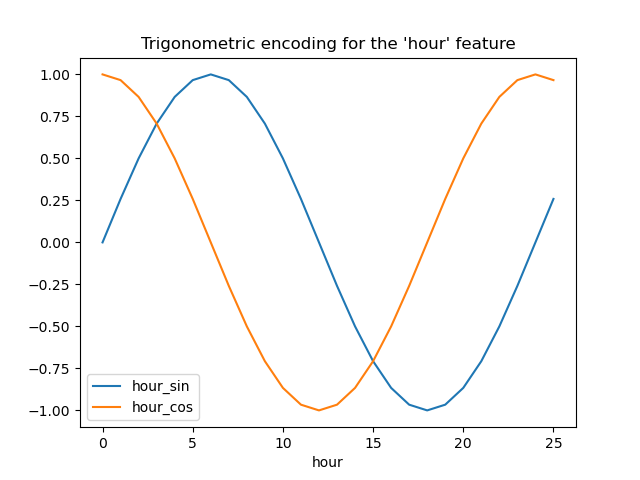
Trigonometric encoding for the 'hour' feature

Let’s use a 2D scatter plot with the hours encoded as colors to better see how this representation maps the 24 hours of the day to a 2D space, akin to some sort of a 24 hour version of an analog clock. Note that the “25th” hour is mapped back to the 1st hour because of the periodic nature of the sine/cosine representation.

fig, ax = plt.subplots(figsize=(7, 5))
sp = ax.scatter(hour_df["hour_sin"], hour_df["hour_cos"], c=hour_df["hour"])
ax.set(
    xlabel="sin(hour)",
    ylabel="cos(hour)",
)
_ = fig.colorbar(sp)
plot cyclical feature engineering

We can now build a feature extraction pipeline using this strategy:

cyclic_cossin_transformer = ColumnTransformer(
    transformers=[
        ("categorical", one_hot_encoder, categorical_columns),
        ("month_sin", sin_transformer(12), ["month"]),
        ("month_cos", cos_transformer(12), ["month"]),
        ("weekday_sin", sin_transformer(7), ["weekday"]),
        ("weekday_cos", cos_transformer(7), ["weekday"]),
        ("hour_sin", sin_transformer(24), ["hour"]),
        ("hour_cos", cos_transformer(24), ["hour"]),
    ],
    remainder=MinMaxScaler(),
    verbose_feature_names_out=True,
)
cyclic_cossin_linear_pipeline = make_pipeline(
    cyclic_cossin_transformer,
    RidgeCV(alphas=alphas),
)
evaluate(cyclic_cossin_linear_pipeline, X, y, cv=ts_cv)
Mean Absolute Error:     0.125 +/- 0.014
Root Mean Squared Error: 0.166 +/- 0.020
Pipeline(steps=[('columntransformer',
                 ColumnTransformer(remainder=MinMaxScaler(),
                                   transformers=[('categorical',
                                                  OneHotEncoder(handle_unknown='ignore',
                                                                sparse_output=False),
                                                  Index(['season', 'holiday', 'workingday', 'weather'], dtype='str')),
                                                 ('month_sin',
                                                  FunctionTransformer(feature_names_out='one-to-one',
                                                                      func=<function sin_transformer.<locals>.<lambda> at 0x7b2...
                 RidgeCV(alphas=array([1.00000000e-06, 3.16227766e-06, 1.00000000e-05, 3.16227766e-05,
       1.00000000e-04, 3.16227766e-04, 1.00000000e-03, 3.16227766e-03,
       1.00000000e-02, 3.16227766e-02, 1.00000000e-01, 3.16227766e-01,
       1.00000000e+00, 3.16227766e+00, 1.00000000e+01, 3.16227766e+01,
       1.00000000e+02, 3.16227766e+02, 1.00000000e+03, 3.16227766e+03,
       1.00000000e+04, 3.16227766e+04, 1.00000000e+05, 3.16227766e+05,
       1.00000000e+06])))])
In a Jupyter environment, please rerun this cell to show the HTML representation or trust the notebook.
On GitHub, the HTML representation is unable to render, please try loading this page with nbviewer.org.
Parameters
steps steps: list of tuples

List of (name of step, estimator) tuples that are to be chained in
sequential order. To be compatible with the scikit-learn API, all steps
must define `fit`. All non-last steps must also define `transform`. See
:ref:`Combining Estimators <combining_estimators>` for more details.
[('columntransformer', ...), ('ridgecv', ...)]
transform_input transform_input: list of str, default=None

The names of the :term:`metadata` parameters that should be transformed by the
pipeline before passing it to the step consuming it.

This enables transforming some input arguments to ``fit`` (other than ``X``)
to be transformed by the steps of the pipeline up to the step which requires
them. Requirement is defined via :ref:`metadata routing <metadata_routing>`.
For instance, this can be used to pass a validation set through the pipeline.

You can only set this if metadata routing is enabled, which you
can enable using ``sklearn.set_config(enable_metadata_routing=True)``.

.. versionadded:: 1.6
None
memory memory: str or object with the joblib.Memory interface, default=None

Used to cache the fitted transformers of the pipeline. The last step
will never be cached, even if it is a transformer. By default, no
caching is performed. If a string is given, it is the path to the
caching directory. Enabling caching triggers a clone of the transformers
before fitting. Therefore, the transformer instance given to the
pipeline cannot be inspected directly. Use the attribute ``named_steps``
or ``steps`` to inspect estimators within the pipeline. Caching the
transformers is advantageous when fitting is time consuming. See
:ref:`sphx_glr_auto_examples_neighbors_plot_caching_nearest_neighbors.py`
for an example on how to enable caching.
None
verbose verbose: bool, default=False

If True, the time elapsed while fitting each step will be printed as it
is completed.
False
Fitted attributes
Name Type Value
feature_names_in_ feature_names_in_: ndarray of shape (`n_features_in_`,)

Names of features seen during :term:`fit`. Only defined if the
underlying estimator exposes such an attribute when fit.

.. versionadded:: 1.0
ndarray[object](12,) ['season','year','month',...,'feel_temp','humidity','windspeed']
n_features_in_ n_features_in_: int

Number of features seen during :term:`fit`. Only defined if the
underlying first estimator in `steps` exposes such an attribute
when fit.

.. versionadded:: 0.24
int 12
Parameters
transformers transformers: list of tuples

List of (name, transformer, columns) tuples specifying the
transformer objects to be applied to subsets of the data.

name : str
Like in Pipeline and FeatureUnion, this allows the transformer and
its parameters to be set using ``set_params`` and searched in grid
search.
transformer : {'drop', 'passthrough'} or estimator
Estimator must support :term:`fit` and :term:`transform`.
Special-cased strings 'drop' and 'passthrough' are accepted as
well, to indicate to drop the columns or to pass them through
untransformed, respectively.
columns : str, array-like of str, int, array-like of int, array-like of bool, slice or callable
Indexes the data on its second axis. Integers are interpreted as
positional columns, while strings can reference DataFrame columns
by name. A scalar string or int should be used where
``transformer`` expects X to be a 1d array-like (vector),
otherwise a 2d array will be passed to the transformer.
A callable is passed the input data `X` and can return any of the
above. To select multiple columns by name or dtype, you can use
:obj:`make_column_selector`.
[('categorical', ...), ('month_sin', ...), ...]
remainder remainder: {'drop', 'passthrough'} or estimator, default='drop'

By default, only the specified columns in `transformers` are
transformed and combined in the output, and the non-specified
columns are dropped. (default of ``'drop'``).
By specifying ``remainder='passthrough'``, all remaining columns that
were not specified in `transformers`, but present in the data passed
to `fit` will be automatically passed through. This subset of columns
is concatenated with the output of the transformers. For dataframes,
extra columns not seen during `fit` will be excluded from the output
of `transform`.
By setting ``remainder`` to be an estimator, the remaining
non-specified columns will use the ``remainder`` estimator. The
estimator must support :term:`fit` and :term:`transform`.
Note that using this feature requires that the DataFrame columns
input at :term:`fit` and :term:`transform` have identical order.
MinMaxScaler()
sparse_threshold sparse_threshold: float, default=0.3

If the output of the different transformers contains sparse matrices,
these will be stacked as a sparse matrix if the overall density is
lower than this value. Use ``sparse_threshold=0`` to always return
dense. When the transformed output consists of all dense data, the
stacked result will be dense, and this keyword will be ignored.
0.3
n_jobs n_jobs: int, default=None

Number of jobs to run in parallel.
``None`` means 1 unless in a :obj:`joblib.parallel_backend` context.
``-1`` means using all processors. See :term:`Glossary <n_jobs>`
for more details.
None
transformer_weights transformer_weights: dict, default=None

Multiplicative weights for features per transformer. The output of the
transformer is multiplied by these weights. Keys are transformer names,
values the weights.
None
verbose verbose: bool, default=False

If True, the time elapsed while fitting each transformer will be
printed as it is completed.
False
verbose_feature_names_out verbose_feature_names_out: bool, str or Callable[[str, str], str], default=True

- If True, :meth:`ColumnTransformer.get_feature_names_out` will prefix
all feature names with the name of the transformer that generated that
feature. It is equivalent to setting
`verbose_feature_names_out="{transformer_name}__{feature_name}"`.
- If False, :meth:`ColumnTransformer.get_feature_names_out` will not
prefix any feature names and will error if feature names are not
unique.
- If ``Callable[[str, str], str]``,
:meth:`ColumnTransformer.get_feature_names_out` will rename all the features
using the name of the transformer. The first argument of the callable is the
transformer name and the second argument is the feature name. The returned
string will be the new feature name.
- If ``str``, it must be a string ready for formatting. The given string will
be formatted using two field names: ``transformer_name`` and ``feature_name``.
e.g. ``"{feature_name}__{transformer_name}"``. See :meth:`str.format` method
from the standard library for more info.

.. versionadded:: 1.0

.. versionchanged:: 1.6
`verbose_feature_names_out` can be a callable or a string to be formatted.
True
Fitted attributes
Name Type Value
feature_names_in_ feature_names_in_: ndarray of shape (`n_features_in_`,)

Names of features seen during :term:`fit`. Defined only when `X`
has feature names that are all strings.

.. versionadded:: 1.0
ndarray[object](12,) ['season','year','month',...,'feel_temp','humidity','windspeed']
n_features_in_ n_features_in_: int

Number of features seen during :term:`fit`. Only defined if the
underlying transformers expose such an attribute when fit.

.. versionadded:: 0.24
int 12
named_transformers_ named_transformers_: :class:`~sklearn.utils.Bunch`

Read-only attribute to access any transformer by given name.
Keys are transformer names and values are the fitted transformer
objects.
Bunch {'categorical...inMaxScaler()}
output_indices_ output_indices_: dict

A dictionary from each transformer name to a slice, where the slice
corresponds to indices in the transformed output. This is useful to
inspect which transformer is responsible for which transformed
feature(s).

.. versionadded:: 1.0
dict {'ca...al': slice(0, 11, None), 'ho...os': slice(16, 17, None), 'ho...in': slice(15, 16, None), 'mo...os': slice(12, 13, None), ...}
sparse_output_ sparse_output_: bool

Boolean flag indicating whether the output of ``transform`` is a
sparse matrix or a dense numpy array, which depends on the output
of the individual transformers and the `sparse_threshold` keyword.
bool False
transformers_ transformers_: list

The collection of fitted transformers as tuples of (name,
fitted_transformer, column). `fitted_transformer` can be an estimator,
or `'drop'`; `'passthrough'` is replaced with an equivalent
:class:`~sklearn.preprocessing.FunctionTransformer`. In case there were
no columns selected, this will be the unfitted transformer. If there
are remaining columns, the final element is a tuple of the form:
('remainder', transformer, remaining_columns) corresponding to the
``remainder`` parameter. If there are remaining columns, then
``len(transformers_)==len(transformers)+1``, otherwise
``len(transformers_)==len(transformers)``.

.. versionadded:: 1.7
The format of the remaining columns now attempts to match that of the other
transformers: if all columns were provided as column names (`str`), the
remaining columns are stored as column names; if all columns were provided
as mask arrays (`bool`), so are the remaining columns; in all other cases
the remaining columns are stored as indices (`int`).
list [('ca...al', OneHotEncoder..._output=False), Index(['seaso..., dtype='str')), ('mo...in', FunctionTrans...7b283a069f30>), ['month']), ('mo...os', FunctionTrans...7b287407fd70>), ['month']), ('we...in', FunctionTrans...7b287407c300>), ['weekday']), ...]
Index(['season', 'holiday', 'workingday', 'weather'], dtype='str')
Parameters
sparse_output sparse_output: bool, default=True

When ``True``, it returns a SciPy sparse matrix/array
in "Compressed Sparse Row" (CSR) format.

.. versionadded:: 1.2
`sparse` was renamed to `sparse_output`
False
handle_unknown handle_unknown: {'error', 'ignore', 'infrequent_if_exist', 'warn'}, default='error'

Specifies the way unknown categories are handled during :meth:`transform`.

- 'error' : Raise an error if an unknown category is present during transform.
- 'ignore' : When an unknown category is encountered during
transform, the resulting one-hot encoded columns for this feature
will be all zeros. In the inverse transform, an unknown category
will be denoted as None.
- 'infrequent_if_exist' : When an unknown category is encountered
during transform, the resulting one-hot encoded columns for this
feature will map to the infrequent category if it exists. The
infrequent category will be mapped to the last position in the
encoding. During inverse transform, an unknown category will be
mapped to the category denoted `'infrequent'` if it exists. If the
`'infrequent'` category does not exist, then :meth:`transform` and
:meth:`inverse_transform` will handle an unknown category as with
`handle_unknown='ignore'`. Infrequent categories exist based on
`min_frequency` and `max_categories`. Read more in the
:ref:`User Guide <encoder_infrequent_categories>`.
- 'warn' : When an unknown category is encountered during transform
a warning is issued, and the encoding then proceeds as described for
`handle_unknown="infrequent_if_exist"`.

.. versionchanged:: 1.1
`'infrequent_if_exist'` was added to automatically handle unknown
categories and infrequent categories.

.. versionadded:: 1.6
The option `"warn"` was added in 1.6.
'ignore'
categories categories: 'auto' or a list of array-like, default='auto'

Categories (unique values) per feature:

- 'auto' : Determine categories automatically from the training data.
- list : ``categories[i]`` holds the categories expected in the ith
column. The passed categories should not mix strings and numeric
values within a single feature, and should be sorted in case of
numeric values.

The used categories can be found in the ``categories_`` attribute.

.. versionadded:: 0.20
'auto'
drop drop: {'first', 'if_binary'} or an array-like of shape (n_features,), default=None

Specifies a methodology to use to drop one of the categories per
feature. This is useful in situations where perfectly collinear
features cause problems, such as when feeding the resulting data
into an unregularized linear regression model.

However, dropping one category breaks the symmetry of the original
representation and can therefore induce a bias in downstream models,
for instance for penalized linear classification or regression models.

- None : retain all features (the default).
- 'first' : drop the first category in each feature. If only one
category is present, the feature will be dropped entirely.
- 'if_binary' : drop the first category in each feature with two
categories. Features with 1 or more than 2 categories are
left intact.
- array : ``drop[i]`` is the category in feature ``X[:, i]`` that
should be dropped.

When `max_categories` or `min_frequency` is configured to group
infrequent categories, the dropping behavior is handled after the
grouping.

.. versionadded:: 0.21
The parameter `drop` was added in 0.21.

.. versionchanged:: 0.23
The option `drop='if_binary'` was added in 0.23.

.. versionchanged:: 1.1
Support for dropping infrequent categories.
None
dtype dtype: number type, default=np.float64

Desired dtype of output.
<class 'numpy.float64'>
min_frequency min_frequency: int or float, default=None

Specifies the minimum frequency below which a category will be
considered infrequent.

- If `int`, categories with a smaller cardinality will be considered
infrequent.

- If `float`, categories with a smaller cardinality than
`min_frequency * n_samples` will be considered infrequent.

.. versionadded:: 1.1
Read more in the :ref:`User Guide <encoder_infrequent_categories>`.
None
max_categories max_categories: int, default=None

Specifies an upper limit to the number of output features for each input
feature when considering infrequent categories. If there are infrequent
categories, `max_categories` includes the category representing the
infrequent categories along with the frequent categories. If `None`,
there is no limit to the number of output features.

.. versionadded:: 1.1
Read more in the :ref:`User Guide <encoder_infrequent_categories>`.
None
feature_name_combiner feature_name_combiner: "concat" or callable, default="concat"

Callable with signature `def callable(input_feature, category)` that returns a
string. This is used to create feature names to be returned by
:meth:`get_feature_names_out`.

`"concat"` concatenates encoded feature name and category with
`feature + "_" + str(category)`.E.g. feature X with values 1, 6, 7 create
feature names `X_1, X_6, X_7`.

.. versionadded:: 1.3
'concat'
Fitted attributes
Name Type Value
categories_ categories_: list of arrays

The categories of each feature determined during fitting
(in order of the features in X and corresponding with the output
of ``transform``). This includes the category specified in ``drop``
(if any).
list [array(['fall'... dtype=object), array(['False... dtype=object), array(['False... dtype=object), array(['clear... dtype=object)]
drop_idx_ drop_idx_: array of shape (n_features,)

- ``drop_idx_[i]`` is the index in ``categories_[i]`` of the category
to be dropped for each feature.
- ``drop_idx_[i] = None`` if no category is to be dropped from the
feature with index ``i``, e.g. when `drop='if_binary'` and the
feature isn't binary.
- ``drop_idx_ = None`` if all the transformed features will be
retained.

If infrequent categories are enabled by setting `min_frequency` or
`max_categories` to a non-default value and `drop_idx[i]` corresponds
to an infrequent category, then the entire infrequent category is
dropped.

.. versionchanged:: 0.23
Added the possibility to contain `None` values.
NoneType None
feature_names_in_ feature_names_in_: ndarray of shape (`n_features_in_`,)

Names of features seen during :term:`fit`. Defined only when `X`
has feature names that are all strings.

.. versionadded:: 1.0
ndarray[object](4,) ['season','holiday','workingday','weather']
n_features_in_ n_features_in_: int

Number of features seen during :term:`fit`.

.. versionadded:: 1.0
int 4
11 features
season_fall
season_spring
season_summer
season_winter
holiday_False
holiday_True
workingday_False
workingday_True
weather_clear
weather_misty
weather_rain
['month']
Parameters
func func: callable, default=None

The callable to use for the transformation. This will be passed
the same arguments as transform, with args and kwargs forwarded.
If func is None, then func will be the identity function.
<function sin...x7b283a069f30>
feature_names_out feature_names_out: callable, 'one-to-one' or None, default=None

Determines the list of feature names that will be returned by the
`get_feature_names_out` method. If it is 'one-to-one', then the output
feature names will be equal to the input feature names. If it is a
callable, then it must take two positional arguments: this
`FunctionTransformer` (`self`) and an array-like of input feature names
(`input_features`). It must return an array-like of output feature
names. The `get_feature_names_out` method is only defined if
`feature_names_out` is not None.

See ``get_feature_names_out`` for more details.

.. versionadded:: 1.1
'one-to-one'
inverse_func inverse_func: callable, default=None

The callable to use for the inverse transformation. This will be
passed the same arguments as inverse transform, with args and
kwargs forwarded. If inverse_func is None, then inverse_func
will be the identity function.
None
validate validate: bool, default=False

Indicate that the input X array should be checked before calling
``func``. The possibilities are:

- If False, there is no input validation.
- If True, then X will be converted to a 2-dimensional NumPy array or
sparse matrix. If the conversion is not possible an exception is
raised.

.. versionchanged:: 0.22
The default of ``validate`` changed from True to False.
False
accept_sparse accept_sparse: bool, default=False

Indicate that func accepts a sparse matrix as input. If validate is
False, this has no effect. Otherwise, if accept_sparse is false,
sparse matrix inputs will cause an exception to be raised.
False
check_inverse check_inverse: bool, default=True

Whether to check that or ``func`` followed by ``inverse_func`` leads to
the original inputs. It can be used for a sanity check, raising a
warning when the condition is not fulfilled.

.. versionadded:: 0.20
True
kw_args kw_args: dict, default=None

Dictionary of additional keyword arguments to pass to func.

.. versionadded:: 0.18
None
inv_kw_args inv_kw_args: dict, default=None

Dictionary of additional keyword arguments to pass to inverse_func.

.. versionadded:: 0.18
None
Fitted attributes
Name Type Value
feature_names_in_ feature_names_in_: ndarray of shape (`n_features_in_`,)

Names of features seen during :term:`fit`. Defined only when `X` has feature
names that are all strings.

.. versionadded:: 1.0
ndarray[object](1,) ['month']
n_features_in_ n_features_in_: int

Number of features seen during :term:`fit`.

.. versionadded:: 0.24
int 1
1 feature
month
['month']
Parameters
func func: callable, default=None

The callable to use for the transformation. This will be passed
the same arguments as transform, with args and kwargs forwarded.
If func is None, then func will be the identity function.
<function cos...x7b287407fd70>
feature_names_out feature_names_out: callable, 'one-to-one' or None, default=None

Determines the list of feature names that will be returned by the
`get_feature_names_out` method. If it is 'one-to-one', then the output
feature names will be equal to the input feature names. If it is a
callable, then it must take two positional arguments: this
`FunctionTransformer` (`self`) and an array-like of input feature names
(`input_features`). It must return an array-like of output feature
names. The `get_feature_names_out` method is only defined if
`feature_names_out` is not None.

See ``get_feature_names_out`` for more details.

.. versionadded:: 1.1
'one-to-one'
inverse_func inverse_func: callable, default=None

The callable to use for the inverse transformation. This will be
passed the same arguments as inverse transform, with args and
kwargs forwarded. If inverse_func is None, then inverse_func
will be the identity function.
None
validate validate: bool, default=False

Indicate that the input X array should be checked before calling
``func``. The possibilities are:

- If False, there is no input validation.
- If True, then X will be converted to a 2-dimensional NumPy array or
sparse matrix. If the conversion is not possible an exception is
raised.

.. versionchanged:: 0.22
The default of ``validate`` changed from True to False.
False
accept_sparse accept_sparse: bool, default=False

Indicate that func accepts a sparse matrix as input. If validate is
False, this has no effect. Otherwise, if accept_sparse is false,
sparse matrix inputs will cause an exception to be raised.
False
check_inverse check_inverse: bool, default=True

Whether to check that or ``func`` followed by ``inverse_func`` leads to
the original inputs. It can be used for a sanity check, raising a
warning when the condition is not fulfilled.

.. versionadded:: 0.20
True
kw_args kw_args: dict, default=None

Dictionary of additional keyword arguments to pass to func.

.. versionadded:: 0.18
None
inv_kw_args inv_kw_args: dict, default=None

Dictionary of additional keyword arguments to pass to inverse_func.

.. versionadded:: 0.18
None
Fitted attributes
Name Type Value
feature_names_in_ feature_names_in_: ndarray of shape (`n_features_in_`,)

Names of features seen during :term:`fit`. Defined only when `X` has feature
names that are all strings.

.. versionadded:: 1.0
ndarray[object](1,) ['month']
n_features_in_ n_features_in_: int

Number of features seen during :term:`fit`.

.. versionadded:: 0.24
int 1
1 feature
month
['weekday']
Parameters
func func: callable, default=None

The callable to use for the transformation. This will be passed
the same arguments as transform, with args and kwargs forwarded.
If func is None, then func will be the identity function.
<function sin...x7b287407c300>
feature_names_out feature_names_out: callable, 'one-to-one' or None, default=None

Determines the list of feature names that will be returned by the
`get_feature_names_out` method. If it is 'one-to-one', then the output
feature names will be equal to the input feature names. If it is a
callable, then it must take two positional arguments: this
`FunctionTransformer` (`self`) and an array-like of input feature names
(`input_features`). It must return an array-like of output feature
names. The `get_feature_names_out` method is only defined if
`feature_names_out` is not None.

See ``get_feature_names_out`` for more details.

.. versionadded:: 1.1
'one-to-one'
inverse_func inverse_func: callable, default=None

The callable to use for the inverse transformation. This will be
passed the same arguments as inverse transform, with args and
kwargs forwarded. If inverse_func is None, then inverse_func
will be the identity function.
None
validate validate: bool, default=False

Indicate that the input X array should be checked before calling
``func``. The possibilities are:

- If False, there is no input validation.
- If True, then X will be converted to a 2-dimensional NumPy array or
sparse matrix. If the conversion is not possible an exception is
raised.

.. versionchanged:: 0.22
The default of ``validate`` changed from True to False.
False
accept_sparse accept_sparse: bool, default=False

Indicate that func accepts a sparse matrix as input. If validate is
False, this has no effect. Otherwise, if accept_sparse is false,
sparse matrix inputs will cause an exception to be raised.
False
check_inverse check_inverse: bool, default=True

Whether to check that or ``func`` followed by ``inverse_func`` leads to
the original inputs. It can be used for a sanity check, raising a
warning when the condition is not fulfilled.

.. versionadded:: 0.20
True
kw_args kw_args: dict, default=None

Dictionary of additional keyword arguments to pass to func.

.. versionadded:: 0.18
None
inv_kw_args inv_kw_args: dict, default=None

Dictionary of additional keyword arguments to pass to inverse_func.

.. versionadded:: 0.18
None
Fitted attributes
Name Type Value
feature_names_in_ feature_names_in_: ndarray of shape (`n_features_in_`,)

Names of features seen during :term:`fit`. Defined only when `X` has feature
names that are all strings.

.. versionadded:: 1.0
ndarray[object](1,) ['weekday']
n_features_in_ n_features_in_: int

Number of features seen during :term:`fit`.

.. versionadded:: 0.24
int 1
1 feature
weekday
['weekday']
Parameters
func func: callable, default=None

The callable to use for the transformation. This will be passed
the same arguments as transform, with args and kwargs forwarded.
If func is None, then func will be the identity function.
<function cos...x7b287407e400>
feature_names_out feature_names_out: callable, 'one-to-one' or None, default=None

Determines the list of feature names that will be returned by the
`get_feature_names_out` method. If it is 'one-to-one', then the output
feature names will be equal to the input feature names. If it is a
callable, then it must take two positional arguments: this
`FunctionTransformer` (`self`) and an array-like of input feature names
(`input_features`). It must return an array-like of output feature
names. The `get_feature_names_out` method is only defined if
`feature_names_out` is not None.

See ``get_feature_names_out`` for more details.

.. versionadded:: 1.1
'one-to-one'
inverse_func inverse_func: callable, default=None

The callable to use for the inverse transformation. This will be
passed the same arguments as inverse transform, with args and
kwargs forwarded. If inverse_func is None, then inverse_func
will be the identity function.
None
validate validate: bool, default=False

Indicate that the input X array should be checked before calling
``func``. The possibilities are:

- If False, there is no input validation.
- If True, then X will be converted to a 2-dimensional NumPy array or
sparse matrix. If the conversion is not possible an exception is
raised.

.. versionchanged:: 0.22
The default of ``validate`` changed from True to False.
False
accept_sparse accept_sparse: bool, default=False

Indicate that func accepts a sparse matrix as input. If validate is
False, this has no effect. Otherwise, if accept_sparse is false,
sparse matrix inputs will cause an exception to be raised.
False
check_inverse check_inverse: bool, default=True

Whether to check that or ``func`` followed by ``inverse_func`` leads to
the original inputs. It can be used for a sanity check, raising a
warning when the condition is not fulfilled.

.. versionadded:: 0.20
True
kw_args kw_args: dict, default=None

Dictionary of additional keyword arguments to pass to func.

.. versionadded:: 0.18
None
inv_kw_args inv_kw_args: dict, default=None

Dictionary of additional keyword arguments to pass to inverse_func.

.. versionadded:: 0.18
None
Fitted attributes
Name Type Value
feature_names_in_ feature_names_in_: ndarray of shape (`n_features_in_`,)

Names of features seen during :term:`fit`. Defined only when `X` has feature
names that are all strings.

.. versionadded:: 1.0
ndarray[object](1,) ['weekday']
n_features_in_ n_features_in_: int

Number of features seen during :term:`fit`.

.. versionadded:: 0.24
int 1
1 feature
weekday
['hour']
Parameters
func func: callable, default=None

The callable to use for the transformation. This will be passed
the same arguments as transform, with args and kwargs forwarded.
If func is None, then func will be the identity function.
<function sin...x7b287407ceb0>
feature_names_out feature_names_out: callable, 'one-to-one' or None, default=None

Determines the list of feature names that will be returned by the
`get_feature_names_out` method. If it is 'one-to-one', then the output
feature names will be equal to the input feature names. If it is a
callable, then it must take two positional arguments: this
`FunctionTransformer` (`self`) and an array-like of input feature names
(`input_features`). It must return an array-like of output feature
names. The `get_feature_names_out` method is only defined if
`feature_names_out` is not None.

See ``get_feature_names_out`` for more details.

.. versionadded:: 1.1
'one-to-one'
inverse_func inverse_func: callable, default=None

The callable to use for the inverse transformation. This will be
passed the same arguments as inverse transform, with args and
kwargs forwarded. If inverse_func is None, then inverse_func
will be the identity function.
None
validate validate: bool, default=False

Indicate that the input X array should be checked before calling
``func``. The possibilities are:

- If False, there is no input validation.
- If True, then X will be converted to a 2-dimensional NumPy array or
sparse matrix. If the conversion is not possible an exception is
raised.

.. versionchanged:: 0.22
The default of ``validate`` changed from True to False.
False
accept_sparse accept_sparse: bool, default=False

Indicate that func accepts a sparse matrix as input. If validate is
False, this has no effect. Otherwise, if accept_sparse is false,
sparse matrix inputs will cause an exception to be raised.
False
check_inverse check_inverse: bool, default=True

Whether to check that or ``func`` followed by ``inverse_func`` leads to
the original inputs. It can be used for a sanity check, raising a
warning when the condition is not fulfilled.

.. versionadded:: 0.20
True
kw_args kw_args: dict, default=None

Dictionary of additional keyword arguments to pass to func.

.. versionadded:: 0.18
None
inv_kw_args inv_kw_args: dict, default=None

Dictionary of additional keyword arguments to pass to inverse_func.

.. versionadded:: 0.18
None
Fitted attributes
Name Type Value
feature_names_in_ feature_names_in_: ndarray of shape (`n_features_in_`,)

Names of features seen during :term:`fit`. Defined only when `X` has feature
names that are all strings.

.. versionadded:: 1.0
ndarray[object](1,) ['hour']
n_features_in_ n_features_in_: int

Number of features seen during :term:`fit`.

.. versionadded:: 0.24
int 1
1 feature
hour
['hour']
Parameters
func func: callable, default=None

The callable to use for the transformation. This will be passed
the same arguments as transform, with args and kwargs forwarded.
If func is None, then func will be the identity function.
<function cos...x7b287407f3d0>
feature_names_out feature_names_out: callable, 'one-to-one' or None, default=None

Determines the list of feature names that will be returned by the
`get_feature_names_out` method. If it is 'one-to-one', then the output
feature names will be equal to the input feature names. If it is a
callable, then it must take two positional arguments: this
`FunctionTransformer` (`self`) and an array-like of input feature names
(`input_features`). It must return an array-like of output feature
names. The `get_feature_names_out` method is only defined if
`feature_names_out` is not None.

See ``get_feature_names_out`` for more details.

.. versionadded:: 1.1
'one-to-one'
inverse_func inverse_func: callable, default=None

The callable to use for the inverse transformation. This will be
passed the same arguments as inverse transform, with args and
kwargs forwarded. If inverse_func is None, then inverse_func
will be the identity function.
None
validate validate: bool, default=False

Indicate that the input X array should be checked before calling
``func``. The possibilities are:

- If False, there is no input validation.
- If True, then X will be converted to a 2-dimensional NumPy array or
sparse matrix. If the conversion is not possible an exception is
raised.

.. versionchanged:: 0.22
The default of ``validate`` changed from True to False.
False
accept_sparse accept_sparse: bool, default=False

Indicate that func accepts a sparse matrix as input. If validate is
False, this has no effect. Otherwise, if accept_sparse is false,
sparse matrix inputs will cause an exception to be raised.
False
check_inverse check_inverse: bool, default=True

Whether to check that or ``func`` followed by ``inverse_func`` leads to
the original inputs. It can be used for a sanity check, raising a
warning when the condition is not fulfilled.

.. versionadded:: 0.20
True
kw_args kw_args: dict, default=None

Dictionary of additional keyword arguments to pass to func.

.. versionadded:: 0.18
None
inv_kw_args inv_kw_args: dict, default=None

Dictionary of additional keyword arguments to pass to inverse_func.

.. versionadded:: 0.18
None
Fitted attributes
Name Type Value
feature_names_in_ feature_names_in_: ndarray of shape (`n_features_in_`,)

Names of features seen during :term:`fit`. Defined only when `X` has feature
names that are all strings.

.. versionadded:: 1.0
ndarray[object](1,) ['hour']
n_features_in_ n_features_in_: int

Number of features seen during :term:`fit`.

.. versionadded:: 0.24
int 1
1 feature
hour
['year', 'temp', 'feel_temp', 'humidity', 'windspeed']
Parameters
feature_range feature_range: tuple (min, max), default=(0, 1)

Desired range of transformed data.
(0, ...)
copy copy: bool, default=True

Set to False to perform inplace row normalization and avoid a
copy (if the input is already a numpy array).
True
clip clip: bool, default=False

Set to True to clip transformed values of held-out data to
provided `feature_range`.
Since this parameter will clip values, `inverse_transform` may not
be able to restore the original data.

.. note::
Setting `clip=True` does not prevent feature drift (a distribution
shift between training and test data). The transformed values are clipped
to the `feature_range`, which helps avoid unintended behavior in models
sensitive to out-of-range inputs (e.g. linear models). Use with care,
as clipping can distort the distribution of test data.

.. versionadded:: 0.24
False
Fitted attributes
Name Type Value
data_max_ data_max_: ndarray of shape (n_features,)

Per feature maximum seen in the data

.. versionadded:: 0.17
*data_max_*
ndarray[float64](5,) [ 1. ,39.36,50. , 1. ,57. ]
data_min_ data_min_: ndarray of shape (n_features,)

Per feature minimum seen in the data

.. versionadded:: 0.17
*data_min_*
ndarray[float64](5,) [0. ,0.82,0.76,0.16,0. ]
data_range_ data_range_: ndarray of shape (n_features,)

Per feature range ``(data_max_ - data_min_)`` seen in the data

.. versionadded:: 0.17
*data_range_*
ndarray[float64](5,) [ 1. ,38.54,49.24, 0.84,57. ]
feature_names_in_ feature_names_in_: ndarray of shape (`n_features_in_`,)

Names of features seen during :term:`fit`. Defined only when `X`
has feature names that are all strings.

.. versionadded:: 1.0
ndarray[object](5,) ['year','temp','feel_temp','humidity','windspeed']
min_ min_: ndarray of shape (n_features,)

Per feature adjustment for minimum. Equivalent to
``min - X.min(axis=0) * self.scale_``
ndarray[float64](5,) [ 0. ,-0.02,-0.02,-0.19, 0. ]
n_features_in_ n_features_in_: int

Number of features seen during :term:`fit`.

.. versionadded:: 0.24
int 5
n_samples_seen_ n_samples_seen_: int

The number of samples processed by the estimator.
It will be reset on new calls to fit, but increments across
``partial_fit`` calls.
int 10000
scale_ scale_: ndarray of shape (n_features,)

Per feature relative scaling of the data. Equivalent to
``(max - min) / (X.max(axis=0) - X.min(axis=0))``

.. versionadded:: 0.17
*scale_* attribute.
ndarray[float64](5,) [1. ,0.03,0.02,1.19,0.02]
5 features
year
temp
feel_temp
humidity
windspeed
22 features
categorical__season_fall
categorical__season_spring
categorical__season_summer
categorical__season_winter
categorical__holiday_False
categorical__holiday_True
categorical__workingday_False
categorical__workingday_True
categorical__weather_clear
categorical__weather_misty
categorical__weather_rain
month_sin__month
month_cos__month
weekday_sin__weekday
weekday_cos__weekday
hour_sin__hour
hour_cos__hour
remainder__year
remainder__temp
remainder__feel_temp
remainder__humidity
remainder__windspeed
Parameters
alphas alphas: array-like of shape (n_alphas,), default=(0.1, 1.0, 10.0)

Array of alpha values to try.
Regularization strength; must be a positive float. Regularization
improves the conditioning of the problem and reduces the variance of
the estimates. Larger values specify stronger regularization.
Alpha corresponds to ``1 / (2C)`` in other linear models such as
:class:`~sklearn.linear_model.LogisticRegression` or
:class:`~sklearn.svm.LinearSVC`.
If using Leave-One-Out cross-validation, alphas must be strictly positive.

For an example on how regularization strength affects the model coefficients,
see :ref:`sphx_glr_auto_examples_linear_model_plot_ridge_coeffs.py`.
array([1.0000...00000000e+06])
fit_intercept fit_intercept: bool, default=True

Whether to calculate the intercept for this model. If set
to false, no intercept will be used in calculations
(i.e. data is expected to be centered).
True
scoring scoring: str, callable, default=None

The scoring method to use for cross-validation. Options:

- str: see :ref:`scoring_string_names` for options.
- callable: a scorer callable object (e.g., function) with signature
``scorer(estimator, X, y)``. See :ref:`scoring_callable` for details.
- `None`: negative :ref:`mean squared error <mean_squared_error>` if cv is
None (i.e. when using leave-one-out cross-validation), or
:ref:`coefficient of determination <r2_score>` (:math:`R^2`) otherwise.
None
cv cv: int, cross-validation generator or an iterable, default=None

Determines the cross-validation splitting strategy.
Possible inputs for cv are:

- None, to use the efficient Leave-One-Out cross-validation
- integer, to specify the number of folds,
- :term:`CV splitter`,
- an iterable yielding (train, test) splits as arrays of indices.

For integer/None inputs, if ``y`` is binary or multiclass,
:class:`~sklearn.model_selection.StratifiedKFold` is used, else,
:class:`~sklearn.model_selection.KFold` is used.

Refer :ref:`User Guide <cross_validation>` for the various
cross-validation strategies that can be used here.
None
gcv_mode gcv_mode: {'auto', 'svd', 'eigen'}, default='auto'

Flag indicating which strategy to use when performing
Leave-One-Out Cross-Validation. Options are::

'auto' : same as 'eigen'
'svd' : use singular value decomposition of X when X is dense,
fallback to 'eigen' when X is sparse
'eigen' : use eigendecomposition of X X' when n_samples <= n_features
or X' X when n_features < n_samples

The 'auto' mode is the default and is intended to pick the cheaper
option depending on the shape and sparsity of the training data.
None
store_cv_results store_cv_results: bool, default=False

Flag indicating if the cross-validation values corresponding to
each alpha should be stored in the ``cv_results_`` attribute (see
below). This flag is only compatible with ``cv=None`` (i.e. using
Leave-One-Out Cross-Validation).

.. versionchanged:: 1.5
Parameter name changed from `store_cv_values` to `store_cv_results`.
False
alpha_per_target alpha_per_target: bool, default=False

Flag indicating whether to optimize the alpha value (picked from the
`alphas` parameter list) for each target separately (for multi-output
settings: multiple prediction targets). When set to `True`, after
fitting, the `alpha_` attribute will contain a value for each target.
When set to `False`, a single alpha is used for all targets.

.. versionadded:: 0.24
False
Fitted attributes
Name Type Value
alpha_ alpha_: float or ndarray of shape (n_targets,)

Estimated regularization parameter, or, if ``alpha_per_target=True``,
the estimated regularization parameter for each target.
float 1
best_score_ best_score_: float or ndarray of shape (n_targets,)

Score of base estimator with best alpha, or, if
``alpha_per_target=True``, a score for each target.

.. versionadded:: 0.23
float64 -0.01384
coef_ coef_: ndarray of shape (n_features) or (n_targets, n_features)

Weight vector(s).
ndarray[float64](22,) [-0. ,-0.04, 0.01,..., 0.18,-0.03,-0.03]
intercept_ intercept_: float or ndarray of shape (n_targets,)

Independent term in decision function. Set to 0.0 if
``fit_intercept = False``.
float64 0.04623
n_features_in_ n_features_in_: int

Number of features seen during :term:`fit`.

.. versionadded:: 0.24
int 22


The performance of our linear regression model with this simple feature engineering is a bit better than using the original ordinal time features but worse than using the one-hot encoded time features. We will further analyze possible reasons for this disappointing outcome at the end of this notebook.

Periodic spline features#

We can try an alternative encoding of the periodic time-related features using spline transformations with a large enough number of splines, and as a result a larger number of expanded features compared to the sine/cosine transformation:

from sklearn.preprocessing import SplineTransformer


def periodic_spline_transformer(period, n_splines=None, degree=3):
    if n_splines is None:
        n_splines = period
    n_knots = n_splines + 1  # periodic and include_bias is True
    return SplineTransformer(
        degree=degree,
        n_knots=n_knots,
        knots=np.linspace(0, period, n_knots).reshape(n_knots, 1),
        extrapolation="periodic",
        include_bias=True,
    )

Again, let us visualize the effect of this feature expansion on some synthetic hour data with a bit of extrapolation beyond hour=23:

hour_df = pd.DataFrame(
    np.linspace(0, 26, 1000).reshape(-1, 1),
    columns=["hour"],
)
splines = periodic_spline_transformer(24, n_splines=12).fit_transform(hour_df)
splines_df = pd.DataFrame(
    splines,
    columns=[f"spline_{i}" for i in range(splines.shape[1])],
)
pd.concat([hour_df, splines_df], axis="columns").plot(x="hour", cmap=plt.cm.tab20b)
_ = plt.title("Periodic spline-based encoding for the 'hour' feature")
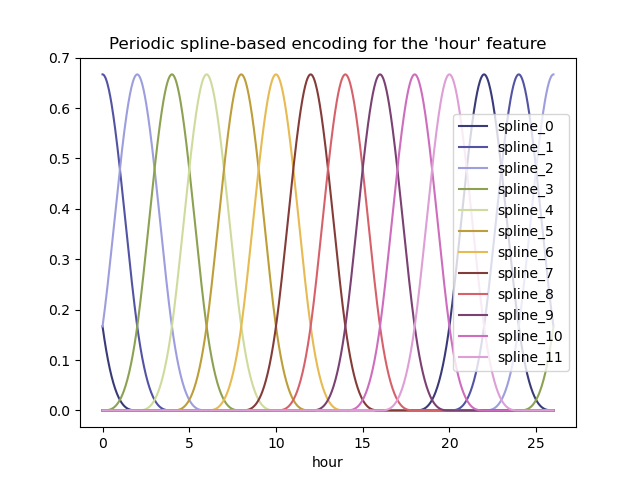
Periodic spline-based encoding for the 'hour' feature

Thanks to the use of the extrapolation="periodic" parameter, we observe that the feature encoding stays smooth when extrapolating beyond midnight.

We can now build a predictive pipeline using this alternative periodic feature engineering strategy.

It is possible to use fewer splines than discrete levels for those ordinal values. This makes spline-based encoding more efficient than one-hot encoding while preserving most of the expressivity:

cyclic_spline_transformer = ColumnTransformer(
    transformers=[
        ("categorical", one_hot_encoder, categorical_columns),
        ("cyclic_month", periodic_spline_transformer(12, n_splines=6), ["month"]),
        ("cyclic_weekday", periodic_spline_transformer(7, n_splines=3), ["weekday"]),
        ("cyclic_hour", periodic_spline_transformer(24, n_splines=12), ["hour"]),
    ],
    remainder=MinMaxScaler(),
    verbose_feature_names_out=False,
)
cyclic_spline_linear_pipeline = make_pipeline(
    cyclic_spline_transformer,
    RidgeCV(alphas=alphas),
)
evaluate(cyclic_spline_linear_pipeline, X, y, cv=ts_cv)
Mean Absolute Error:     0.097 +/- 0.011
Root Mean Squared Error: 0.132 +/- 0.013
Pipeline(steps=[('columntransformer',
                 ColumnTransformer(remainder=MinMaxScaler(),
                                   transformers=[('categorical',
                                                  OneHotEncoder(handle_unknown='ignore',
                                                                sparse_output=False),
                                                  Index(['season', 'holiday', 'workingday', 'weather'], dtype='str')),
                                                 ('cyclic_month',
                                                  SplineTransformer(extrapolation='periodic',
                                                                    knots=array([[ 0.],
       [ 2.],
       [ 4.],
       [ 6.],
       [ 8.],
       [10.],
       [12.]]),
                                                                    n_knots...
                 RidgeCV(alphas=array([1.00000000e-06, 3.16227766e-06, 1.00000000e-05, 3.16227766e-05,
       1.00000000e-04, 3.16227766e-04, 1.00000000e-03, 3.16227766e-03,
       1.00000000e-02, 3.16227766e-02, 1.00000000e-01, 3.16227766e-01,
       1.00000000e+00, 3.16227766e+00, 1.00000000e+01, 3.16227766e+01,
       1.00000000e+02, 3.16227766e+02, 1.00000000e+03, 3.16227766e+03,
       1.00000000e+04, 3.16227766e+04, 1.00000000e+05, 3.16227766e+05,
       1.00000000e+06])))])
In a Jupyter environment, please rerun this cell to show the HTML representation or trust the notebook.
On GitHub, the HTML representation is unable to render, please try loading this page with nbviewer.org.
Parameters
steps steps: list of tuples

List of (name of step, estimator) tuples that are to be chained in
sequential order. To be compatible with the scikit-learn API, all steps
must define `fit`. All non-last steps must also define `transform`. See
:ref:`Combining Estimators <combining_estimators>` for more details.
[('columntransformer', ...), ('ridgecv', ...)]
transform_input transform_input: list of str, default=None

The names of the :term:`metadata` parameters that should be transformed by the
pipeline before passing it to the step consuming it.

This enables transforming some input arguments to ``fit`` (other than ``X``)
to be transformed by the steps of the pipeline up to the step which requires
them. Requirement is defined via :ref:`metadata routing <metadata_routing>`.
For instance, this can be used to pass a validation set through the pipeline.

You can only set this if metadata routing is enabled, which you
can enable using ``sklearn.set_config(enable_metadata_routing=True)``.

.. versionadded:: 1.6
None
memory memory: str or object with the joblib.Memory interface, default=None

Used to cache the fitted transformers of the pipeline. The last step
will never be cached, even if it is a transformer. By default, no
caching is performed. If a string is given, it is the path to the
caching directory. Enabling caching triggers a clone of the transformers
before fitting. Therefore, the transformer instance given to the
pipeline cannot be inspected directly. Use the attribute ``named_steps``
or ``steps`` to inspect estimators within the pipeline. Caching the
transformers is advantageous when fitting is time consuming. See
:ref:`sphx_glr_auto_examples_neighbors_plot_caching_nearest_neighbors.py`
for an example on how to enable caching.
None
verbose verbose: bool, default=False

If True, the time elapsed while fitting each step will be printed as it
is completed.
False
Fitted attributes
Name Type Value
feature_names_in_ feature_names_in_: ndarray of shape (`n_features_in_`,)

Names of features seen during :term:`fit`. Only defined if the
underlying estimator exposes such an attribute when fit.

.. versionadded:: 1.0
ndarray[object](12,) ['season','year','month',...,'feel_temp','humidity','windspeed']
n_features_in_ n_features_in_: int

Number of features seen during :term:`fit`. Only defined if the
underlying first estimator in `steps` exposes such an attribute
when fit.

.. versionadded:: 0.24
int 12
Parameters
transformers transformers: list of tuples

List of (name, transformer, columns) tuples specifying the
transformer objects to be applied to subsets of the data.

name : str
Like in Pipeline and FeatureUnion, this allows the transformer and
its parameters to be set using ``set_params`` and searched in grid
search.
transformer : {'drop', 'passthrough'} or estimator
Estimator must support :term:`fit` and :term:`transform`.
Special-cased strings 'drop' and 'passthrough' are accepted as
well, to indicate to drop the columns or to pass them through
untransformed, respectively.
columns : str, array-like of str, int, array-like of int, array-like of bool, slice or callable
Indexes the data on its second axis. Integers are interpreted as
positional columns, while strings can reference DataFrame columns
by name. A scalar string or int should be used where
``transformer`` expects X to be a 1d array-like (vector),
otherwise a 2d array will be passed to the transformer.
A callable is passed the input data `X` and can return any of the
above. To select multiple columns by name or dtype, you can use
:obj:`make_column_selector`.
[('categorical', ...), ('cyclic_month', ...), ...]
remainder remainder: {'drop', 'passthrough'} or estimator, default='drop'

By default, only the specified columns in `transformers` are
transformed and combined in the output, and the non-specified
columns are dropped. (default of ``'drop'``).
By specifying ``remainder='passthrough'``, all remaining columns that
were not specified in `transformers`, but present in the data passed
to `fit` will be automatically passed through. This subset of columns
is concatenated with the output of the transformers. For dataframes,
extra columns not seen during `fit` will be excluded from the output
of `transform`.
By setting ``remainder`` to be an estimator, the remaining
non-specified columns will use the ``remainder`` estimator. The
estimator must support :term:`fit` and :term:`transform`.
Note that using this feature requires that the DataFrame columns
input at :term:`fit` and :term:`transform` have identical order.
MinMaxScaler()
verbose_feature_names_out verbose_feature_names_out: bool, str or Callable[[str, str], str], default=True

- If True, :meth:`ColumnTransformer.get_feature_names_out` will prefix
all feature names with the name of the transformer that generated that
feature. It is equivalent to setting
`verbose_feature_names_out="{transformer_name}__{feature_name}"`.
- If False, :meth:`ColumnTransformer.get_feature_names_out` will not
prefix any feature names and will error if feature names are not
unique.
- If ``Callable[[str, str], str]``,
:meth:`ColumnTransformer.get_feature_names_out` will rename all the features
using the name of the transformer. The first argument of the callable is the
transformer name and the second argument is the feature name. The returned
string will be the new feature name.
- If ``str``, it must be a string ready for formatting. The given string will
be formatted using two field names: ``transformer_name`` and ``feature_name``.
e.g. ``"{feature_name}__{transformer_name}"``. See :meth:`str.format` method
from the standard library for more info.

.. versionadded:: 1.0

.. versionchanged:: 1.6
`verbose_feature_names_out` can be a callable or a string to be formatted.
False
sparse_threshold sparse_threshold: float, default=0.3

If the output of the different transformers contains sparse matrices,
these will be stacked as a sparse matrix if the overall density is
lower than this value. Use ``sparse_threshold=0`` to always return
dense. When the transformed output consists of all dense data, the
stacked result will be dense, and this keyword will be ignored.
0.3
n_jobs n_jobs: int, default=None

Number of jobs to run in parallel.
``None`` means 1 unless in a :obj:`joblib.parallel_backend` context.
``-1`` means using all processors. See :term:`Glossary <n_jobs>`
for more details.
None
transformer_weights transformer_weights: dict, default=None

Multiplicative weights for features per transformer. The output of the
transformer is multiplied by these weights. Keys are transformer names,
values the weights.
None
verbose verbose: bool, default=False

If True, the time elapsed while fitting each transformer will be
printed as it is completed.
False
Fitted attributes
Name Type Value
feature_names_in_ feature_names_in_: ndarray of shape (`n_features_in_`,)

Names of features seen during :term:`fit`. Defined only when `X`
has feature names that are all strings.

.. versionadded:: 1.0
ndarray[object](12,) ['season','year','month',...,'feel_temp','humidity','windspeed']
n_features_in_ n_features_in_: int

Number of features seen during :term:`fit`. Only defined if the
underlying transformers expose such an attribute when fit.

.. versionadded:: 0.24
int 12
named_transformers_ named_transformers_: :class:`~sklearn.utils.Bunch`

Read-only attribute to access any transformer by given name.
Keys are transformer names and values are the fitted transformer
objects.
Bunch {'categorical...inMaxScaler()}
output_indices_ output_indices_: dict

A dictionary from each transformer name to a slice, where the slice
corresponds to indices in the transformed output. This is useful to
inspect which transformer is responsible for which transformed
feature(s).

.. versionadded:: 1.0
dict {'ca...al': slice(0, 11, None), 'cy...ur': slice(20, 32, None), 'cy...th': slice(11, 17, None), 'cy...ay': slice(17, 20, None), ...}
sparse_output_ sparse_output_: bool

Boolean flag indicating whether the output of ``transform`` is a
sparse matrix or a dense numpy array, which depends on the output
of the individual transformers and the `sparse_threshold` keyword.
bool False
transformers_ transformers_: list

The collection of fitted transformers as tuples of (name,
fitted_transformer, column). `fitted_transformer` can be an estimator,
or `'drop'`; `'passthrough'` is replaced with an equivalent
:class:`~sklearn.preprocessing.FunctionTransformer`. In case there were
no columns selected, this will be the unfitted transformer. If there
are remaining columns, the final element is a tuple of the form:
('remainder', transformer, remaining_columns) corresponding to the
``remainder`` parameter. If there are remaining columns, then
``len(transformers_)==len(transformers)+1``, otherwise
``len(transformers_)==len(transformers)``.

.. versionadded:: 1.7
The format of the remaining columns now attempts to match that of the other
transformers: if all columns were provided as column names (`str`), the
remaining columns are stored as column names; if all columns were provided
as mask arrays (`bool`), so are the remaining columns; in all other cases
the remaining columns are stored as indices (`int`).
list [('ca...al', OneHotEncoder..._output=False), Index(['seaso..., dtype='str')), ('cy...th', SplineTransfo... n_knots=7), ['month']), ('cy...ay', SplineTransfo... n_knots=4), ['weekday']), ('cy...ur', SplineTransfo... n_knots=13), ['hour']), ...]
Index(['season', 'holiday', 'workingday', 'weather'], dtype='str')
Parameters
sparse_output sparse_output: bool, default=True

When ``True``, it returns a SciPy sparse matrix/array
in "Compressed Sparse Row" (CSR) format.

.. versionadded:: 1.2
`sparse` was renamed to `sparse_output`
False
handle_unknown handle_unknown: {'error', 'ignore', 'infrequent_if_exist', 'warn'}, default='error'

Specifies the way unknown categories are handled during :meth:`transform`.

- 'error' : Raise an error if an unknown category is present during transform.
- 'ignore' : When an unknown category is encountered during
transform, the resulting one-hot encoded columns for this feature
will be all zeros. In the inverse transform, an unknown category
will be denoted as None.
- 'infrequent_if_exist' : When an unknown category is encountered
during transform, the resulting one-hot encoded columns for this
feature will map to the infrequent category if it exists. The
infrequent category will be mapped to the last position in the
encoding. During inverse transform, an unknown category will be
mapped to the category denoted `'infrequent'` if it exists. If the
`'infrequent'` category does not exist, then :meth:`transform` and
:meth:`inverse_transform` will handle an unknown category as with
`handle_unknown='ignore'`. Infrequent categories exist based on
`min_frequency` and `max_categories`. Read more in the
:ref:`User Guide <encoder_infrequent_categories>`.
- 'warn' : When an unknown category is encountered during transform
a warning is issued, and the encoding then proceeds as described for
`handle_unknown="infrequent_if_exist"`.

.. versionchanged:: 1.1
`'infrequent_if_exist'` was added to automatically handle unknown
categories and infrequent categories.

.. versionadded:: 1.6
The option `"warn"` was added in 1.6.
'ignore'
categories categories: 'auto' or a list of array-like, default='auto'

Categories (unique values) per feature:

- 'auto' : Determine categories automatically from the training data.
- list : ``categories[i]`` holds the categories expected in the ith
column. The passed categories should not mix strings and numeric
values within a single feature, and should be sorted in case of
numeric values.

The used categories can be found in the ``categories_`` attribute.

.. versionadded:: 0.20
'auto'
drop drop: {'first', 'if_binary'} or an array-like of shape (n_features,), default=None

Specifies a methodology to use to drop one of the categories per
feature. This is useful in situations where perfectly collinear
features cause problems, such as when feeding the resulting data
into an unregularized linear regression model.

However, dropping one category breaks the symmetry of the original
representation and can therefore induce a bias in downstream models,
for instance for penalized linear classification or regression models.

- None : retain all features (the default).
- 'first' : drop the first category in each feature. If only one
category is present, the feature will be dropped entirely.
- 'if_binary' : drop the first category in each feature with two
categories. Features with 1 or more than 2 categories are
left intact.
- array : ``drop[i]`` is the category in feature ``X[:, i]`` that
should be dropped.

When `max_categories` or `min_frequency` is configured to group
infrequent categories, the dropping behavior is handled after the
grouping.

.. versionadded:: 0.21
The parameter `drop` was added in 0.21.

.. versionchanged:: 0.23
The option `drop='if_binary'` was added in 0.23.

.. versionchanged:: 1.1
Support for dropping infrequent categories.
None
dtype dtype: number type, default=np.float64

Desired dtype of output.
<class 'numpy.float64'>
min_frequency min_frequency: int or float, default=None

Specifies the minimum frequency below which a category will be
considered infrequent.

- If `int`, categories with a smaller cardinality will be considered
infrequent.

- If `float`, categories with a smaller cardinality than
`min_frequency * n_samples` will be considered infrequent.

.. versionadded:: 1.1
Read more in the :ref:`User Guide <encoder_infrequent_categories>`.
None
max_categories max_categories: int, default=None

Specifies an upper limit to the number of output features for each input
feature when considering infrequent categories. If there are infrequent
categories, `max_categories` includes the category representing the
infrequent categories along with the frequent categories. If `None`,
there is no limit to the number of output features.

.. versionadded:: 1.1
Read more in the :ref:`User Guide <encoder_infrequent_categories>`.
None
feature_name_combiner feature_name_combiner: "concat" or callable, default="concat"

Callable with signature `def callable(input_feature, category)` that returns a
string. This is used to create feature names to be returned by
:meth:`get_feature_names_out`.

`"concat"` concatenates encoded feature name and category with
`feature + "_" + str(category)`.E.g. feature X with values 1, 6, 7 create
feature names `X_1, X_6, X_7`.

.. versionadded:: 1.3
'concat'
Fitted attributes
Name Type Value
categories_ categories_: list of arrays

The categories of each feature determined during fitting
(in order of the features in X and corresponding with the output
of ``transform``). This includes the category specified in ``drop``
(if any).
list [array(['fall'... dtype=object), array(['False... dtype=object), array(['False... dtype=object), array(['clear... dtype=object)]
drop_idx_ drop_idx_: array of shape (n_features,)

- ``drop_idx_[i]`` is the index in ``categories_[i]`` of the category
to be dropped for each feature.
- ``drop_idx_[i] = None`` if no category is to be dropped from the
feature with index ``i``, e.g. when `drop='if_binary'` and the
feature isn't binary.
- ``drop_idx_ = None`` if all the transformed features will be
retained.

If infrequent categories are enabled by setting `min_frequency` or
`max_categories` to a non-default value and `drop_idx[i]` corresponds
to an infrequent category, then the entire infrequent category is
dropped.

.. versionchanged:: 0.23
Added the possibility to contain `None` values.
NoneType None
feature_names_in_ feature_names_in_: ndarray of shape (`n_features_in_`,)

Names of features seen during :term:`fit`. Defined only when `X`
has feature names that are all strings.

.. versionadded:: 1.0
ndarray[object](4,) ['season','holiday','workingday','weather']
n_features_in_ n_features_in_: int

Number of features seen during :term:`fit`.

.. versionadded:: 1.0
int 4
11 features
season_fall
season_spring
season_summer
season_winter
holiday_False
holiday_True
workingday_False
workingday_True
weather_clear
weather_misty
weather_rain
['month']
Parameters
n_knots n_knots: int, default=5

Number of knots of the splines if `knots` equals one of
{'uniform', 'quantile'}. Must be larger or equal 2. Ignored if `knots`
is array-like.
7
knots knots: {'uniform', 'quantile'} or array-like of shape (n_knots, n_features), default='uniform'

Set knot positions such that first knot <= features <= last knot.

- If 'uniform', `n_knots` number of knots are distributed uniformly
from min to max values of the features.
- If 'quantile', they are distributed uniformly along the quantiles of
the features.
- If an array-like is given, it directly specifies the sorted knot
positions including the boundary knots. Note that, internally,
`degree` number of knots are added before the first knot, the same
after the last knot.
array([[ 0.],... [12.]])
extrapolation extrapolation: {'error', 'constant', 'linear', 'continue', 'periodic'}, default='constant'

If 'error', values outside the min and max values of the training
features raises a `ValueError`. If 'constant', the value of the
splines at minimum and maximum value of the features is used as
constant extrapolation. If 'linear', a linear extrapolation is used.
If 'continue', the splines are extrapolated as is, i.e. option
`extrapolate=True` in :class:`scipy.interpolate.BSpline`. If
'periodic', periodic splines with a periodicity equal to the distance
between the first and last knot are used. Periodic splines enforce
equal function values and derivatives at the first and last knot.
For example, this makes it possible to avoid introducing an arbitrary
jump between Dec 31st and Jan 1st in spline features derived from a
naturally periodic "day-of-year" input feature. In this case it is
recommended to manually set the knot values to control the period.
'periodic'
degree degree: int, default=3

The polynomial degree of the spline basis. Must be a non-negative
integer.
3
include_bias include_bias: bool, default=True

If False, then the last spline element inside the data range
of a feature is dropped. As B-splines sum to one over the spline basis
functions for each data point, they implicitly include a bias term,
i.e. a column of ones. It acts as an intercept term in a linear models.
True
order order: {'C', 'F'}, default='C'

Order of output array in the dense case. `'F'` order is faster to compute, but
may slow down subsequent estimators.
'C'
handle_missing handle_missing: {'error', 'zeros'}, default='error'

Specifies the way missing values are handled.

- 'error' : Raise an error if `np.nan` values are present during :meth:`fit`.
- 'zeros' : Encode splines of missing values with values `0`.

Note that `handle_missing='zeros'` differs from first imputing missing values
with zeros and then creating the spline basis. The latter creates spline basis
functions which have non-zero values at the missing values
whereas this option simply sets all spline basis function values to zero at the
missing values.

.. versionadded:: 1.8
'error'
sparse_output sparse_output: bool, default=False

Will return sparse CSR matrix if set True else will return an array.

.. versionadded:: 1.2
False
Fitted attributes
Name Type Value
bsplines_ bsplines_: list of shape (n_features,)

List of BSplines objects, one for each feature.
list [<scipy.interp...x7b28346da9d0>]
feature_names_in_ feature_names_in_: ndarray of shape (`n_features_in_`,)

Names of features seen during :term:`fit`. Defined only when `X`
has feature names that are all strings.

.. versionadded:: 1.0
ndarray[object](1,) ['month']
n_features_in_ n_features_in_: int

The total number of input features.
int 1
n_features_out_ n_features_out_: int

The total number of output features, which is computed as
`n_features * n_splines`, where `n_splines` is
the number of bases elements of the B-splines,
`n_knots + degree - 1` for non-periodic splines and
`n_knots - 1` for periodic ones.
If `include_bias=False`, then it is only
`n_features * (n_splines - 1)`.
int 6
6 features
month_sp_0
month_sp_1
month_sp_2
month_sp_3
month_sp_4
month_sp_5
['weekday']
Parameters
n_knots n_knots: int, default=5

Number of knots of the splines if `knots` equals one of
{'uniform', 'quantile'}. Must be larger or equal 2. Ignored if `knots`
is array-like.
4
knots knots: {'uniform', 'quantile'} or array-like of shape (n_knots, n_features), default='uniform'

Set knot positions such that first knot <= features <= last knot.

- If 'uniform', `n_knots` number of knots are distributed uniformly
from min to max values of the features.
- If 'quantile', they are distributed uniformly along the quantiles of
the features.
- If an array-like is given, it directly specifies the sorted knot
positions including the boundary knots. Note that, internally,
`degree` number of knots are added before the first knot, the same
after the last knot.
array([[0. ...[7. ]])
extrapolation extrapolation: {'error', 'constant', 'linear', 'continue', 'periodic'}, default='constant'

If 'error', values outside the min and max values of the training
features raises a `ValueError`. If 'constant', the value of the
splines at minimum and maximum value of the features is used as
constant extrapolation. If 'linear', a linear extrapolation is used.
If 'continue', the splines are extrapolated as is, i.e. option
`extrapolate=True` in :class:`scipy.interpolate.BSpline`. If
'periodic', periodic splines with a periodicity equal to the distance
between the first and last knot are used. Periodic splines enforce
equal function values and derivatives at the first and last knot.
For example, this makes it possible to avoid introducing an arbitrary
jump between Dec 31st and Jan 1st in spline features derived from a
naturally periodic "day-of-year" input feature. In this case it is
recommended to manually set the knot values to control the period.
'periodic'
degree degree: int, default=3

The polynomial degree of the spline basis. Must be a non-negative
integer.
3
include_bias include_bias: bool, default=True

If False, then the last spline element inside the data range
of a feature is dropped. As B-splines sum to one over the spline basis
functions for each data point, they implicitly include a bias term,
i.e. a column of ones. It acts as an intercept term in a linear models.
True
order order: {'C', 'F'}, default='C'

Order of output array in the dense case. `'F'` order is faster to compute, but
may slow down subsequent estimators.
'C'
handle_missing handle_missing: {'error', 'zeros'}, default='error'

Specifies the way missing values are handled.

- 'error' : Raise an error if `np.nan` values are present during :meth:`fit`.
- 'zeros' : Encode splines of missing values with values `0`.

Note that `handle_missing='zeros'` differs from first imputing missing values
with zeros and then creating the spline basis. The latter creates spline basis
functions which have non-zero values at the missing values
whereas this option simply sets all spline basis function values to zero at the
missing values.

.. versionadded:: 1.8
'error'
sparse_output sparse_output: bool, default=False

Will return sparse CSR matrix if set True else will return an array.

.. versionadded:: 1.2
False
Fitted attributes
Name Type Value
bsplines_ bsplines_: list of shape (n_features,)

List of BSplines objects, one for each feature.
list [<scipy.interp...x7b28346dbed0>]
feature_names_in_ feature_names_in_: ndarray of shape (`n_features_in_`,)

Names of features seen during :term:`fit`. Defined only when `X`
has feature names that are all strings.

.. versionadded:: 1.0
ndarray[object](1,) ['weekday']
n_features_in_ n_features_in_: int

The total number of input features.
int 1
n_features_out_ n_features_out_: int

The total number of output features, which is computed as
`n_features * n_splines`, where `n_splines` is
the number of bases elements of the B-splines,
`n_knots + degree - 1` for non-periodic splines and
`n_knots - 1` for periodic ones.
If `include_bias=False`, then it is only
`n_features * (n_splines - 1)`.
int 3
3 features
weekday_sp_0
weekday_sp_1
weekday_sp_2
['hour']
Parameters
n_knots n_knots: int, default=5

Number of knots of the splines if `knots` equals one of
{'uniform', 'quantile'}. Must be larger or equal 2. Ignored if `knots`
is array-like.
13
knots knots: {'uniform', 'quantile'} or array-like of shape (n_knots, n_features), default='uniform'

Set knot positions such that first knot <= features <= last knot.

- If 'uniform', `n_knots` number of knots are distributed uniformly
from min to max values of the features.
- If 'quantile', they are distributed uniformly along the quantiles of
the features.
- If an array-like is given, it directly specifies the sorted knot
positions including the boundary knots. Note that, internally,
`degree` number of knots are added before the first knot, the same
after the last knot.
array([[ 0.],... [24.]])
extrapolation extrapolation: {'error', 'constant', 'linear', 'continue', 'periodic'}, default='constant'

If 'error', values outside the min and max values of the training
features raises a `ValueError`. If 'constant', the value of the
splines at minimum and maximum value of the features is used as
constant extrapolation. If 'linear', a linear extrapolation is used.
If 'continue', the splines are extrapolated as is, i.e. option
`extrapolate=True` in :class:`scipy.interpolate.BSpline`. If
'periodic', periodic splines with a periodicity equal to the distance
between the first and last knot are used. Periodic splines enforce
equal function values and derivatives at the first and last knot.
For example, this makes it possible to avoid introducing an arbitrary
jump between Dec 31st and Jan 1st in spline features derived from a
naturally periodic "day-of-year" input feature. In this case it is
recommended to manually set the knot values to control the period.
'periodic'
degree degree: int, default=3

The polynomial degree of the spline basis. Must be a non-negative
integer.
3
include_bias include_bias: bool, default=True

If False, then the last spline element inside the data range
of a feature is dropped. As B-splines sum to one over the spline basis
functions for each data point, they implicitly include a bias term,
i.e. a column of ones. It acts as an intercept term in a linear models.
True
order order: {'C', 'F'}, default='C'

Order of output array in the dense case. `'F'` order is faster to compute, but
may slow down subsequent estimators.
'C'
handle_missing handle_missing: {'error', 'zeros'}, default='error'

Specifies the way missing values are handled.

- 'error' : Raise an error if `np.nan` values are present during :meth:`fit`.
- 'zeros' : Encode splines of missing values with values `0`.

Note that `handle_missing='zeros'` differs from first imputing missing values
with zeros and then creating the spline basis. The latter creates spline basis
functions which have non-zero values at the missing values
whereas this option simply sets all spline basis function values to zero at the
missing values.

.. versionadded:: 1.8
'error'
sparse_output sparse_output: bool, default=False

Will return sparse CSR matrix if set True else will return an array.

.. versionadded:: 1.2
False
Fitted attributes
Name Type Value
bsplines_ bsplines_: list of shape (n_features,)

List of BSplines objects, one for each feature.
list [<scipy.interp...x7b28346d87d0>]
feature_names_in_ feature_names_in_: ndarray of shape (`n_features_in_`,)

Names of features seen during :term:`fit`. Defined only when `X`
has feature names that are all strings.

.. versionadded:: 1.0
ndarray[object](1,) ['hour']
n_features_in_ n_features_in_: int

The total number of input features.
int 1
n_features_out_ n_features_out_: int

The total number of output features, which is computed as
`n_features * n_splines`, where `n_splines` is
the number of bases elements of the B-splines,
`n_knots + degree - 1` for non-periodic splines and
`n_knots - 1` for periodic ones.
If `include_bias=False`, then it is only
`n_features * (n_splines - 1)`.
int 12
12 features
hour_sp_0
hour_sp_1
hour_sp_2
hour_sp_3
hour_sp_4
hour_sp_5
hour_sp_6
hour_sp_7
hour_sp_8
hour_sp_9
hour_sp_10
hour_sp_11
['year', 'temp', 'feel_temp', 'humidity', 'windspeed']
Parameters
feature_range feature_range: tuple (min, max), default=(0, 1)

Desired range of transformed data.
(0, ...)
copy copy: bool, default=True

Set to False to perform inplace row normalization and avoid a
copy (if the input is already a numpy array).
True
clip clip: bool, default=False

Set to True to clip transformed values of held-out data to
provided `feature_range`.
Since this parameter will clip values, `inverse_transform` may not
be able to restore the original data.

.. note::
Setting `clip=True` does not prevent feature drift (a distribution
shift between training and test data). The transformed values are clipped
to the `feature_range`, which helps avoid unintended behavior in models
sensitive to out-of-range inputs (e.g. linear models). Use with care,
as clipping can distort the distribution of test data.

.. versionadded:: 0.24
False
Fitted attributes
Name Type Value
data_max_ data_max_: ndarray of shape (n_features,)

Per feature maximum seen in the data

.. versionadded:: 0.17
*data_max_*
ndarray[float64](5,) [ 1. ,39.36,50. , 1. ,57. ]
data_min_ data_min_: ndarray of shape (n_features,)

Per feature minimum seen in the data

.. versionadded:: 0.17
*data_min_*
ndarray[float64](5,) [0. ,0.82,0.76,0.16,0. ]
data_range_ data_range_: ndarray of shape (n_features,)

Per feature range ``(data_max_ - data_min_)`` seen in the data

.. versionadded:: 0.17
*data_range_*
ndarray[float64](5,) [ 1. ,38.54,49.24, 0.84,57. ]
feature_names_in_ feature_names_in_: ndarray of shape (`n_features_in_`,)

Names of features seen during :term:`fit`. Defined only when `X`
has feature names that are all strings.

.. versionadded:: 1.0
ndarray[object](5,) ['year','temp','feel_temp','humidity','windspeed']
min_ min_: ndarray of shape (n_features,)

Per feature adjustment for minimum. Equivalent to
``min - X.min(axis=0) * self.scale_``
ndarray[float64](5,) [ 0. ,-0.02,-0.02,-0.19, 0. ]
n_features_in_ n_features_in_: int

Number of features seen during :term:`fit`.

.. versionadded:: 0.24
int 5
n_samples_seen_ n_samples_seen_: int

The number of samples processed by the estimator.
It will be reset on new calls to fit, but increments across
``partial_fit`` calls.
int 10000
scale_ scale_: ndarray of shape (n_features,)

Per feature relative scaling of the data. Equivalent to
``(max - min) / (X.max(axis=0) - X.min(axis=0))``

.. versionadded:: 0.17
*scale_* attribute.
ndarray[float64](5,) [1. ,0.03,0.02,1.19,0.02]
5 features
year
temp
feel_temp
humidity
windspeed
37 features
season_fall
season_spring
season_summer
season_winter
holiday_False
holiday_True
workingday_False
workingday_True
weather_clear
weather_misty
weather_rain
month_sp_0
month_sp_1
month_sp_2
month_sp_3
month_sp_4
month_sp_5
weekday_sp_0
weekday_sp_1
weekday_sp_2
hour_sp_0
hour_sp_1
hour_sp_2
hour_sp_3
hour_sp_4
hour_sp_5
hour_sp_6
hour_sp_7
hour_sp_8
hour_sp_9
hour_sp_10
hour_sp_11
year
temp
feel_temp
humidity
windspeed
Parameters
alphas alphas: array-like of shape (n_alphas,), default=(0.1, 1.0, 10.0)

Array of alpha values to try.
Regularization strength; must be a positive float. Regularization
improves the conditioning of the problem and reduces the variance of
the estimates. Larger values specify stronger regularization.
Alpha corresponds to ``1 / (2C)`` in other linear models such as
:class:`~sklearn.linear_model.LogisticRegression` or
:class:`~sklearn.svm.LinearSVC`.
If using Leave-One-Out cross-validation, alphas must be strictly positive.

For an example on how regularization strength affects the model coefficients,
see :ref:`sphx_glr_auto_examples_linear_model_plot_ridge_coeffs.py`.
array([1.0000...00000000e+06])
fit_intercept fit_intercept: bool, default=True

Whether to calculate the intercept for this model. If set
to false, no intercept will be used in calculations
(i.e. data is expected to be centered).
True
scoring scoring: str, callable, default=None

The scoring method to use for cross-validation. Options:

- str: see :ref:`scoring_string_names` for options.
- callable: a scorer callable object (e.g., function) with signature
``scorer(estimator, X, y)``. See :ref:`scoring_callable` for details.
- `None`: negative :ref:`mean squared error <mean_squared_error>` if cv is
None (i.e. when using leave-one-out cross-validation), or
:ref:`coefficient of determination <r2_score>` (:math:`R^2`) otherwise.
None
cv cv: int, cross-validation generator or an iterable, default=None

Determines the cross-validation splitting strategy.
Possible inputs for cv are:

- None, to use the efficient Leave-One-Out cross-validation
- integer, to specify the number of folds,
- :term:`CV splitter`,
- an iterable yielding (train, test) splits as arrays of indices.

For integer/None inputs, if ``y`` is binary or multiclass,
:class:`~sklearn.model_selection.StratifiedKFold` is used, else,
:class:`~sklearn.model_selection.KFold` is used.

Refer :ref:`User Guide <cross_validation>` for the various
cross-validation strategies that can be used here.
None
gcv_mode gcv_mode: {'auto', 'svd', 'eigen'}, default='auto'

Flag indicating which strategy to use when performing
Leave-One-Out Cross-Validation. Options are::

'auto' : same as 'eigen'
'svd' : use singular value decomposition of X when X is dense,
fallback to 'eigen' when X is sparse
'eigen' : use eigendecomposition of X X' when n_samples <= n_features
or X' X when n_features < n_samples

The 'auto' mode is the default and is intended to pick the cheaper
option depending on the shape and sparsity of the training data.
None
store_cv_results store_cv_results: bool, default=False

Flag indicating if the cross-validation values corresponding to
each alpha should be stored in the ``cv_results_`` attribute (see
below). This flag is only compatible with ``cv=None`` (i.e. using
Leave-One-Out Cross-Validation).

.. versionchanged:: 1.5
Parameter name changed from `store_cv_values` to `store_cv_results`.
False
alpha_per_target alpha_per_target: bool, default=False

Flag indicating whether to optimize the alpha value (picked from the
`alphas` parameter list) for each target separately (for multi-output
settings: multiple prediction targets). When set to `True`, after
fitting, the `alpha_` attribute will contain a value for each target.
When set to `False`, a single alpha is used for all targets.

.. versionadded:: 0.24
False
Fitted attributes
Name Type Value
alpha_ alpha_: float or ndarray of shape (n_targets,)

Estimated regularization parameter, or, if ``alpha_per_target=True``,
the estimated regularization parameter for each target.
float 1
best_score_ best_score_: float or ndarray of shape (n_targets,)

Score of base estimator with best alpha, or, if
``alpha_per_target=True``, a score for each target.

.. versionadded:: 0.23
float64 -0.008547
coef_ coef_: ndarray of shape (n_features) or (n_targets, n_features)

Weight vector(s).
ndarray[float64](37,) [ 0. ,-0.03, 0.01,..., 0.15,-0.06,-0.04]
intercept_ intercept_: float or ndarray of shape (n_targets,)

Independent term in decision function. Set to 0.0 if
``fit_intercept = False``.
float64 0.03652
n_features_in_ n_features_in_: int

Number of features seen during :term:`fit`.

.. versionadded:: 0.24
int 37


Spline features make it possible for the linear model to successfully leverage the periodic time-related features and reduce the error from ~14% to ~10% of the maximum demand, which is similar to what we observed with the one-hot encoded features.

Qualitative analysis of the impact of features on linear model predictions#

Here, we want to visualize the impact of the feature engineering choices on the time related shape of the predictions.

To do so we consider an arbitrary time-based split to compare the predictions on a range of held out data points.

naive_linear_pipeline.fit(X.iloc[train_0], y.iloc[train_0])
naive_linear_predictions = naive_linear_pipeline.predict(X.iloc[test_0])

one_hot_linear_pipeline.fit(X.iloc[train_0], y.iloc[train_0])
one_hot_linear_predictions = one_hot_linear_pipeline.predict(X.iloc[test_0])

cyclic_cossin_linear_pipeline.fit(X.iloc[train_0], y.iloc[train_0])
cyclic_cossin_linear_predictions = cyclic_cossin_linear_pipeline.predict(X.iloc[test_0])

cyclic_spline_linear_pipeline.fit(X.iloc[train_0], y.iloc[train_0])
cyclic_spline_linear_predictions = cyclic_spline_linear_pipeline.predict(X.iloc[test_0])

We visualize those predictions by zooming on the last 96 hours (4 days) of the test set to get some qualitative insights:

last_hours = slice(-96, None)
fig, ax = plt.subplots(figsize=(12, 4))
fig.suptitle("Predictions by linear models")
ax.plot(
    y.iloc[test_0].values[last_hours],
    "x-",
    alpha=0.2,
    label="Actual demand",
    color="black",
)
ax.plot(naive_linear_predictions[last_hours], "x-", label="Ordinal time features")
ax.plot(
    cyclic_cossin_linear_predictions[last_hours],
    "x-",
    label="Trigonometric time features",
)
ax.plot(
    cyclic_spline_linear_predictions[last_hours],
    "x-",
    label="Spline-based time features",
)
ax.plot(
    one_hot_linear_predictions[last_hours],
    "x-",
    label="One-hot time features",
)
_ = ax.legend()
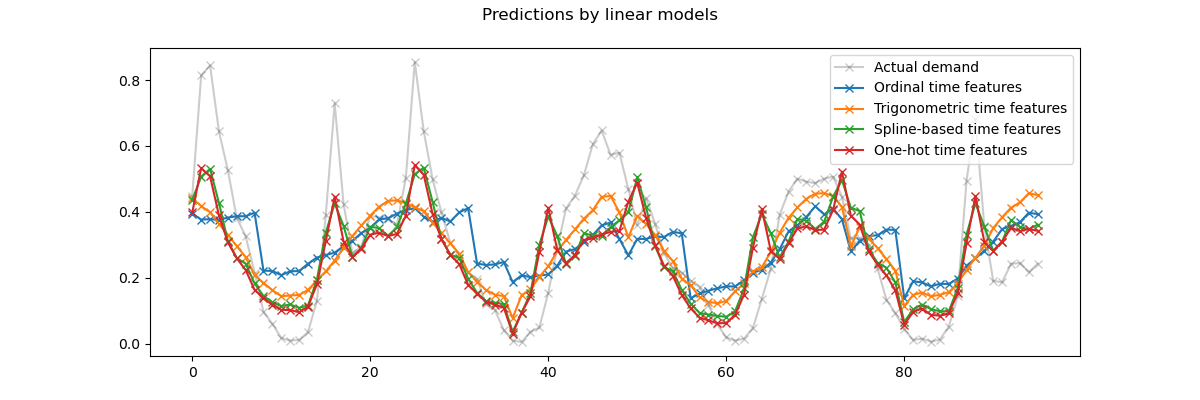
Predictions by linear models

We can draw the following conclusions from the above plot:

  • The raw ordinal time-related features are problematic because they do not capture the natural periodicity: we observe a big jump in the predictions at the end of each day when the hour features goes from 23 back to 0. We can expect similar artifacts at the end of each week or each year.

  • As expected, the trigonometric features (sine and cosine) do not have these discontinuities at midnight, but the linear regression model fails to leverage those features to properly model intra-day variations. Using trigonometric features for higher harmonics or additional trigonometric features for the natural period with different phases could potentially fix this problem.

  • the periodic spline-based features fix those two problems at once: they give more expressivity to the linear model by making it possible to focus on specific hours thanks to the use of 12 splines. Furthermore the extrapolation="periodic" option enforces a smooth representation between hour=23 and hour=0.

  • The one-hot encoded features behave similarly to the periodic spline-based features but are more spiky: for instance they can better model the morning peak during the week days since this peak lasts shorter than an hour. However, we will see in the following that what can be an advantage for linear models is not necessarily one for more expressive models.

We can also compare the number of features extracted by each feature engineering pipeline:

naive_linear_pipeline[:-1].transform(X).shape
(17379, 19)
one_hot_linear_pipeline[:-1].transform(X).shape
(17379, 59)
cyclic_cossin_linear_pipeline[:-1].transform(X).shape
(17379, 22)
cyclic_spline_linear_pipeline[:-1].transform(X).shape
(17379, 37)

This confirms that the one-hot encoding and the spline encoding strategies create a lot more features for the time representation than the alternatives, which in turn gives the downstream linear model more flexibility (degrees of freedom) to avoid underfitting.

Finally, we observe that none of the linear models can approximate the true bike rentals demand, especially for the peaks that can be very sharp at rush hours during the working days but much flatter during the week-ends: the most accurate linear models based on splines or one-hot encoding tend to forecast peaks of commuting-related bike rentals even on the week-ends and under-estimate the commuting-related events during the working days.

These systematic prediction errors reveal a form of under-fitting and can be explained by the lack of interactions terms between features, e.g. “workingday” and features derived from “hours”. This issue will be addressed in the following section.

Modeling pairwise interactions with splines and polynomial features#

Linear models do not automatically capture interaction effects between input features. It does not help that some features are marginally non-linear as is the case with features constructed by SplineTransformer (or one-hot encoding or binning).

However, it is possible to use the PolynomialFeatures class on coarse grained spline encoded hours to model the “workingday”/”hours” interaction explicitly without introducing too many new variables:

from sklearn.pipeline import FeatureUnion
from sklearn.preprocessing import PolynomialFeatures

hour_workday_interaction = make_pipeline(
    ColumnTransformer(
        [
            ("cyclic_hour", periodic_spline_transformer(24, n_splines=8), ["hour"]),
            (
                "workingday",
                FunctionTransformer(
                    lambda x: x == "True", feature_names_out="one-to-one"
                ),
                ["workingday"],
            ),
        ],
        verbose_feature_names_out=False,
    ),
    PolynomialFeatures(degree=2, interaction_only=True, include_bias=False),
)

Those features are then combined with the ones already computed in the previous spline-base pipeline. We can observe a nice performance improvement by modeling this pairwise interaction explicitly:

cyclic_spline_interactions_pipeline = make_pipeline(
    FeatureUnion(
        [
            ("marginal", cyclic_spline_transformer),
            ("interactions", hour_workday_interaction),
        ],
        verbose_feature_names_out=True,
    ).set_output(transform="pandas"),
    RidgeCV(alphas=alphas),
)
evaluate(cyclic_spline_interactions_pipeline, X, y, cv=ts_cv)
Mean Absolute Error:     0.078 +/- 0.009
Root Mean Squared Error: 0.104 +/- 0.009
Pipeline(steps=[('featureunion',
                 FeatureUnion(transformer_list=[('marginal',
                                                 ColumnTransformer(remainder=MinMaxScaler(),
                                                                   transformers=[('categorical',
                                                                                  OneHotEncoder(handle_unknown='ignore',
                                                                                                sparse_output=False),
                                                                                  Index(['season', 'holiday', 'workingday', 'weather'], dtype='str')),
                                                                                 ('cyclic_month',
                                                                                  SplineTransformer(extrapolation='periodic',
                                                                                                    knots=array([[ 0.],
       [ 2....
                 RidgeCV(alphas=array([1.00000000e-06, 3.16227766e-06, 1.00000000e-05, 3.16227766e-05,
       1.00000000e-04, 3.16227766e-04, 1.00000000e-03, 3.16227766e-03,
       1.00000000e-02, 3.16227766e-02, 1.00000000e-01, 3.16227766e-01,
       1.00000000e+00, 3.16227766e+00, 1.00000000e+01, 3.16227766e+01,
       1.00000000e+02, 3.16227766e+02, 1.00000000e+03, 3.16227766e+03,
       1.00000000e+04, 3.16227766e+04, 1.00000000e+05, 3.16227766e+05,
       1.00000000e+06])))])
In a Jupyter environment, please rerun this cell to show the HTML representation or trust the notebook.
On GitHub, the HTML representation is unable to render, please try loading this page with nbviewer.org.
Parameters
steps steps: list of tuples

List of (name of step, estimator) tuples that are to be chained in
sequential order. To be compatible with the scikit-learn API, all steps
must define `fit`. All non-last steps must also define `transform`. See
:ref:`Combining Estimators <combining_estimators>` for more details.
[('featureunion', ...), ('ridgecv', ...)]
transform_input transform_input: list of str, default=None

The names of the :term:`metadata` parameters that should be transformed by the
pipeline before passing it to the step consuming it.

This enables transforming some input arguments to ``fit`` (other than ``X``)
to be transformed by the steps of the pipeline up to the step which requires
them. Requirement is defined via :ref:`metadata routing <metadata_routing>`.
For instance, this can be used to pass a validation set through the pipeline.

You can only set this if metadata routing is enabled, which you
can enable using ``sklearn.set_config(enable_metadata_routing=True)``.

.. versionadded:: 1.6
None
memory memory: str or object with the joblib.Memory interface, default=None

Used to cache the fitted transformers of the pipeline. The last step
will never be cached, even if it is a transformer. By default, no
caching is performed. If a string is given, it is the path to the
caching directory. Enabling caching triggers a clone of the transformers
before fitting. Therefore, the transformer instance given to the
pipeline cannot be inspected directly. Use the attribute ``named_steps``
or ``steps`` to inspect estimators within the pipeline. Caching the
transformers is advantageous when fitting is time consuming. See
:ref:`sphx_glr_auto_examples_neighbors_plot_caching_nearest_neighbors.py`
for an example on how to enable caching.
None
verbose verbose: bool, default=False

If True, the time elapsed while fitting each step will be printed as it
is completed.
False
Fitted attributes
Name Type Value
feature_names_in_ feature_names_in_: ndarray of shape (`n_features_in_`,)

Names of features seen during :term:`fit`. Only defined if the
underlying estimator exposes such an attribute when fit.

.. versionadded:: 1.0
ndarray[object](12,) ['season','year','month',...,'feel_temp','humidity','windspeed']
n_features_in_ n_features_in_: int

Number of features seen during :term:`fit`. Only defined if the
underlying first estimator in `steps` exposes such an attribute
when fit.

.. versionadded:: 0.24
int 12
Parameters
transformer_list transformer_list: list of (str, transformer) tuples

List of transformer objects to be applied to the data. The first
half of each tuple is the name of the transformer. The transformer can
be 'drop' for it to be ignored or can be 'passthrough' for features to
be passed unchanged.

.. versionadded:: 1.1
Added the option `"passthrough"`.

.. versionchanged:: 0.22
Deprecated `None` as a transformer in favor of 'drop'.
[('marginal', ...), ('interactions', ...)]
n_jobs n_jobs: int, default=None

Number of jobs to run in parallel.
``None`` means 1 unless in a :obj:`joblib.parallel_backend` context.
``-1`` means using all processors. See :term:`Glossary <n_jobs>`
for more details.

.. versionchanged:: v0.20
`n_jobs` default changed from 1 to None
None
transformer_weights transformer_weights: dict, default=None

Multiplicative weights for features per transformer.
Keys are transformer names, values the weights.
Raises ValueError if key not present in ``transformer_list``.
None
verbose verbose: bool, default=False

If True, the time elapsed while fitting each transformer will be
printed as it is completed.
False
verbose_feature_names_out verbose_feature_names_out: bool, default=True

If True, :meth:`get_feature_names_out` will prefix all feature names
with the name of the transformer that generated that feature.
If False, :meth:`get_feature_names_out` will not prefix any feature
names and will error if feature names are not unique.

.. versionadded:: 1.5
True
Fitted attributes
Name Type Value
feature_names_in_ feature_names_in_: ndarray of shape (`n_features_in_`,)

Names of features seen during :term:`fit`. Defined only when
`X` has feature names that are all strings.

.. versionadded:: 1.3
ndarray[object](12,) ['season','year','month',...,'feel_temp','humidity','windspeed']
n_features_in_ n_features_in_: int

Number of features seen during :term:`fit`. Only defined if the
underlying first transformer in `transformer_list` exposes such an
attribute when fit.

.. versionadded:: 0.24
int 12
Index(['season', 'holiday', 'workingday', 'weather'], dtype='str')
Parameters
sparse_output sparse_output: bool, default=True

When ``True``, it returns a SciPy sparse matrix/array
in "Compressed Sparse Row" (CSR) format.

.. versionadded:: 1.2
`sparse` was renamed to `sparse_output`
False
handle_unknown handle_unknown: {'error', 'ignore', 'infrequent_if_exist', 'warn'}, default='error'

Specifies the way unknown categories are handled during :meth:`transform`.

- 'error' : Raise an error if an unknown category is present during transform.
- 'ignore' : When an unknown category is encountered during
transform, the resulting one-hot encoded columns for this feature
will be all zeros. In the inverse transform, an unknown category
will be denoted as None.
- 'infrequent_if_exist' : When an unknown category is encountered
during transform, the resulting one-hot encoded columns for this
feature will map to the infrequent category if it exists. The
infrequent category will be mapped to the last position in the
encoding. During inverse transform, an unknown category will be
mapped to the category denoted `'infrequent'` if it exists. If the
`'infrequent'` category does not exist, then :meth:`transform` and
:meth:`inverse_transform` will handle an unknown category as with
`handle_unknown='ignore'`. Infrequent categories exist based on
`min_frequency` and `max_categories`. Read more in the
:ref:`User Guide <encoder_infrequent_categories>`.
- 'warn' : When an unknown category is encountered during transform
a warning is issued, and the encoding then proceeds as described for
`handle_unknown="infrequent_if_exist"`.

.. versionchanged:: 1.1
`'infrequent_if_exist'` was added to automatically handle unknown
categories and infrequent categories.

.. versionadded:: 1.6
The option `"warn"` was added in 1.6.
'ignore'
categories categories: 'auto' or a list of array-like, default='auto'

Categories (unique values) per feature:

- 'auto' : Determine categories automatically from the training data.
- list : ``categories[i]`` holds the categories expected in the ith
column. The passed categories should not mix strings and numeric
values within a single feature, and should be sorted in case of
numeric values.

The used categories can be found in the ``categories_`` attribute.

.. versionadded:: 0.20
'auto'
drop drop: {'first', 'if_binary'} or an array-like of shape (n_features,), default=None

Specifies a methodology to use to drop one of the categories per
feature. This is useful in situations where perfectly collinear
features cause problems, such as when feeding the resulting data
into an unregularized linear regression model.

However, dropping one category breaks the symmetry of the original
representation and can therefore induce a bias in downstream models,
for instance for penalized linear classification or regression models.

- None : retain all features (the default).
- 'first' : drop the first category in each feature. If only one
category is present, the feature will be dropped entirely.
- 'if_binary' : drop the first category in each feature with two
categories. Features with 1 or more than 2 categories are
left intact.
- array : ``drop[i]`` is the category in feature ``X[:, i]`` that
should be dropped.

When `max_categories` or `min_frequency` is configured to group
infrequent categories, the dropping behavior is handled after the
grouping.

.. versionadded:: 0.21
The parameter `drop` was added in 0.21.

.. versionchanged:: 0.23
The option `drop='if_binary'` was added in 0.23.

.. versionchanged:: 1.1
Support for dropping infrequent categories.
None
dtype dtype: number type, default=np.float64

Desired dtype of output.
<class 'numpy.float64'>
min_frequency min_frequency: int or float, default=None

Specifies the minimum frequency below which a category will be
considered infrequent.

- If `int`, categories with a smaller cardinality will be considered
infrequent.

- If `float`, categories with a smaller cardinality than
`min_frequency * n_samples` will be considered infrequent.

.. versionadded:: 1.1
Read more in the :ref:`User Guide <encoder_infrequent_categories>`.
None
max_categories max_categories: int, default=None

Specifies an upper limit to the number of output features for each input
feature when considering infrequent categories. If there are infrequent
categories, `max_categories` includes the category representing the
infrequent categories along with the frequent categories. If `None`,
there is no limit to the number of output features.

.. versionadded:: 1.1
Read more in the :ref:`User Guide <encoder_infrequent_categories>`.
None
feature_name_combiner feature_name_combiner: "concat" or callable, default="concat"

Callable with signature `def callable(input_feature, category)` that returns a
string. This is used to create feature names to be returned by
:meth:`get_feature_names_out`.

`"concat"` concatenates encoded feature name and category with
`feature + "_" + str(category)`.E.g. feature X with values 1, 6, 7 create
feature names `X_1, X_6, X_7`.

.. versionadded:: 1.3
'concat'
Fitted attributes
Name Type Value
categories_ categories_: list of arrays

The categories of each feature determined during fitting
(in order of the features in X and corresponding with the output
of ``transform``). This includes the category specified in ``drop``
(if any).
list [array(['fall'... dtype=object), array(['False... dtype=object), array(['False... dtype=object), array(['clear... dtype=object)]
drop_idx_ drop_idx_: array of shape (n_features,)

- ``drop_idx_[i]`` is the index in ``categories_[i]`` of the category
to be dropped for each feature.
- ``drop_idx_[i] = None`` if no category is to be dropped from the
feature with index ``i``, e.g. when `drop='if_binary'` and the
feature isn't binary.
- ``drop_idx_ = None`` if all the transformed features will be
retained.

If infrequent categories are enabled by setting `min_frequency` or
`max_categories` to a non-default value and `drop_idx[i]` corresponds
to an infrequent category, then the entire infrequent category is
dropped.

.. versionchanged:: 0.23
Added the possibility to contain `None` values.
NoneType None
feature_names_in_ feature_names_in_: ndarray of shape (`n_features_in_`,)

Names of features seen during :term:`fit`. Defined only when `X`
has feature names that are all strings.

.. versionadded:: 1.0
ndarray[object](4,) ['season','holiday','workingday','weather']
n_features_in_ n_features_in_: int

Number of features seen during :term:`fit`.

.. versionadded:: 1.0
int 4
11 features
season_fall
season_spring
season_summer
season_winter
holiday_False
holiday_True
workingday_False
workingday_True
weather_clear
weather_misty
weather_rain
['month']
Parameters
n_knots n_knots: int, default=5

Number of knots of the splines if `knots` equals one of
{'uniform', 'quantile'}. Must be larger or equal 2. Ignored if `knots`
is array-like.
7
knots knots: {'uniform', 'quantile'} or array-like of shape (n_knots, n_features), default='uniform'

Set knot positions such that first knot <= features <= last knot.

- If 'uniform', `n_knots` number of knots are distributed uniformly
from min to max values of the features.
- If 'quantile', they are distributed uniformly along the quantiles of
the features.
- If an array-like is given, it directly specifies the sorted knot
positions including the boundary knots. Note that, internally,
`degree` number of knots are added before the first knot, the same
after the last knot.
array([[ 0.],... [12.]])
extrapolation extrapolation: {'error', 'constant', 'linear', 'continue', 'periodic'}, default='constant'

If 'error', values outside the min and max values of the training
features raises a `ValueError`. If 'constant', the value of the
splines at minimum and maximum value of the features is used as
constant extrapolation. If 'linear', a linear extrapolation is used.
If 'continue', the splines are extrapolated as is, i.e. option
`extrapolate=True` in :class:`scipy.interpolate.BSpline`. If
'periodic', periodic splines with a periodicity equal to the distance
between the first and last knot are used. Periodic splines enforce
equal function values and derivatives at the first and last knot.
For example, this makes it possible to avoid introducing an arbitrary
jump between Dec 31st and Jan 1st in spline features derived from a
naturally periodic "day-of-year" input feature. In this case it is
recommended to manually set the knot values to control the period.
'periodic'
degree degree: int, default=3

The polynomial degree of the spline basis. Must be a non-negative
integer.
3
include_bias include_bias: bool, default=True

If False, then the last spline element inside the data range
of a feature is dropped. As B-splines sum to one over the spline basis
functions for each data point, they implicitly include a bias term,
i.e. a column of ones. It acts as an intercept term in a linear models.
True
order order: {'C', 'F'}, default='C'

Order of output array in the dense case. `'F'` order is faster to compute, but
may slow down subsequent estimators.
'C'
handle_missing handle_missing: {'error', 'zeros'}, default='error'

Specifies the way missing values are handled.

- 'error' : Raise an error if `np.nan` values are present during :meth:`fit`.
- 'zeros' : Encode splines of missing values with values `0`.

Note that `handle_missing='zeros'` differs from first imputing missing values
with zeros and then creating the spline basis. The latter creates spline basis
functions which have non-zero values at the missing values
whereas this option simply sets all spline basis function values to zero at the
missing values.

.. versionadded:: 1.8
'error'
sparse_output sparse_output: bool, default=False

Will return sparse CSR matrix if set True else will return an array.

.. versionadded:: 1.2
False
Fitted attributes
Name Type Value
bsplines_ bsplines_: list of shape (n_features,)

List of BSplines objects, one for each feature.
list [<scipy.interp...x7b283a088950>]
feature_names_in_ feature_names_in_: ndarray of shape (`n_features_in_`,)

Names of features seen during :term:`fit`. Defined only when `X`
has feature names that are all strings.

.. versionadded:: 1.0
ndarray[object](1,) ['month']
n_features_in_ n_features_in_: int

The total number of input features.
int 1
n_features_out_ n_features_out_: int

The total number of output features, which is computed as
`n_features * n_splines`, where `n_splines` is
the number of bases elements of the B-splines,
`n_knots + degree - 1` for non-periodic splines and
`n_knots - 1` for periodic ones.
If `include_bias=False`, then it is only
`n_features * (n_splines - 1)`.
int 6
6 features
month_sp_0
month_sp_1
month_sp_2
month_sp_3
month_sp_4
month_sp_5
['weekday']
Parameters
n_knots n_knots: int, default=5

Number of knots of the splines if `knots` equals one of
{'uniform', 'quantile'}. Must be larger or equal 2. Ignored if `knots`
is array-like.
4
knots knots: {'uniform', 'quantile'} or array-like of shape (n_knots, n_features), default='uniform'

Set knot positions such that first knot <= features <= last knot.

- If 'uniform', `n_knots` number of knots are distributed uniformly
from min to max values of the features.
- If 'quantile', they are distributed uniformly along the quantiles of
the features.
- If an array-like is given, it directly specifies the sorted knot
positions including the boundary knots. Note that, internally,
`degree` number of knots are added before the first knot, the same
after the last knot.
array([[0. ...[7. ]])
extrapolation extrapolation: {'error', 'constant', 'linear', 'continue', 'periodic'}, default='constant'

If 'error', values outside the min and max values of the training
features raises a `ValueError`. If 'constant', the value of the
splines at minimum and maximum value of the features is used as
constant extrapolation. If 'linear', a linear extrapolation is used.
If 'continue', the splines are extrapolated as is, i.e. option
`extrapolate=True` in :class:`scipy.interpolate.BSpline`. If
'periodic', periodic splines with a periodicity equal to the distance
between the first and last knot are used. Periodic splines enforce
equal function values and derivatives at the first and last knot.
For example, this makes it possible to avoid introducing an arbitrary
jump between Dec 31st and Jan 1st in spline features derived from a
naturally periodic "day-of-year" input feature. In this case it is
recommended to manually set the knot values to control the period.
'periodic'
degree degree: int, default=3

The polynomial degree of the spline basis. Must be a non-negative
integer.
3
include_bias include_bias: bool, default=True

If False, then the last spline element inside the data range
of a feature is dropped. As B-splines sum to one over the spline basis
functions for each data point, they implicitly include a bias term,
i.e. a column of ones. It acts as an intercept term in a linear models.
True
order order: {'C', 'F'}, default='C'

Order of output array in the dense case. `'F'` order is faster to compute, but
may slow down subsequent estimators.
'C'
handle_missing handle_missing: {'error', 'zeros'}, default='error'

Specifies the way missing values are handled.

- 'error' : Raise an error if `np.nan` values are present during :meth:`fit`.
- 'zeros' : Encode splines of missing values with values `0`.

Note that `handle_missing='zeros'` differs from first imputing missing values
with zeros and then creating the spline basis. The latter creates spline basis
functions which have non-zero values at the missing values
whereas this option simply sets all spline basis function values to zero at the
missing values.

.. versionadded:: 1.8
'error'
sparse_output sparse_output: bool, default=False

Will return sparse CSR matrix if set True else will return an array.

.. versionadded:: 1.2
False
Fitted attributes
Name Type Value
bsplines_ bsplines_: list of shape (n_features,)

List of BSplines objects, one for each feature.
list [<scipy.interp...x7b283a089fd0>]
feature_names_in_ feature_names_in_: ndarray of shape (`n_features_in_`,)

Names of features seen during :term:`fit`. Defined only when `X`
has feature names that are all strings.

.. versionadded:: 1.0
ndarray[object](1,) ['weekday']
n_features_in_ n_features_in_: int

The total number of input features.
int 1
n_features_out_ n_features_out_: int

The total number of output features, which is computed as
`n_features * n_splines`, where `n_splines` is
the number of bases elements of the B-splines,
`n_knots + degree - 1` for non-periodic splines and
`n_knots - 1` for periodic ones.
If `include_bias=False`, then it is only
`n_features * (n_splines - 1)`.
int 3
3 features
weekday_sp_0
weekday_sp_1
weekday_sp_2
['hour']
Parameters
n_knots n_knots: int, default=5

Number of knots of the splines if `knots` equals one of
{'uniform', 'quantile'}. Must be larger or equal 2. Ignored if `knots`
is array-like.
13
knots knots: {'uniform', 'quantile'} or array-like of shape (n_knots, n_features), default='uniform'

Set knot positions such that first knot <= features <= last knot.

- If 'uniform', `n_knots` number of knots are distributed uniformly
from min to max values of the features.
- If 'quantile', they are distributed uniformly along the quantiles of
the features.
- If an array-like is given, it directly specifies the sorted knot
positions including the boundary knots. Note that, internally,
`degree` number of knots are added before the first knot, the same
after the last knot.
array([[ 0.],... [24.]])
extrapolation extrapolation: {'error', 'constant', 'linear', 'continue', 'periodic'}, default='constant'

If 'error', values outside the min and max values of the training
features raises a `ValueError`. If 'constant', the value of the
splines at minimum and maximum value of the features is used as
constant extrapolation. If 'linear', a linear extrapolation is used.
If 'continue', the splines are extrapolated as is, i.e. option
`extrapolate=True` in :class:`scipy.interpolate.BSpline`. If
'periodic', periodic splines with a periodicity equal to the distance
between the first and last knot are used. Periodic splines enforce
equal function values and derivatives at the first and last knot.
For example, this makes it possible to avoid introducing an arbitrary
jump between Dec 31st and Jan 1st in spline features derived from a
naturally periodic "day-of-year" input feature. In this case it is
recommended to manually set the knot values to control the period.
'periodic'
degree degree: int, default=3

The polynomial degree of the spline basis. Must be a non-negative
integer.
3
include_bias include_bias: bool, default=True

If False, then the last spline element inside the data range
of a feature is dropped. As B-splines sum to one over the spline basis
functions for each data point, they implicitly include a bias term,
i.e. a column of ones. It acts as an intercept term in a linear models.
True
order order: {'C', 'F'}, default='C'

Order of output array in the dense case. `'F'` order is faster to compute, but
may slow down subsequent estimators.
'C'
handle_missing handle_missing: {'error', 'zeros'}, default='error'

Specifies the way missing values are handled.

- 'error' : Raise an error if `np.nan` values are present during :meth:`fit`.
- 'zeros' : Encode splines of missing values with values `0`.

Note that `handle_missing='zeros'` differs from first imputing missing values
with zeros and then creating the spline basis. The latter creates spline basis
functions which have non-zero values at the missing values
whereas this option simply sets all spline basis function values to zero at the
missing values.

.. versionadded:: 1.8
'error'
sparse_output sparse_output: bool, default=False

Will return sparse CSR matrix if set True else will return an array.

.. versionadded:: 1.2
False
Fitted attributes
Name Type Value
bsplines_ bsplines_: list of shape (n_features,)

List of BSplines objects, one for each feature.
list [<scipy.interp...x7b283a089950>]
feature_names_in_ feature_names_in_: ndarray of shape (`n_features_in_`,)

Names of features seen during :term:`fit`. Defined only when `X`
has feature names that are all strings.

.. versionadded:: 1.0
ndarray[object](1,) ['hour']
n_features_in_ n_features_in_: int

The total number of input features.
int 1
n_features_out_ n_features_out_: int

The total number of output features, which is computed as
`n_features * n_splines`, where `n_splines` is
the number of bases elements of the B-splines,
`n_knots + degree - 1` for non-periodic splines and
`n_knots - 1` for periodic ones.
If `include_bias=False`, then it is only
`n_features * (n_splines - 1)`.
int 12
12 features
hour_sp_0
hour_sp_1
hour_sp_2
hour_sp_3
hour_sp_4
hour_sp_5
hour_sp_6
hour_sp_7
hour_sp_8
hour_sp_9
hour_sp_10
hour_sp_11
['year', 'temp', 'feel_temp', 'humidity', 'windspeed']
Parameters
feature_range feature_range: tuple (min, max), default=(0, 1)

Desired range of transformed data.
(0, ...)
copy copy: bool, default=True

Set to False to perform inplace row normalization and avoid a
copy (if the input is already a numpy array).
True
clip clip: bool, default=False

Set to True to clip transformed values of held-out data to
provided `feature_range`.
Since this parameter will clip values, `inverse_transform` may not
be able to restore the original data.

.. note::
Setting `clip=True` does not prevent feature drift (a distribution
shift between training and test data). The transformed values are clipped
to the `feature_range`, which helps avoid unintended behavior in models
sensitive to out-of-range inputs (e.g. linear models). Use with care,
as clipping can distort the distribution of test data.

.. versionadded:: 0.24
False
Fitted attributes
Name Type Value
data_max_ data_max_: ndarray of shape (n_features,)

Per feature maximum seen in the data

.. versionadded:: 0.17
*data_max_*
ndarray[float64](5,) [ 1. ,39.36,50. , 1. ,57. ]
data_min_ data_min_: ndarray of shape (n_features,)

Per feature minimum seen in the data

.. versionadded:: 0.17
*data_min_*
ndarray[float64](5,) [0. ,0.82,0.76,0.16,0. ]
data_range_ data_range_: ndarray of shape (n_features,)

Per feature range ``(data_max_ - data_min_)`` seen in the data

.. versionadded:: 0.17
*data_range_*
ndarray[float64](5,) [ 1. ,38.54,49.24, 0.84,57. ]
feature_names_in_ feature_names_in_: ndarray of shape (`n_features_in_`,)

Names of features seen during :term:`fit`. Defined only when `X`
has feature names that are all strings.

.. versionadded:: 1.0
ndarray[object](5,) ['year','temp','feel_temp','humidity','windspeed']
min_ min_: ndarray of shape (n_features,)

Per feature adjustment for minimum. Equivalent to
``min - X.min(axis=0) * self.scale_``
ndarray[float64](5,) [ 0. ,-0.02,-0.02,-0.19, 0. ]
n_features_in_ n_features_in_: int

Number of features seen during :term:`fit`.

.. versionadded:: 0.24
int 5
n_samples_seen_ n_samples_seen_: int

The number of samples processed by the estimator.
It will be reset on new calls to fit, but increments across
``partial_fit`` calls.
int 10000
scale_ scale_: ndarray of shape (n_features,)

Per feature relative scaling of the data. Equivalent to
``(max - min) / (X.max(axis=0) - X.min(axis=0))``

.. versionadded:: 0.17
*scale_* attribute.
ndarray[float64](5,) [1. ,0.03,0.02,1.19,0.02]
5 features
year
temp
feel_temp
humidity
windspeed
37 features
season_fall
season_spring
season_summer
season_winter
holiday_False
holiday_True
workingday_False
workingday_True
weather_clear
weather_misty
weather_rain
month_sp_0
month_sp_1
month_sp_2
month_sp_3
month_sp_4
month_sp_5
weekday_sp_0
weekday_sp_1
weekday_sp_2
hour_sp_0
hour_sp_1
hour_sp_2
hour_sp_3
hour_sp_4
hour_sp_5
hour_sp_6
hour_sp_7
hour_sp_8
hour_sp_9
hour_sp_10
hour_sp_11
year
temp
feel_temp
humidity
windspeed
Parameters
transformers transformers: list of tuples

List of (name, transformer, columns) tuples specifying the
transformer objects to be applied to subsets of the data.

name : str
Like in Pipeline and FeatureUnion, this allows the transformer and
its parameters to be set using ``set_params`` and searched in grid
search.
transformer : {'drop', 'passthrough'} or estimator
Estimator must support :term:`fit` and :term:`transform`.
Special-cased strings 'drop' and 'passthrough' are accepted as
well, to indicate to drop the columns or to pass them through
untransformed, respectively.
columns : str, array-like of str, int, array-like of int, array-like of bool, slice or callable
Indexes the data on its second axis. Integers are interpreted as
positional columns, while strings can reference DataFrame columns
by name. A scalar string or int should be used where
``transformer`` expects X to be a 1d array-like (vector),
otherwise a 2d array will be passed to the transformer.
A callable is passed the input data `X` and can return any of the
above. To select multiple columns by name or dtype, you can use
:obj:`make_column_selector`.
[('cyclic_hour', ...), ('workingday', ...)]
verbose_feature_names_out verbose_feature_names_out: bool, str or Callable[[str, str], str], default=True

- If True, :meth:`ColumnTransformer.get_feature_names_out` will prefix
all feature names with the name of the transformer that generated that
feature. It is equivalent to setting
`verbose_feature_names_out="{transformer_name}__{feature_name}"`.
- If False, :meth:`ColumnTransformer.get_feature_names_out` will not
prefix any feature names and will error if feature names are not
unique.
- If ``Callable[[str, str], str]``,
:meth:`ColumnTransformer.get_feature_names_out` will rename all the features
using the name of the transformer. The first argument of the callable is the
transformer name and the second argument is the feature name. The returned
string will be the new feature name.
- If ``str``, it must be a string ready for formatting. The given string will
be formatted using two field names: ``transformer_name`` and ``feature_name``.
e.g. ``"{feature_name}__{transformer_name}"``. See :meth:`str.format` method
from the standard library for more info.

.. versionadded:: 1.0

.. versionchanged:: 1.6
`verbose_feature_names_out` can be a callable or a string to be formatted.
False
remainder remainder: {'drop', 'passthrough'} or estimator, default='drop'

By default, only the specified columns in `transformers` are
transformed and combined in the output, and the non-specified
columns are dropped. (default of ``'drop'``).
By specifying ``remainder='passthrough'``, all remaining columns that
were not specified in `transformers`, but present in the data passed
to `fit` will be automatically passed through. This subset of columns
is concatenated with the output of the transformers. For dataframes,
extra columns not seen during `fit` will be excluded from the output
of `transform`.
By setting ``remainder`` to be an estimator, the remaining
non-specified columns will use the ``remainder`` estimator. The
estimator must support :term:`fit` and :term:`transform`.
Note that using this feature requires that the DataFrame columns
input at :term:`fit` and :term:`transform` have identical order.
'drop'
sparse_threshold sparse_threshold: float, default=0.3

If the output of the different transformers contains sparse matrices,
these will be stacked as a sparse matrix if the overall density is
lower than this value. Use ``sparse_threshold=0`` to always return
dense. When the transformed output consists of all dense data, the
stacked result will be dense, and this keyword will be ignored.
0.3
n_jobs n_jobs: int, default=None

Number of jobs to run in parallel.
``None`` means 1 unless in a :obj:`joblib.parallel_backend` context.
``-1`` means using all processors. See :term:`Glossary <n_jobs>`
for more details.
None
transformer_weights transformer_weights: dict, default=None

Multiplicative weights for features per transformer. The output of the
transformer is multiplied by these weights. Keys are transformer names,
values the weights.
None
verbose verbose: bool, default=False

If True, the time elapsed while fitting each transformer will be
printed as it is completed.
False
Fitted attributes
Name Type Value
feature_names_in_ feature_names_in_: ndarray of shape (`n_features_in_`,)

Names of features seen during :term:`fit`. Defined only when `X`
has feature names that are all strings.

.. versionadded:: 1.0
ndarray[object](12,) ['season','year','month',...,'feel_temp','humidity','windspeed']
n_features_in_ n_features_in_: int

Number of features seen during :term:`fit`. Only defined if the
underlying transformers expose such an attribute when fit.

.. versionadded:: 0.24
int 12
named_transformers_ named_transformers_: :class:`~sklearn.utils.Bunch`

Read-only attribute to access any transformer by given name.
Keys are transformer names and values are the fitted transformer
objects.
Bunch {'cyclic_hour...nder': 'drop'}
output_indices_ output_indices_: dict

A dictionary from each transformer name to a slice, where the slice
corresponds to indices in the transformed output. This is useful to
inspect which transformer is responsible for which transformed
feature(s).

.. versionadded:: 1.0
dict {'cy...ur': slice(0, 8, None), 're...er': slice(0, 0, None), 'wo...ay': slice(8, 9, None)}
sparse_output_ sparse_output_: bool

Boolean flag indicating whether the output of ``transform`` is a
sparse matrix or a dense numpy array, which depends on the output
of the individual transformers and the `sparse_threshold` keyword.
bool False
transformers_ transformers_: list

The collection of fitted transformers as tuples of (name,
fitted_transformer, column). `fitted_transformer` can be an estimator,
or `'drop'`; `'passthrough'` is replaced with an equivalent
:class:`~sklearn.preprocessing.FunctionTransformer`. In case there were
no columns selected, this will be the unfitted transformer. If there
are remaining columns, the final element is a tuple of the form:
('remainder', transformer, remaining_columns) corresponding to the
``remainder`` parameter. If there are remaining columns, then
``len(transformers_)==len(transformers)+1``, otherwise
``len(transformers_)==len(transformers)``.

.. versionadded:: 1.7
The format of the remaining columns now attempts to match that of the other
transformers: if all columns were provided as column names (`str`), the
remaining columns are stored as column names; if all columns were provided
as mask arrays (`bool`), so are the remaining columns; in all other cases
the remaining columns are stored as indices (`int`).
list [('cy...ur', SplineTransfo... n_knots=9), ['hour']), ('wo...ay', FunctionTrans...7b2876a9f060>), ['wo...ay']), ('re...er', 'drop', ['season', 'year', 'month', 'holiday', ...])]
['hour']
Parameters
n_knots n_knots: int, default=5

Number of knots of the splines if `knots` equals one of
{'uniform', 'quantile'}. Must be larger or equal 2. Ignored if `knots`
is array-like.
9
knots knots: {'uniform', 'quantile'} or array-like of shape (n_knots, n_features), default='uniform'

Set knot positions such that first knot <= features <= last knot.

- If 'uniform', `n_knots` number of knots are distributed uniformly
from min to max values of the features.
- If 'quantile', they are distributed uniformly along the quantiles of
the features.
- If an array-like is given, it directly specifies the sorted knot
positions including the boundary knots. Note that, internally,
`degree` number of knots are added before the first knot, the same
after the last knot.
array([[ 0.],... [24.]])
extrapolation extrapolation: {'error', 'constant', 'linear', 'continue', 'periodic'}, default='constant'

If 'error', values outside the min and max values of the training
features raises a `ValueError`. If 'constant', the value of the
splines at minimum and maximum value of the features is used as
constant extrapolation. If 'linear', a linear extrapolation is used.
If 'continue', the splines are extrapolated as is, i.e. option
`extrapolate=True` in :class:`scipy.interpolate.BSpline`. If
'periodic', periodic splines with a periodicity equal to the distance
between the first and last knot are used. Periodic splines enforce
equal function values and derivatives at the first and last knot.
For example, this makes it possible to avoid introducing an arbitrary
jump between Dec 31st and Jan 1st in spline features derived from a
naturally periodic "day-of-year" input feature. In this case it is
recommended to manually set the knot values to control the period.
'periodic'
degree degree: int, default=3

The polynomial degree of the spline basis. Must be a non-negative
integer.
3
include_bias include_bias: bool, default=True

If False, then the last spline element inside the data range
of a feature is dropped. As B-splines sum to one over the spline basis
functions for each data point, they implicitly include a bias term,
i.e. a column of ones. It acts as an intercept term in a linear models.
True
order order: {'C', 'F'}, default='C'

Order of output array in the dense case. `'F'` order is faster to compute, but
may slow down subsequent estimators.
'C'
handle_missing handle_missing: {'error', 'zeros'}, default='error'

Specifies the way missing values are handled.

- 'error' : Raise an error if `np.nan` values are present during :meth:`fit`.
- 'zeros' : Encode splines of missing values with values `0`.

Note that `handle_missing='zeros'` differs from first imputing missing values
with zeros and then creating the spline basis. The latter creates spline basis
functions which have non-zero values at the missing values
whereas this option simply sets all spline basis function values to zero at the
missing values.

.. versionadded:: 1.8
'error'
sparse_output sparse_output: bool, default=False

Will return sparse CSR matrix if set True else will return an array.

.. versionadded:: 1.2
False
Fitted attributes
Name Type Value
bsplines_ bsplines_: list of shape (n_features,)

List of BSplines objects, one for each feature.
list [<scipy.interp...x7b283a0880d0>]
feature_names_in_ feature_names_in_: ndarray of shape (`n_features_in_`,)

Names of features seen during :term:`fit`. Defined only when `X`
has feature names that are all strings.

.. versionadded:: 1.0
ndarray[object](1,) ['hour']
n_features_in_ n_features_in_: int

The total number of input features.
int 1
n_features_out_ n_features_out_: int

The total number of output features, which is computed as
`n_features * n_splines`, where `n_splines` is
the number of bases elements of the B-splines,
`n_knots + degree - 1` for non-periodic splines and
`n_knots - 1` for periodic ones.
If `include_bias=False`, then it is only
`n_features * (n_splines - 1)`.
int 8
8 features
hour_sp_0
hour_sp_1
hour_sp_2
hour_sp_3
hour_sp_4
hour_sp_5
hour_sp_6
hour_sp_7
['workingday']
Parameters
func func: callable, default=None

The callable to use for the transformation. This will be passed
the same arguments as transform, with args and kwargs forwarded.
If func is None, then func will be the identity function.
<function <la...x7b2876a9f060>
feature_names_out feature_names_out: callable, 'one-to-one' or None, default=None

Determines the list of feature names that will be returned by the
`get_feature_names_out` method. If it is 'one-to-one', then the output
feature names will be equal to the input feature names. If it is a
callable, then it must take two positional arguments: this
`FunctionTransformer` (`self`) and an array-like of input feature names
(`input_features`). It must return an array-like of output feature
names. The `get_feature_names_out` method is only defined if
`feature_names_out` is not None.

See ``get_feature_names_out`` for more details.

.. versionadded:: 1.1
'one-to-one'
inverse_func inverse_func: callable, default=None

The callable to use for the inverse transformation. This will be
passed the same arguments as inverse transform, with args and
kwargs forwarded. If inverse_func is None, then inverse_func
will be the identity function.
None
validate validate: bool, default=False

Indicate that the input X array should be checked before calling
``func``. The possibilities are:

- If False, there is no input validation.
- If True, then X will be converted to a 2-dimensional NumPy array or
sparse matrix. If the conversion is not possible an exception is
raised.

.. versionchanged:: 0.22
The default of ``validate`` changed from True to False.
False
accept_sparse accept_sparse: bool, default=False

Indicate that func accepts a sparse matrix as input. If validate is
False, this has no effect. Otherwise, if accept_sparse is false,
sparse matrix inputs will cause an exception to be raised.
False
check_inverse check_inverse: bool, default=True

Whether to check that or ``func`` followed by ``inverse_func`` leads to
the original inputs. It can be used for a sanity check, raising a
warning when the condition is not fulfilled.

.. versionadded:: 0.20
True
kw_args kw_args: dict, default=None

Dictionary of additional keyword arguments to pass to func.

.. versionadded:: 0.18
None
inv_kw_args inv_kw_args: dict, default=None

Dictionary of additional keyword arguments to pass to inverse_func.

.. versionadded:: 0.18
None
Fitted attributes
Name Type Value
feature_names_in_ feature_names_in_: ndarray of shape (`n_features_in_`,)

Names of features seen during :term:`fit`. Defined only when `X` has feature
names that are all strings.

.. versionadded:: 1.0
ndarray[object](1,) ['workingday']
n_features_in_ n_features_in_: int

Number of features seen during :term:`fit`.

.. versionadded:: 0.24
int 1
1 feature
workingday
9 features
hour_sp_0
hour_sp_1
hour_sp_2
hour_sp_3
hour_sp_4
hour_sp_5
hour_sp_6
hour_sp_7
workingday
Parameters
interaction_only interaction_only: bool, default=False

If `True`, only interaction features are produced: features that are
products of at most `degree` *distinct* input features, i.e. terms with
power of 2 or higher of the same input feature are excluded:

- included: `x[0]`, `x[1]`, `x[0] * x[1]`, etc.
- excluded: `x[0] ** 2`, `x[0] ** 2 * x[1]`, etc.
True
include_bias include_bias: bool, default=True

If `True` (default), then include a bias column, the feature in which
all polynomial powers are zero (i.e. a column of ones - acts as an
intercept term in a linear model).
False
degree degree: int or tuple (min_degree, max_degree), default=2

If a single int is given, it specifies the maximal degree of the
polynomial features. If a tuple `(min_degree, max_degree)` is passed,
then `min_degree` is the minimum and `max_degree` is the maximum
polynomial degree of the generated features. Note that `min_degree=0`
and `min_degree=1` are equivalent as outputting the degree zero term is
determined by `include_bias`.
2
order order: {'C', 'F'}, default='C'

Order of output array in the dense case. `'F'` order is faster to
compute, but may slow down subsequent estimators.

.. versionadded:: 0.21
'C'
Fitted attributes
Name Type Value
feature_names_in_ feature_names_in_: ndarray of shape (`n_features_in_`,)

Names of features seen during :term:`fit`. Defined only when `X`
has feature names that are all strings.

.. versionadded:: 1.0
ndarray[object](9,) ['hour_sp_0','hour_sp_1','hour_sp_2',...,'hour_sp_6','hour_sp_7', 'workingday']
n_features_in_ n_features_in_: int

Number of features seen during :term:`fit`.

.. versionadded:: 0.24
int 9
n_output_features_ n_output_features_: int

The total number of polynomial output features. The number of output
features is computed by iterating over all suitably sized combinations
of input features.
int 45
powers_ powers_: ndarray of shape (`n_output_features_`, `n_features_in_`)

`powers_[i, j]` is the exponent of the jth input in the ith output.
ndarray[int64](45, 9) [[1,0,0,...,0,0,0], [0,1,0,...,0,0,0], [0,0,1,...,0,0,0], ..., [0,0,0,...,1,1,0], [0,0,0,...,1,0,1], [0,0,0,...,0,1,1]]
45 features
hour_sp_0
hour_sp_1
hour_sp_2
hour_sp_3
hour_sp_4
hour_sp_5
hour_sp_6
hour_sp_7
workingday
hour_sp_0 hour_sp_1
hour_sp_0 hour_sp_2
hour_sp_0 hour_sp_3
hour_sp_0 hour_sp_4
hour_sp_0 hour_sp_5
hour_sp_0 hour_sp_6
hour_sp_0 hour_sp_7
hour_sp_0 workingday
hour_sp_1 hour_sp_2
hour_sp_1 hour_sp_3
hour_sp_1 hour_sp_4
hour_sp_1 hour_sp_5
hour_sp_1 hour_sp_6
hour_sp_1 hour_sp_7
hour_sp_1 workingday
hour_sp_2 hour_sp_3
hour_sp_2 hour_sp_4
hour_sp_2 hour_sp_5
hour_sp_2 hour_sp_6
hour_sp_2 hour_sp_7
hour_sp_2 workingday
hour_sp_3 hour_sp_4
hour_sp_3 hour_sp_5
hour_sp_3 hour_sp_6
hour_sp_3 hour_sp_7
hour_sp_3 workingday
hour_sp_4 hour_sp_5
hour_sp_4 hour_sp_6
hour_sp_4 hour_sp_7
hour_sp_4 workingday
hour_sp_5 hour_sp_6
hour_sp_5 hour_sp_7
hour_sp_5 workingday
hour_sp_6 hour_sp_7
hour_sp_6 workingday
hour_sp_7 workingday
82 features
marginal__season_fall
marginal__season_spring
marginal__season_summer
marginal__season_winter
marginal__holiday_False
marginal__holiday_True
marginal__workingday_False
marginal__workingday_True
marginal__weather_clear
marginal__weather_misty
marginal__weather_rain
marginal__month_sp_0
marginal__month_sp_1
marginal__month_sp_2
marginal__month_sp_3
marginal__month_sp_4
marginal__month_sp_5
marginal__weekday_sp_0
marginal__weekday_sp_1
marginal__weekday_sp_2
marginal__hour_sp_0
marginal__hour_sp_1
marginal__hour_sp_2
marginal__hour_sp_3
marginal__hour_sp_4
marginal__hour_sp_5
marginal__hour_sp_6
marginal__hour_sp_7
marginal__hour_sp_8
marginal__hour_sp_9
marginal__hour_sp_10
marginal__hour_sp_11
marginal__year
marginal__temp
marginal__feel_temp
marginal__humidity
marginal__windspeed
interactions__hour_sp_0
interactions__hour_sp_1
interactions__hour_sp_2
interactions__hour_sp_3
interactions__hour_sp_4
interactions__hour_sp_5
interactions__hour_sp_6
interactions__hour_sp_7
interactions__workingday
interactions__hour_sp_0 hour_sp_1
interactions__hour_sp_0 hour_sp_2
interactions__hour_sp_0 hour_sp_3
interactions__hour_sp_0 hour_sp_4
interactions__hour_sp_0 hour_sp_5
interactions__hour_sp_0 hour_sp_6
interactions__hour_sp_0 hour_sp_7
interactions__hour_sp_0 workingday
interactions__hour_sp_1 hour_sp_2
interactions__hour_sp_1 hour_sp_3
interactions__hour_sp_1 hour_sp_4
interactions__hour_sp_1 hour_sp_5
interactions__hour_sp_1 hour_sp_6
interactions__hour_sp_1 hour_sp_7
interactions__hour_sp_1 workingday
interactions__hour_sp_2 hour_sp_3
interactions__hour_sp_2 hour_sp_4
interactions__hour_sp_2 hour_sp_5
interactions__hour_sp_2 hour_sp_6
interactions__hour_sp_2 hour_sp_7
interactions__hour_sp_2 workingday
interactions__hour_sp_3 hour_sp_4
interactions__hour_sp_3 hour_sp_5
interactions__hour_sp_3 hour_sp_6
interactions__hour_sp_3 hour_sp_7
interactions__hour_sp_3 workingday
interactions__hour_sp_4 hour_sp_5
interactions__hour_sp_4 hour_sp_6
interactions__hour_sp_4 hour_sp_7
interactions__hour_sp_4 workingday
interactions__hour_sp_5 hour_sp_6
interactions__hour_sp_5 hour_sp_7
interactions__hour_sp_5 workingday
interactions__hour_sp_6 hour_sp_7
interactions__hour_sp_6 workingday
interactions__hour_sp_7 workingday
Parameters
alphas alphas: array-like of shape (n_alphas,), default=(0.1, 1.0, 10.0)

Array of alpha values to try.
Regularization strength; must be a positive float. Regularization
improves the conditioning of the problem and reduces the variance of
the estimates. Larger values specify stronger regularization.
Alpha corresponds to ``1 / (2C)`` in other linear models such as
:class:`~sklearn.linear_model.LogisticRegression` or
:class:`~sklearn.svm.LinearSVC`.
If using Leave-One-Out cross-validation, alphas must be strictly positive.

For an example on how regularization strength affects the model coefficients,
see :ref:`sphx_glr_auto_examples_linear_model_plot_ridge_coeffs.py`.
array([1.0000...00000000e+06])
fit_intercept fit_intercept: bool, default=True

Whether to calculate the intercept for this model. If set
to false, no intercept will be used in calculations
(i.e. data is expected to be centered).
True
scoring scoring: str, callable, default=None

The scoring method to use for cross-validation. Options:

- str: see :ref:`scoring_string_names` for options.
- callable: a scorer callable object (e.g., function) with signature
``scorer(estimator, X, y)``. See :ref:`scoring_callable` for details.
- `None`: negative :ref:`mean squared error <mean_squared_error>` if cv is
None (i.e. when using leave-one-out cross-validation), or
:ref:`coefficient of determination <r2_score>` (:math:`R^2`) otherwise.
None
cv cv: int, cross-validation generator or an iterable, default=None

Determines the cross-validation splitting strategy.
Possible inputs for cv are:

- None, to use the efficient Leave-One-Out cross-validation
- integer, to specify the number of folds,
- :term:`CV splitter`,
- an iterable yielding (train, test) splits as arrays of indices.

For integer/None inputs, if ``y`` is binary or multiclass,
:class:`~sklearn.model_selection.StratifiedKFold` is used, else,
:class:`~sklearn.model_selection.KFold` is used.

Refer :ref:`User Guide <cross_validation>` for the various
cross-validation strategies that can be used here.
None
gcv_mode gcv_mode: {'auto', 'svd', 'eigen'}, default='auto'

Flag indicating which strategy to use when performing
Leave-One-Out Cross-Validation. Options are::

'auto' : same as 'eigen'
'svd' : use singular value decomposition of X when X is dense,
fallback to 'eigen' when X is sparse
'eigen' : use eigendecomposition of X X' when n_samples <= n_features
or X' X when n_features < n_samples

The 'auto' mode is the default and is intended to pick the cheaper
option depending on the shape and sparsity of the training data.
None
store_cv_results store_cv_results: bool, default=False

Flag indicating if the cross-validation values corresponding to
each alpha should be stored in the ``cv_results_`` attribute (see
below). This flag is only compatible with ``cv=None`` (i.e. using
Leave-One-Out Cross-Validation).

.. versionchanged:: 1.5
Parameter name changed from `store_cv_values` to `store_cv_results`.
False
alpha_per_target alpha_per_target: bool, default=False

Flag indicating whether to optimize the alpha value (picked from the
`alphas` parameter list) for each target separately (for multi-output
settings: multiple prediction targets). When set to `True`, after
fitting, the `alpha_` attribute will contain a value for each target.
When set to `False`, a single alpha is used for all targets.

.. versionadded:: 0.24
False
Fitted attributes
Name Type Value
alpha_ alpha_: float or ndarray of shape (n_targets,)

Estimated regularization parameter, or, if ``alpha_per_target=True``,
the estimated regularization parameter for each target.
float 0.0001
best_score_ best_score_: float or ndarray of shape (n_targets,)

Score of base estimator with best alpha, or, if
``alpha_per_target=True``, a score for each target.

.. versionadded:: 0.23
float64 -0.004999
coef_ coef_: ndarray of shape (n_features) or (n_targets, n_features)

Weight vector(s).
ndarray[float64](82,) [ 0. ,-0.03, 0. ,..., 4.57,-0.18, 0.3 ]
feature_names_in_ feature_names_in_: ndarray of shape (`n_features_in_`,)

Names of features seen during :term:`fit`. Defined only when `X`
has feature names that are all strings.

.. versionadded:: 1.0
ndarray[object](82,) ['marginal__season_fall','marginal__season_spring', 'marginal__season_summer',...,'interactions__hour_sp_6 hour_sp_7', 'interactions__hour_sp_6 workingday','interactions__hour_sp_7 workingday']
intercept_ intercept_: float or ndarray of shape (n_targets,)

Independent term in decision function. Set to 0.0 if
``fit_intercept = False``.
float64 0.05941
n_features_in_ n_features_in_: int

Number of features seen during :term:`fit`.

.. versionadded:: 0.24
int 82


Modeling non-linear feature interactions with kernels#

The previous analysis highlighted the need to model the interactions between "workingday" and "hours". Another example of a such a non-linear interaction that we would like to model could be the impact of the rain that might not be the same during the working days and the week-ends and holidays for instance.

To model all such interactions, we could either use a polynomial expansion on all marginal features at once, after their spline-based expansion. However, this would create a quadratic number of features which can cause overfitting and computational tractability issues.

Alternatively, we can use the Nyström method to compute an approximate polynomial kernel expansion. Let us try the latter:

from sklearn.kernel_approximation import Nystroem

cyclic_spline_poly_pipeline = make_pipeline(
    cyclic_spline_transformer,
    Nystroem(kernel="poly", degree=2, n_components=300, random_state=0),
    RidgeCV(alphas=alphas),
)
evaluate(cyclic_spline_poly_pipeline, X, y, cv=ts_cv)
Mean Absolute Error:     0.053 +/- 0.002
Root Mean Squared Error: 0.076 +/- 0.004
Pipeline(steps=[('columntransformer',
                 ColumnTransformer(remainder=MinMaxScaler(),
                                   transformers=[('categorical',
                                                  OneHotEncoder(handle_unknown='ignore',
                                                                sparse_output=False),
                                                  Index(['season', 'holiday', 'workingday', 'weather'], dtype='str')),
                                                 ('cyclic_month',
                                                  SplineTransformer(extrapolation='periodic',
                                                                    knots=array([[ 0.],
       [ 2.],
       [ 4.],
       [ 6.],
       [ 8.],
       [10.],
       [12.]]),
                                                                    n_knots...
                 RidgeCV(alphas=array([1.00000000e-06, 3.16227766e-06, 1.00000000e-05, 3.16227766e-05,
       1.00000000e-04, 3.16227766e-04, 1.00000000e-03, 3.16227766e-03,
       1.00000000e-02, 3.16227766e-02, 1.00000000e-01, 3.16227766e-01,
       1.00000000e+00, 3.16227766e+00, 1.00000000e+01, 3.16227766e+01,
       1.00000000e+02, 3.16227766e+02, 1.00000000e+03, 3.16227766e+03,
       1.00000000e+04, 3.16227766e+04, 1.00000000e+05, 3.16227766e+05,
       1.00000000e+06])))])
In a Jupyter environment, please rerun this cell to show the HTML representation or trust the notebook.
On GitHub, the HTML representation is unable to render, please try loading this page with nbviewer.org.
Parameters
steps steps: list of tuples

List of (name of step, estimator) tuples that are to be chained in
sequential order. To be compatible with the scikit-learn API, all steps
must define `fit`. All non-last steps must also define `transform`. See
:ref:`Combining Estimators <combining_estimators>` for more details.
[('columntransformer', ...), ('nystroem', ...), ...]
transform_input transform_input: list of str, default=None

The names of the :term:`metadata` parameters that should be transformed by the
pipeline before passing it to the step consuming it.

This enables transforming some input arguments to ``fit`` (other than ``X``)
to be transformed by the steps of the pipeline up to the step which requires
them. Requirement is defined via :ref:`metadata routing <metadata_routing>`.
For instance, this can be used to pass a validation set through the pipeline.

You can only set this if metadata routing is enabled, which you
can enable using ``sklearn.set_config(enable_metadata_routing=True)``.

.. versionadded:: 1.6
None
memory memory: str or object with the joblib.Memory interface, default=None

Used to cache the fitted transformers of the pipeline. The last step
will never be cached, even if it is a transformer. By default, no
caching is performed. If a string is given, it is the path to the
caching directory. Enabling caching triggers a clone of the transformers
before fitting. Therefore, the transformer instance given to the
pipeline cannot be inspected directly. Use the attribute ``named_steps``
or ``steps`` to inspect estimators within the pipeline. Caching the
transformers is advantageous when fitting is time consuming. See
:ref:`sphx_glr_auto_examples_neighbors_plot_caching_nearest_neighbors.py`
for an example on how to enable caching.
None
verbose verbose: bool, default=False

If True, the time elapsed while fitting each step will be printed as it
is completed.
False
Fitted attributes
Name Type Value
feature_names_in_ feature_names_in_: ndarray of shape (`n_features_in_`,)

Names of features seen during :term:`fit`. Only defined if the
underlying estimator exposes such an attribute when fit.

.. versionadded:: 1.0
ndarray[object](12,) ['season','year','month',...,'feel_temp','humidity','windspeed']
n_features_in_ n_features_in_: int

Number of features seen during :term:`fit`. Only defined if the
underlying first estimator in `steps` exposes such an attribute
when fit.

.. versionadded:: 0.24
int 12
Parameters
transformers transformers: list of tuples

List of (name, transformer, columns) tuples specifying the
transformer objects to be applied to subsets of the data.

name : str
Like in Pipeline and FeatureUnion, this allows the transformer and
its parameters to be set using ``set_params`` and searched in grid
search.
transformer : {'drop', 'passthrough'} or estimator
Estimator must support :term:`fit` and :term:`transform`.
Special-cased strings 'drop' and 'passthrough' are accepted as
well, to indicate to drop the columns or to pass them through
untransformed, respectively.
columns : str, array-like of str, int, array-like of int, array-like of bool, slice or callable
Indexes the data on its second axis. Integers are interpreted as
positional columns, while strings can reference DataFrame columns
by name. A scalar string or int should be used where
``transformer`` expects X to be a 1d array-like (vector),
otherwise a 2d array will be passed to the transformer.
A callable is passed the input data `X` and can return any of the
above. To select multiple columns by name or dtype, you can use
:obj:`make_column_selector`.
[('categorical', ...), ('cyclic_month', ...), ...]
remainder remainder: {'drop', 'passthrough'} or estimator, default='drop'

By default, only the specified columns in `transformers` are
transformed and combined in the output, and the non-specified
columns are dropped. (default of ``'drop'``).
By specifying ``remainder='passthrough'``, all remaining columns that
were not specified in `transformers`, but present in the data passed
to `fit` will be automatically passed through. This subset of columns
is concatenated with the output of the transformers. For dataframes,
extra columns not seen during `fit` will be excluded from the output
of `transform`.
By setting ``remainder`` to be an estimator, the remaining
non-specified columns will use the ``remainder`` estimator. The
estimator must support :term:`fit` and :term:`transform`.
Note that using this feature requires that the DataFrame columns
input at :term:`fit` and :term:`transform` have identical order.
MinMaxScaler()
verbose_feature_names_out verbose_feature_names_out: bool, str or Callable[[str, str], str], default=True

- If True, :meth:`ColumnTransformer.get_feature_names_out` will prefix
all feature names with the name of the transformer that generated that
feature. It is equivalent to setting
`verbose_feature_names_out="{transformer_name}__{feature_name}"`.
- If False, :meth:`ColumnTransformer.get_feature_names_out` will not
prefix any feature names and will error if feature names are not
unique.
- If ``Callable[[str, str], str]``,
:meth:`ColumnTransformer.get_feature_names_out` will rename all the features
using the name of the transformer. The first argument of the callable is the
transformer name and the second argument is the feature name. The returned
string will be the new feature name.
- If ``str``, it must be a string ready for formatting. The given string will
be formatted using two field names: ``transformer_name`` and ``feature_name``.
e.g. ``"{feature_name}__{transformer_name}"``. See :meth:`str.format` method
from the standard library for more info.

.. versionadded:: 1.0

.. versionchanged:: 1.6
`verbose_feature_names_out` can be a callable or a string to be formatted.
False
sparse_threshold sparse_threshold: float, default=0.3

If the output of the different transformers contains sparse matrices,
these will be stacked as a sparse matrix if the overall density is
lower than this value. Use ``sparse_threshold=0`` to always return
dense. When the transformed output consists of all dense data, the
stacked result will be dense, and this keyword will be ignored.
0.3
n_jobs n_jobs: int, default=None

Number of jobs to run in parallel.
``None`` means 1 unless in a :obj:`joblib.parallel_backend` context.
``-1`` means using all processors. See :term:`Glossary <n_jobs>`
for more details.
None
transformer_weights transformer_weights: dict, default=None

Multiplicative weights for features per transformer. The output of the
transformer is multiplied by these weights. Keys are transformer names,
values the weights.
None
verbose verbose: bool, default=False

If True, the time elapsed while fitting each transformer will be
printed as it is completed.
False
Fitted attributes
Name Type Value
feature_names_in_ feature_names_in_: ndarray of shape (`n_features_in_`,)

Names of features seen during :term:`fit`. Defined only when `X`
has feature names that are all strings.

.. versionadded:: 1.0
ndarray[object](12,) ['season','year','month',...,'feel_temp','humidity','windspeed']
n_features_in_ n_features_in_: int

Number of features seen during :term:`fit`. Only defined if the
underlying transformers expose such an attribute when fit.

.. versionadded:: 0.24
int 12
named_transformers_ named_transformers_: :class:`~sklearn.utils.Bunch`

Read-only attribute to access any transformer by given name.
Keys are transformer names and values are the fitted transformer
objects.
Bunch {'categorical...inMaxScaler()}
output_indices_ output_indices_: dict

A dictionary from each transformer name to a slice, where the slice
corresponds to indices in the transformed output. This is useful to
inspect which transformer is responsible for which transformed
feature(s).

.. versionadded:: 1.0
dict {'ca...al': slice(0, 11, None), 'cy...ur': slice(20, 32, None), 'cy...th': slice(11, 17, None), 'cy...ay': slice(17, 20, None), ...}
sparse_output_ sparse_output_: bool

Boolean flag indicating whether the output of ``transform`` is a
sparse matrix or a dense numpy array, which depends on the output
of the individual transformers and the `sparse_threshold` keyword.
bool False
transformers_ transformers_: list

The collection of fitted transformers as tuples of (name,
fitted_transformer, column). `fitted_transformer` can be an estimator,
or `'drop'`; `'passthrough'` is replaced with an equivalent
:class:`~sklearn.preprocessing.FunctionTransformer`. In case there were
no columns selected, this will be the unfitted transformer. If there
are remaining columns, the final element is a tuple of the form:
('remainder', transformer, remaining_columns) corresponding to the
``remainder`` parameter. If there are remaining columns, then
``len(transformers_)==len(transformers)+1``, otherwise
``len(transformers_)==len(transformers)``.

.. versionadded:: 1.7
The format of the remaining columns now attempts to match that of the other
transformers: if all columns were provided as column names (`str`), the
remaining columns are stored as column names; if all columns were provided
as mask arrays (`bool`), so are the remaining columns; in all other cases
the remaining columns are stored as indices (`int`).
list [('ca...al', OneHotEncoder..._output=False), Index(['seaso..., dtype='str')), ('cy...th', SplineTransfo... n_knots=7), ['month']), ('cy...ay', SplineTransfo... n_knots=4), ['weekday']), ('cy...ur', SplineTransfo... n_knots=13), ['hour']), ...]
Index(['season', 'holiday', 'workingday', 'weather'], dtype='str')
Parameters
sparse_output sparse_output: bool, default=True

When ``True``, it returns a SciPy sparse matrix/array
in "Compressed Sparse Row" (CSR) format.

.. versionadded:: 1.2
`sparse` was renamed to `sparse_output`
False
handle_unknown handle_unknown: {'error', 'ignore', 'infrequent_if_exist', 'warn'}, default='error'

Specifies the way unknown categories are handled during :meth:`transform`.

- 'error' : Raise an error if an unknown category is present during transform.
- 'ignore' : When an unknown category is encountered during
transform, the resulting one-hot encoded columns for this feature
will be all zeros. In the inverse transform, an unknown category
will be denoted as None.
- 'infrequent_if_exist' : When an unknown category is encountered
during transform, the resulting one-hot encoded columns for this
feature will map to the infrequent category if it exists. The
infrequent category will be mapped to the last position in the
encoding. During inverse transform, an unknown category will be
mapped to the category denoted `'infrequent'` if it exists. If the
`'infrequent'` category does not exist, then :meth:`transform` and
:meth:`inverse_transform` will handle an unknown category as with
`handle_unknown='ignore'`. Infrequent categories exist based on
`min_frequency` and `max_categories`. Read more in the
:ref:`User Guide <encoder_infrequent_categories>`.
- 'warn' : When an unknown category is encountered during transform
a warning is issued, and the encoding then proceeds as described for
`handle_unknown="infrequent_if_exist"`.

.. versionchanged:: 1.1
`'infrequent_if_exist'` was added to automatically handle unknown
categories and infrequent categories.

.. versionadded:: 1.6
The option `"warn"` was added in 1.6.
'ignore'
categories categories: 'auto' or a list of array-like, default='auto'

Categories (unique values) per feature:

- 'auto' : Determine categories automatically from the training data.
- list : ``categories[i]`` holds the categories expected in the ith
column. The passed categories should not mix strings and numeric
values within a single feature, and should be sorted in case of
numeric values.

The used categories can be found in the ``categories_`` attribute.

.. versionadded:: 0.20
'auto'
drop drop: {'first', 'if_binary'} or an array-like of shape (n_features,), default=None

Specifies a methodology to use to drop one of the categories per
feature. This is useful in situations where perfectly collinear
features cause problems, such as when feeding the resulting data
into an unregularized linear regression model.

However, dropping one category breaks the symmetry of the original
representation and can therefore induce a bias in downstream models,
for instance for penalized linear classification or regression models.

- None : retain all features (the default).
- 'first' : drop the first category in each feature. If only one
category is present, the feature will be dropped entirely.
- 'if_binary' : drop the first category in each feature with two
categories. Features with 1 or more than 2 categories are
left intact.
- array : ``drop[i]`` is the category in feature ``X[:, i]`` that
should be dropped.

When `max_categories` or `min_frequency` is configured to group
infrequent categories, the dropping behavior is handled after the
grouping.

.. versionadded:: 0.21
The parameter `drop` was added in 0.21.

.. versionchanged:: 0.23
The option `drop='if_binary'` was added in 0.23.

.. versionchanged:: 1.1
Support for dropping infrequent categories.
None
dtype dtype: number type, default=np.float64

Desired dtype of output.
<class 'numpy.float64'>
min_frequency min_frequency: int or float, default=None

Specifies the minimum frequency below which a category will be
considered infrequent.

- If `int`, categories with a smaller cardinality will be considered
infrequent.

- If `float`, categories with a smaller cardinality than
`min_frequency * n_samples` will be considered infrequent.

.. versionadded:: 1.1
Read more in the :ref:`User Guide <encoder_infrequent_categories>`.
None
max_categories max_categories: int, default=None

Specifies an upper limit to the number of output features for each input
feature when considering infrequent categories. If there are infrequent
categories, `max_categories` includes the category representing the
infrequent categories along with the frequent categories. If `None`,
there is no limit to the number of output features.

.. versionadded:: 1.1
Read more in the :ref:`User Guide <encoder_infrequent_categories>`.
None
feature_name_combiner feature_name_combiner: "concat" or callable, default="concat"

Callable with signature `def callable(input_feature, category)` that returns a
string. This is used to create feature names to be returned by
:meth:`get_feature_names_out`.

`"concat"` concatenates encoded feature name and category with
`feature + "_" + str(category)`.E.g. feature X with values 1, 6, 7 create
feature names `X_1, X_6, X_7`.

.. versionadded:: 1.3
'concat'
Fitted attributes
Name Type Value
categories_ categories_: list of arrays

The categories of each feature determined during fitting
(in order of the features in X and corresponding with the output
of ``transform``). This includes the category specified in ``drop``
(if any).
list [array(['fall'... dtype=object), array(['False... dtype=object), array(['False... dtype=object), array(['clear... dtype=object)]
drop_idx_ drop_idx_: array of shape (n_features,)

- ``drop_idx_[i]`` is the index in ``categories_[i]`` of the category
to be dropped for each feature.
- ``drop_idx_[i] = None`` if no category is to be dropped from the
feature with index ``i``, e.g. when `drop='if_binary'` and the
feature isn't binary.
- ``drop_idx_ = None`` if all the transformed features will be
retained.

If infrequent categories are enabled by setting `min_frequency` or
`max_categories` to a non-default value and `drop_idx[i]` corresponds
to an infrequent category, then the entire infrequent category is
dropped.

.. versionchanged:: 0.23
Added the possibility to contain `None` values.
NoneType None
feature_names_in_ feature_names_in_: ndarray of shape (`n_features_in_`,)

Names of features seen during :term:`fit`. Defined only when `X`
has feature names that are all strings.

.. versionadded:: 1.0
ndarray[object](4,) ['season','holiday','workingday','weather']
n_features_in_ n_features_in_: int

Number of features seen during :term:`fit`.

.. versionadded:: 1.0
int 4
11 features
season_fall
season_spring
season_summer
season_winter
holiday_False
holiday_True
workingday_False
workingday_True
weather_clear
weather_misty
weather_rain
['month']
Parameters
n_knots n_knots: int, default=5

Number of knots of the splines if `knots` equals one of
{'uniform', 'quantile'}. Must be larger or equal 2. Ignored if `knots`
is array-like.
7
knots knots: {'uniform', 'quantile'} or array-like of shape (n_knots, n_features), default='uniform'

Set knot positions such that first knot <= features <= last knot.

- If 'uniform', `n_knots` number of knots are distributed uniformly
from min to max values of the features.
- If 'quantile', they are distributed uniformly along the quantiles of
the features.
- If an array-like is given, it directly specifies the sorted knot
positions including the boundary knots. Note that, internally,
`degree` number of knots are added before the first knot, the same
after the last knot.
array([[ 0.],... [12.]])
extrapolation extrapolation: {'error', 'constant', 'linear', 'continue', 'periodic'}, default='constant'

If 'error', values outside the min and max values of the training
features raises a `ValueError`. If 'constant', the value of the
splines at minimum and maximum value of the features is used as
constant extrapolation. If 'linear', a linear extrapolation is used.
If 'continue', the splines are extrapolated as is, i.e. option
`extrapolate=True` in :class:`scipy.interpolate.BSpline`. If
'periodic', periodic splines with a periodicity equal to the distance
between the first and last knot are used. Periodic splines enforce
equal function values and derivatives at the first and last knot.
For example, this makes it possible to avoid introducing an arbitrary
jump between Dec 31st and Jan 1st in spline features derived from a
naturally periodic "day-of-year" input feature. In this case it is
recommended to manually set the knot values to control the period.
'periodic'
degree degree: int, default=3

The polynomial degree of the spline basis. Must be a non-negative
integer.
3
include_bias include_bias: bool, default=True

If False, then the last spline element inside the data range
of a feature is dropped. As B-splines sum to one over the spline basis
functions for each data point, they implicitly include a bias term,
i.e. a column of ones. It acts as an intercept term in a linear models.
True
order order: {'C', 'F'}, default='C'

Order of output array in the dense case. `'F'` order is faster to compute, but
may slow down subsequent estimators.
'C'
handle_missing handle_missing: {'error', 'zeros'}, default='error'

Specifies the way missing values are handled.

- 'error' : Raise an error if `np.nan` values are present during :meth:`fit`.
- 'zeros' : Encode splines of missing values with values `0`.

Note that `handle_missing='zeros'` differs from first imputing missing values
with zeros and then creating the spline basis. The latter creates spline basis
functions which have non-zero values at the missing values
whereas this option simply sets all spline basis function values to zero at the
missing values.

.. versionadded:: 1.8
'error'
sparse_output sparse_output: bool, default=False

Will return sparse CSR matrix if set True else will return an array.

.. versionadded:: 1.2
False
Fitted attributes
Name Type Value
bsplines_ bsplines_: list of shape (n_features,)

List of BSplines objects, one for each feature.
list [<scipy.interp...x7b283a0884d0>]
feature_names_in_ feature_names_in_: ndarray of shape (`n_features_in_`,)

Names of features seen during :term:`fit`. Defined only when `X`
has feature names that are all strings.

.. versionadded:: 1.0
ndarray[object](1,) ['month']
n_features_in_ n_features_in_: int

The total number of input features.
int 1
n_features_out_ n_features_out_: int

The total number of output features, which is computed as
`n_features * n_splines`, where `n_splines` is
the number of bases elements of the B-splines,
`n_knots + degree - 1` for non-periodic splines and
`n_knots - 1` for periodic ones.
If `include_bias=False`, then it is only
`n_features * (n_splines - 1)`.
int 6
6 features
month_sp_0
month_sp_1
month_sp_2
month_sp_3
month_sp_4
month_sp_5
['weekday']
Parameters
n_knots n_knots: int, default=5

Number of knots of the splines if `knots` equals one of
{'uniform', 'quantile'}. Must be larger or equal 2. Ignored if `knots`
is array-like.
4
knots knots: {'uniform', 'quantile'} or array-like of shape (n_knots, n_features), default='uniform'

Set knot positions such that first knot <= features <= last knot.

- If 'uniform', `n_knots` number of knots are distributed uniformly
from min to max values of the features.
- If 'quantile', they are distributed uniformly along the quantiles of
the features.
- If an array-like is given, it directly specifies the sorted knot
positions including the boundary knots. Note that, internally,
`degree` number of knots are added before the first knot, the same
after the last knot.
array([[0. ...[7. ]])
extrapolation extrapolation: {'error', 'constant', 'linear', 'continue', 'periodic'}, default='constant'

If 'error', values outside the min and max values of the training
features raises a `ValueError`. If 'constant', the value of the
splines at minimum and maximum value of the features is used as
constant extrapolation. If 'linear', a linear extrapolation is used.
If 'continue', the splines are extrapolated as is, i.e. option
`extrapolate=True` in :class:`scipy.interpolate.BSpline`. If
'periodic', periodic splines with a periodicity equal to the distance
between the first and last knot are used. Periodic splines enforce
equal function values and derivatives at the first and last knot.
For example, this makes it possible to avoid introducing an arbitrary
jump between Dec 31st and Jan 1st in spline features derived from a
naturally periodic "day-of-year" input feature. In this case it is
recommended to manually set the knot values to control the period.
'periodic'
degree degree: int, default=3

The polynomial degree of the spline basis. Must be a non-negative
integer.
3
include_bias include_bias: bool, default=True

If False, then the last spline element inside the data range
of a feature is dropped. As B-splines sum to one over the spline basis
functions for each data point, they implicitly include a bias term,
i.e. a column of ones. It acts as an intercept term in a linear models.
True
order order: {'C', 'F'}, default='C'

Order of output array in the dense case. `'F'` order is faster to compute, but
may slow down subsequent estimators.
'C'
handle_missing handle_missing: {'error', 'zeros'}, default='error'

Specifies the way missing values are handled.

- 'error' : Raise an error if `np.nan` values are present during :meth:`fit`.
- 'zeros' : Encode splines of missing values with values `0`.

Note that `handle_missing='zeros'` differs from first imputing missing values
with zeros and then creating the spline basis. The latter creates spline basis
functions which have non-zero values at the missing values
whereas this option simply sets all spline basis function values to zero at the
missing values.

.. versionadded:: 1.8
'error'
sparse_output sparse_output: bool, default=False

Will return sparse CSR matrix if set True else will return an array.

.. versionadded:: 1.2
False
Fitted attributes
Name Type Value
bsplines_ bsplines_: list of shape (n_features,)

List of BSplines objects, one for each feature.
list [<scipy.interp...x7b283a08b9d0>]
feature_names_in_ feature_names_in_: ndarray of shape (`n_features_in_`,)

Names of features seen during :term:`fit`. Defined only when `X`
has feature names that are all strings.

.. versionadded:: 1.0
ndarray[object](1,) ['weekday']
n_features_in_ n_features_in_: int

The total number of input features.
int 1
n_features_out_ n_features_out_: int

The total number of output features, which is computed as
`n_features * n_splines`, where `n_splines` is
the number of bases elements of the B-splines,
`n_knots + degree - 1` for non-periodic splines and
`n_knots - 1` for periodic ones.
If `include_bias=False`, then it is only
`n_features * (n_splines - 1)`.
int 3
3 features
weekday_sp_0
weekday_sp_1
weekday_sp_2
['hour']
Parameters
n_knots n_knots: int, default=5

Number of knots of the splines if `knots` equals one of
{'uniform', 'quantile'}. Must be larger or equal 2. Ignored if `knots`
is array-like.
13
knots knots: {'uniform', 'quantile'} or array-like of shape (n_knots, n_features), default='uniform'

Set knot positions such that first knot <= features <= last knot.

- If 'uniform', `n_knots` number of knots are distributed uniformly
from min to max values of the features.
- If 'quantile', they are distributed uniformly along the quantiles of
the features.
- If an array-like is given, it directly specifies the sorted knot
positions including the boundary knots. Note that, internally,
`degree` number of knots are added before the first knot, the same
after the last knot.
array([[ 0.],... [24.]])
extrapolation extrapolation: {'error', 'constant', 'linear', 'continue', 'periodic'}, default='constant'

If 'error', values outside the min and max values of the training
features raises a `ValueError`. If 'constant', the value of the
splines at minimum and maximum value of the features is used as
constant extrapolation. If 'linear', a linear extrapolation is used.
If 'continue', the splines are extrapolated as is, i.e. option
`extrapolate=True` in :class:`scipy.interpolate.BSpline`. If
'periodic', periodic splines with a periodicity equal to the distance
between the first and last knot are used. Periodic splines enforce
equal function values and derivatives at the first and last knot.
For example, this makes it possible to avoid introducing an arbitrary
jump between Dec 31st and Jan 1st in spline features derived from a
naturally periodic "day-of-year" input feature. In this case it is
recommended to manually set the knot values to control the period.
'periodic'
degree degree: int, default=3

The polynomial degree of the spline basis. Must be a non-negative
integer.
3
include_bias include_bias: bool, default=True

If False, then the last spline element inside the data range
of a feature is dropped. As B-splines sum to one over the spline basis
functions for each data point, they implicitly include a bias term,
i.e. a column of ones. It acts as an intercept term in a linear models.
True
order order: {'C', 'F'}, default='C'

Order of output array in the dense case. `'F'` order is faster to compute, but
may slow down subsequent estimators.
'C'
handle_missing handle_missing: {'error', 'zeros'}, default='error'

Specifies the way missing values are handled.

- 'error' : Raise an error if `np.nan` values are present during :meth:`fit`.
- 'zeros' : Encode splines of missing values with values `0`.

Note that `handle_missing='zeros'` differs from first imputing missing values
with zeros and then creating the spline basis. The latter creates spline basis
functions which have non-zero values at the missing values
whereas this option simply sets all spline basis function values to zero at the
missing values.

.. versionadded:: 1.8
'error'
sparse_output sparse_output: bool, default=False

Will return sparse CSR matrix if set True else will return an array.

.. versionadded:: 1.2
False
Fitted attributes
Name Type Value
bsplines_ bsplines_: list of shape (n_features,)

List of BSplines objects, one for each feature.
list [<scipy.interp...x7b283a0895d0>]
feature_names_in_ feature_names_in_: ndarray of shape (`n_features_in_`,)

Names of features seen during :term:`fit`. Defined only when `X`
has feature names that are all strings.

.. versionadded:: 1.0
ndarray[object](1,) ['hour']
n_features_in_ n_features_in_: int

The total number of input features.
int 1
n_features_out_ n_features_out_: int

The total number of output features, which is computed as
`n_features * n_splines`, where `n_splines` is
the number of bases elements of the B-splines,
`n_knots + degree - 1` for non-periodic splines and
`n_knots - 1` for periodic ones.
If `include_bias=False`, then it is only
`n_features * (n_splines - 1)`.
int 12
12 features
hour_sp_0
hour_sp_1
hour_sp_2
hour_sp_3
hour_sp_4
hour_sp_5
hour_sp_6
hour_sp_7
hour_sp_8
hour_sp_9
hour_sp_10
hour_sp_11
['year', 'temp', 'feel_temp', 'humidity', 'windspeed']
Parameters
feature_range feature_range: tuple (min, max), default=(0, 1)

Desired range of transformed data.
(0, ...)
copy copy: bool, default=True

Set to False to perform inplace row normalization and avoid a
copy (if the input is already a numpy array).
True
clip clip: bool, default=False

Set to True to clip transformed values of held-out data to
provided `feature_range`.
Since this parameter will clip values, `inverse_transform` may not
be able to restore the original data.

.. note::
Setting `clip=True` does not prevent feature drift (a distribution
shift between training and test data). The transformed values are clipped
to the `feature_range`, which helps avoid unintended behavior in models
sensitive to out-of-range inputs (e.g. linear models). Use with care,
as clipping can distort the distribution of test data.

.. versionadded:: 0.24
False
Fitted attributes
Name Type Value
data_max_ data_max_: ndarray of shape (n_features,)

Per feature maximum seen in the data

.. versionadded:: 0.17
*data_max_*
ndarray[float64](5,) [ 1. ,39.36,50. , 1. ,57. ]
data_min_ data_min_: ndarray of shape (n_features,)

Per feature minimum seen in the data

.. versionadded:: 0.17
*data_min_*
ndarray[float64](5,) [0. ,0.82,0.76,0.16,0. ]
data_range_ data_range_: ndarray of shape (n_features,)

Per feature range ``(data_max_ - data_min_)`` seen in the data

.. versionadded:: 0.17
*data_range_*
ndarray[float64](5,) [ 1. ,38.54,49.24, 0.84,57. ]
feature_names_in_ feature_names_in_: ndarray of shape (`n_features_in_`,)

Names of features seen during :term:`fit`. Defined only when `X`
has feature names that are all strings.

.. versionadded:: 1.0
ndarray[object](5,) ['year','temp','feel_temp','humidity','windspeed']
min_ min_: ndarray of shape (n_features,)

Per feature adjustment for minimum. Equivalent to
``min - X.min(axis=0) * self.scale_``
ndarray[float64](5,) [ 0. ,-0.02,-0.02,-0.19, 0. ]
n_features_in_ n_features_in_: int

Number of features seen during :term:`fit`.

.. versionadded:: 0.24
int 5
n_samples_seen_ n_samples_seen_: int

The number of samples processed by the estimator.
It will be reset on new calls to fit, but increments across
``partial_fit`` calls.
int 10000
scale_ scale_: ndarray of shape (n_features,)

Per feature relative scaling of the data. Equivalent to
``(max - min) / (X.max(axis=0) - X.min(axis=0))``

.. versionadded:: 0.17
*scale_* attribute.
ndarray[float64](5,) [1. ,0.03,0.02,1.19,0.02]
5 features
year
temp
feel_temp
humidity
windspeed
37 features
season_fall
season_spring
season_summer
season_winter
holiday_False
holiday_True
workingday_False
workingday_True
weather_clear
weather_misty
weather_rain
month_sp_0
month_sp_1
month_sp_2
month_sp_3
month_sp_4
month_sp_5
weekday_sp_0
weekday_sp_1
weekday_sp_2
hour_sp_0
hour_sp_1
hour_sp_2
hour_sp_3
hour_sp_4
hour_sp_5
hour_sp_6
hour_sp_7
hour_sp_8
hour_sp_9
hour_sp_10
hour_sp_11
year
temp
feel_temp
humidity
windspeed
Parameters
kernel kernel: str or callable, default='rbf'

Kernel map to be approximated. A callable should accept two arguments
and the keyword arguments passed to this object as `kernel_params`, and
should return a floating point number.
'poly'
degree degree: float, default=None

Degree of the polynomial kernel. Ignored by other kernels.
2
n_components n_components: int, default=100

Number of features to construct.
How many data points will be used to construct the mapping.
300
random_state random_state: int, RandomState instance or None, default=None

Pseudo-random number generator to control the uniform sampling without
replacement of `n_components` of the training data to construct the
basis kernel.
Pass an int for reproducible output across multiple function calls.
See :term:`Glossary <random_state>`.
0
gamma gamma: float, default=None

Gamma parameter for the RBF, laplacian, polynomial, exponential chi2
and sigmoid kernels. Interpretation of the default value is left to
the kernel; see the documentation for sklearn.metrics.pairwise.
Ignored by other kernels.
None
coef0 coef0: float, default=None

Zero coefficient for polynomial and sigmoid kernels.
Ignored by other kernels.
None
kernel_params kernel_params: dict, default=None

Additional parameters (keyword arguments) for kernel function passed
as callable object.
None
n_jobs n_jobs: int, default=None

The number of jobs to use for the computation. This works by breaking
down the kernel matrix into `n_jobs` even slices and computing them in
parallel.

``None`` means 1 unless in a :obj:`joblib.parallel_backend` context.
``-1`` means using all processors. See :term:`Glossary <n_jobs>`
for more details.

.. versionadded:: 0.24
None
Fitted attributes
Name Type Value
component_indices_ component_indices_: ndarray of shape (n_components)

Indices of ``components_`` in the training set.
ndarray[int64](300,) [9394, 898,2398,...,2685,5725,8051]
components_ components_: ndarray of shape (n_components, n_features)

Subset of training points used to construct the feature map.
ndarray[float64](300, 37) [[0. ,0. ,1. ,...,0.6 ,0.63,0.33], [0. ,0. ,1. ,...,0.51,0.86,0.19], [1. ,0. ,0. ,...,0.74,0.7 ,0.3 ], ..., [1. ,0. ,0. ,...,0.65,0.64,0.11], [0. ,0. ,0. ,...,0.43,1. ,0. ], [0. ,1. ,0. ,...,0.63,0.25,0.12]]
feature_names_in_ feature_names_in_: ndarray of shape (`n_features_in_`,)

Names of features seen during :term:`fit`. Defined only when `X`
has feature names that are all strings.

.. versionadded:: 1.0
ndarray[object](37,) ['season_fall','season_spring','season_summer',...,'feel_temp','humidity', 'windspeed']
n_features_in_ n_features_in_: int

Number of features seen during :term:`fit`.

.. versionadded:: 0.24
int 37
normalization_ normalization_: ndarray of shape (n_components, n_components)

Normalization matrix needed for embedding.
Square root of the kernel matrix on ``components_``.
ndarray[float64](300, 300) [[ 71.07, 2.07, 11.92,..., -3.79, -1.28, -4.85], [ 2.07, 42.81, 2.42,..., 1.85, -1.69, -0.97], [ 11.92, 2.42,149.76,...,-20.1 , 0.77, -2.76], ..., [ -3.79, 1.85,-20.1 ,...,112.03, -0.52, -2.54], [ -1.28, -1.69, 0.77,..., -0.52, 27.07, 1.13], [ -4.85, -0.97, -2.76,..., -2.54, 1.13, 82.79]]
300 features
nystroem0
nystroem1
nystroem2
nystroem3
nystroem4
nystroem5
nystroem6
nystroem7
nystroem8
nystroem9
nystroem10
nystroem11
nystroem12
nystroem13
nystroem14
nystroem15
nystroem16
nystroem17
nystroem18
nystroem19
nystroem20
nystroem21
nystroem22
nystroem23
nystroem24
nystroem25
nystroem26
nystroem27
nystroem28
nystroem29
nystroem30
nystroem31
nystroem32
nystroem33
nystroem34
nystroem35
nystroem36
nystroem37
nystroem38
nystroem39
nystroem40
nystroem41
nystroem42
nystroem43
nystroem44
nystroem45
nystroem46
nystroem47
nystroem48
nystroem49
nystroem50
nystroem51
nystroem52
nystroem53
nystroem54
nystroem55
nystroem56
nystroem57
nystroem58
nystroem59
nystroem60
nystroem61
nystroem62
nystroem63
nystroem64
nystroem65
nystroem66
nystroem67
nystroem68
nystroem69
nystroem70
nystroem71
nystroem72
nystroem73
nystroem74
nystroem75
nystroem76
nystroem77
nystroem78
nystroem79
nystroem80
nystroem81
nystroem82
nystroem83
nystroem84
nystroem85
nystroem86
nystroem87
nystroem88
nystroem89
nystroem90
nystroem91
nystroem92
nystroem93
nystroem94
nystroem95
nystroem96
nystroem97
nystroem98
nystroem99
nystroem100
nystroem101
nystroem102
nystroem103
nystroem104
nystroem105
nystroem106
nystroem107
nystroem108
nystroem109
nystroem110
nystroem111
nystroem112
nystroem113
nystroem114
nystroem115
nystroem116
nystroem117
nystroem118
nystroem119
nystroem120
nystroem121
nystroem122
nystroem123
nystroem124
nystroem125
nystroem126
nystroem127
nystroem128
nystroem129
nystroem130
nystroem131
nystroem132
nystroem133
nystroem134
nystroem135
nystroem136
nystroem137
nystroem138
nystroem139
nystroem140
nystroem141
nystroem142
nystroem143
nystroem144
nystroem145
nystroem146
nystroem147
nystroem148
nystroem149
nystroem150
nystroem151
nystroem152
nystroem153
nystroem154
nystroem155
nystroem156
nystroem157
nystroem158
nystroem159
nystroem160
nystroem161
nystroem162
nystroem163
nystroem164
nystroem165
nystroem166
nystroem167
nystroem168
nystroem169
nystroem170
nystroem171
nystroem172
nystroem173
nystroem174
nystroem175
nystroem176
nystroem177
nystroem178
nystroem179
nystroem180
nystroem181
nystroem182
nystroem183
nystroem184
nystroem185
nystroem186
nystroem187
nystroem188
nystroem189
nystroem190
nystroem191
nystroem192
nystroem193
nystroem194
nystroem195
nystroem196
nystroem197
nystroem198
nystroem199
nystroem200
nystroem201
nystroem202
nystroem203
nystroem204
nystroem205
nystroem206
nystroem207
nystroem208
nystroem209
nystroem210
nystroem211
nystroem212
nystroem213
nystroem214
nystroem215
nystroem216
nystroem217
nystroem218
nystroem219
nystroem220
nystroem221
nystroem222
nystroem223
nystroem224
nystroem225
nystroem226
nystroem227
nystroem228
nystroem229
nystroem230
nystroem231
nystroem232
nystroem233
nystroem234
nystroem235
nystroem236
nystroem237
nystroem238
nystroem239
nystroem240
nystroem241
nystroem242
nystroem243
nystroem244
nystroem245
nystroem246
nystroem247
nystroem248
nystroem249
nystroem250
nystroem251
nystroem252
nystroem253
nystroem254
nystroem255
nystroem256
nystroem257
nystroem258
nystroem259
nystroem260
nystroem261
nystroem262
nystroem263
nystroem264
nystroem265
nystroem266
nystroem267
nystroem268
nystroem269
nystroem270
nystroem271
nystroem272
nystroem273
nystroem274
nystroem275
nystroem276
nystroem277
nystroem278
nystroem279
nystroem280
nystroem281
nystroem282
nystroem283
nystroem284
nystroem285
nystroem286
nystroem287
nystroem288
nystroem289
nystroem290
nystroem291
nystroem292
nystroem293
nystroem294
nystroem295
nystroem296
nystroem297
nystroem298
nystroem299
Parameters
alphas alphas: array-like of shape (n_alphas,), default=(0.1, 1.0, 10.0)

Array of alpha values to try.
Regularization strength; must be a positive float. Regularization
improves the conditioning of the problem and reduces the variance of
the estimates. Larger values specify stronger regularization.
Alpha corresponds to ``1 / (2C)`` in other linear models such as
:class:`~sklearn.linear_model.LogisticRegression` or
:class:`~sklearn.svm.LinearSVC`.
If using Leave-One-Out cross-validation, alphas must be strictly positive.

For an example on how regularization strength affects the model coefficients,
see :ref:`sphx_glr_auto_examples_linear_model_plot_ridge_coeffs.py`.
array([1.0000...00000000e+06])
fit_intercept fit_intercept: bool, default=True

Whether to calculate the intercept for this model. If set
to false, no intercept will be used in calculations
(i.e. data is expected to be centered).
True
scoring scoring: str, callable, default=None

The scoring method to use for cross-validation. Options:

- str: see :ref:`scoring_string_names` for options.
- callable: a scorer callable object (e.g., function) with signature
``scorer(estimator, X, y)``. See :ref:`scoring_callable` for details.
- `None`: negative :ref:`mean squared error <mean_squared_error>` if cv is
None (i.e. when using leave-one-out cross-validation), or
:ref:`coefficient of determination <r2_score>` (:math:`R^2`) otherwise.
None
cv cv: int, cross-validation generator or an iterable, default=None

Determines the cross-validation splitting strategy.
Possible inputs for cv are:

- None, to use the efficient Leave-One-Out cross-validation
- integer, to specify the number of folds,
- :term:`CV splitter`,
- an iterable yielding (train, test) splits as arrays of indices.

For integer/None inputs, if ``y`` is binary or multiclass,
:class:`~sklearn.model_selection.StratifiedKFold` is used, else,
:class:`~sklearn.model_selection.KFold` is used.

Refer :ref:`User Guide <cross_validation>` for the various
cross-validation strategies that can be used here.
None
gcv_mode gcv_mode: {'auto', 'svd', 'eigen'}, default='auto'

Flag indicating which strategy to use when performing
Leave-One-Out Cross-Validation. Options are::

'auto' : same as 'eigen'
'svd' : use singular value decomposition of X when X is dense,
fallback to 'eigen' when X is sparse
'eigen' : use eigendecomposition of X X' when n_samples <= n_features
or X' X when n_features < n_samples

The 'auto' mode is the default and is intended to pick the cheaper
option depending on the shape and sparsity of the training data.
None
store_cv_results store_cv_results: bool, default=False

Flag indicating if the cross-validation values corresponding to
each alpha should be stored in the ``cv_results_`` attribute (see
below). This flag is only compatible with ``cv=None`` (i.e. using
Leave-One-Out Cross-Validation).

.. versionchanged:: 1.5
Parameter name changed from `store_cv_values` to `store_cv_results`.
False
alpha_per_target alpha_per_target: bool, default=False

Flag indicating whether to optimize the alpha value (picked from the
`alphas` parameter list) for each target separately (for multi-output
settings: multiple prediction targets). When set to `True`, after
fitting, the `alpha_` attribute will contain a value for each target.
When set to `False`, a single alpha is used for all targets.

.. versionadded:: 0.24
False
Fitted attributes
Name Type Value
alpha_ alpha_: float or ndarray of shape (n_targets,)

Estimated regularization parameter, or, if ``alpha_per_target=True``,
the estimated regularization parameter for each target.
float 0.0003162
best_score_ best_score_: float or ndarray of shape (n_targets,)

Score of base estimator with best alpha, or, if
``alpha_per_target=True``, a score for each target.

.. versionadded:: 0.23
float64 -0.00243
coef_ coef_: ndarray of shape (n_features) or (n_targets, n_features)

Weight vector(s).
ndarray[float64](300,) [ 4.39, 1.21,-0.28,...,-0.86, 1.09, 6.02]
intercept_ intercept_: float or ndarray of shape (n_targets,)

Independent term in decision function. Set to 0.0 if
``fit_intercept = False``.
float64 1.956
n_features_in_ n_features_in_: int

Number of features seen during :term:`fit`.

.. versionadded:: 0.24
int 300


We observe that this model can almost rival the performance of the gradient boosted trees with an average error around 5% of the maximum demand.

Note that while the final step of this pipeline is a linear regression model, the intermediate steps such as the spline feature extraction and the Nyström kernel approximation are highly non-linear. As a result the compound pipeline is much more expressive than a simple linear regression model with raw features.

For the sake of completeness, we also evaluate the combination of one-hot encoding and kernel approximation:

one_hot_poly_pipeline = make_pipeline(
    ColumnTransformer(
        transformers=[
            ("categorical", one_hot_encoder, categorical_columns),
            ("one_hot_time", one_hot_encoder, ["hour", "weekday", "month"]),
        ],
        remainder="passthrough",
        verbose_feature_names_out=False,
    ),
    Nystroem(kernel="poly", degree=2, n_components=300, random_state=0),
    RidgeCV(alphas=alphas),
).set_output(transform="pandas")
evaluate(one_hot_poly_pipeline, X, y, cv=ts_cv)
Mean Absolute Error:     0.082 +/- 0.006
Root Mean Squared Error: 0.111 +/- 0.011
Pipeline(steps=[('columntransformer',
                 ColumnTransformer(remainder='passthrough',
                                   transformers=[('categorical',
                                                  OneHotEncoder(handle_unknown='ignore',
                                                                sparse_output=False),
                                                  Index(['season', 'holiday', 'workingday', 'weather'], dtype='str')),
                                                 ('one_hot_time',
                                                  OneHotEncoder(handle_unknown='ignore',
                                                                sparse_output=False),
                                                  ['hour', 'weekday',
                                                   'month'])],
                                   verbose_feature...
                 RidgeCV(alphas=array([1.00000000e-06, 3.16227766e-06, 1.00000000e-05, 3.16227766e-05,
       1.00000000e-04, 3.16227766e-04, 1.00000000e-03, 3.16227766e-03,
       1.00000000e-02, 3.16227766e-02, 1.00000000e-01, 3.16227766e-01,
       1.00000000e+00, 3.16227766e+00, 1.00000000e+01, 3.16227766e+01,
       1.00000000e+02, 3.16227766e+02, 1.00000000e+03, 3.16227766e+03,
       1.00000000e+04, 3.16227766e+04, 1.00000000e+05, 3.16227766e+05,
       1.00000000e+06])))])
In a Jupyter environment, please rerun this cell to show the HTML representation or trust the notebook.
On GitHub, the HTML representation is unable to render, please try loading this page with nbviewer.org.
Parameters
steps steps: list of tuples

List of (name of step, estimator) tuples that are to be chained in
sequential order. To be compatible with the scikit-learn API, all steps
must define `fit`. All non-last steps must also define `transform`. See
:ref:`Combining Estimators <combining_estimators>` for more details.
[('columntransformer', ...), ('nystroem', ...), ...]
transform_input transform_input: list of str, default=None

The names of the :term:`metadata` parameters that should be transformed by the
pipeline before passing it to the step consuming it.

This enables transforming some input arguments to ``fit`` (other than ``X``)
to be transformed by the steps of the pipeline up to the step which requires
them. Requirement is defined via :ref:`metadata routing <metadata_routing>`.
For instance, this can be used to pass a validation set through the pipeline.

You can only set this if metadata routing is enabled, which you
can enable using ``sklearn.set_config(enable_metadata_routing=True)``.

.. versionadded:: 1.6
None
memory memory: str or object with the joblib.Memory interface, default=None

Used to cache the fitted transformers of the pipeline. The last step
will never be cached, even if it is a transformer. By default, no
caching is performed. If a string is given, it is the path to the
caching directory. Enabling caching triggers a clone of the transformers
before fitting. Therefore, the transformer instance given to the
pipeline cannot be inspected directly. Use the attribute ``named_steps``
or ``steps`` to inspect estimators within the pipeline. Caching the
transformers is advantageous when fitting is time consuming. See
:ref:`sphx_glr_auto_examples_neighbors_plot_caching_nearest_neighbors.py`
for an example on how to enable caching.
None
verbose verbose: bool, default=False

If True, the time elapsed while fitting each step will be printed as it
is completed.
False
Fitted attributes
Name Type Value
feature_names_in_ feature_names_in_: ndarray of shape (`n_features_in_`,)

Names of features seen during :term:`fit`. Only defined if the
underlying estimator exposes such an attribute when fit.

.. versionadded:: 1.0
ndarray[object](12,) ['season','year','month',...,'feel_temp','humidity','windspeed']
n_features_in_ n_features_in_: int

Number of features seen during :term:`fit`. Only defined if the
underlying first estimator in `steps` exposes such an attribute
when fit.

.. versionadded:: 0.24
int 12
Parameters
transformers transformers: list of tuples

List of (name, transformer, columns) tuples specifying the
transformer objects to be applied to subsets of the data.

name : str
Like in Pipeline and FeatureUnion, this allows the transformer and
its parameters to be set using ``set_params`` and searched in grid
search.
transformer : {'drop', 'passthrough'} or estimator
Estimator must support :term:`fit` and :term:`transform`.
Special-cased strings 'drop' and 'passthrough' are accepted as
well, to indicate to drop the columns or to pass them through
untransformed, respectively.
columns : str, array-like of str, int, array-like of int, array-like of bool, slice or callable
Indexes the data on its second axis. Integers are interpreted as
positional columns, while strings can reference DataFrame columns
by name. A scalar string or int should be used where
``transformer`` expects X to be a 1d array-like (vector),
otherwise a 2d array will be passed to the transformer.
A callable is passed the input data `X` and can return any of the
above. To select multiple columns by name or dtype, you can use
:obj:`make_column_selector`.
[('categorical', ...), ('one_hot_time', ...)]
remainder remainder: {'drop', 'passthrough'} or estimator, default='drop'

By default, only the specified columns in `transformers` are
transformed and combined in the output, and the non-specified
columns are dropped. (default of ``'drop'``).
By specifying ``remainder='passthrough'``, all remaining columns that
were not specified in `transformers`, but present in the data passed
to `fit` will be automatically passed through. This subset of columns
is concatenated with the output of the transformers. For dataframes,
extra columns not seen during `fit` will be excluded from the output
of `transform`.
By setting ``remainder`` to be an estimator, the remaining
non-specified columns will use the ``remainder`` estimator. The
estimator must support :term:`fit` and :term:`transform`.
Note that using this feature requires that the DataFrame columns
input at :term:`fit` and :term:`transform` have identical order.
'passthrough'
verbose_feature_names_out verbose_feature_names_out: bool, str or Callable[[str, str], str], default=True

- If True, :meth:`ColumnTransformer.get_feature_names_out` will prefix
all feature names with the name of the transformer that generated that
feature. It is equivalent to setting
`verbose_feature_names_out="{transformer_name}__{feature_name}"`.
- If False, :meth:`ColumnTransformer.get_feature_names_out` will not
prefix any feature names and will error if feature names are not
unique.
- If ``Callable[[str, str], str]``,
:meth:`ColumnTransformer.get_feature_names_out` will rename all the features
using the name of the transformer. The first argument of the callable is the
transformer name and the second argument is the feature name. The returned
string will be the new feature name.
- If ``str``, it must be a string ready for formatting. The given string will
be formatted using two field names: ``transformer_name`` and ``feature_name``.
e.g. ``"{feature_name}__{transformer_name}"``. See :meth:`str.format` method
from the standard library for more info.

.. versionadded:: 1.0

.. versionchanged:: 1.6
`verbose_feature_names_out` can be a callable or a string to be formatted.
False
sparse_threshold sparse_threshold: float, default=0.3

If the output of the different transformers contains sparse matrices,
these will be stacked as a sparse matrix if the overall density is
lower than this value. Use ``sparse_threshold=0`` to always return
dense. When the transformed output consists of all dense data, the
stacked result will be dense, and this keyword will be ignored.
0.3
n_jobs n_jobs: int, default=None

Number of jobs to run in parallel.
``None`` means 1 unless in a :obj:`joblib.parallel_backend` context.
``-1`` means using all processors. See :term:`Glossary <n_jobs>`
for more details.
None
transformer_weights transformer_weights: dict, default=None

Multiplicative weights for features per transformer. The output of the
transformer is multiplied by these weights. Keys are transformer names,
values the weights.
None
verbose verbose: bool, default=False

If True, the time elapsed while fitting each transformer will be
printed as it is completed.
False
Fitted attributes
Name Type Value
feature_names_in_ feature_names_in_: ndarray of shape (`n_features_in_`,)

Names of features seen during :term:`fit`. Defined only when `X`
has feature names that are all strings.

.. versionadded:: 1.0
ndarray[object](12,) ['season','year','month',...,'feel_temp','humidity','windspeed']
n_features_in_ n_features_in_: int

Number of features seen during :term:`fit`. Only defined if the
underlying transformers expose such an attribute when fit.

.. versionadded:: 0.24
int 12
named_transformers_ named_transformers_: :class:`~sklearn.utils.Bunch`

Read-only attribute to access any transformer by given name.
Keys are transformer names and values are the fitted transformer
objects.
Bunch {'categorical...'one-to-one')}
output_indices_ output_indices_: dict

A dictionary from each transformer name to a slice, where the slice
corresponds to indices in the transformed output. This is useful to
inspect which transformer is responsible for which transformed
feature(s).

.. versionadded:: 1.0
dict {'ca...al': slice(0, 11, None), 'on...me': slice(11, 54, None), 're...er': slice(54, 59, None)}
sparse_output_ sparse_output_: bool

Boolean flag indicating whether the output of ``transform`` is a
sparse matrix or a dense numpy array, which depends on the output
of the individual transformers and the `sparse_threshold` keyword.
bool False
transformers_ transformers_: list

The collection of fitted transformers as tuples of (name,
fitted_transformer, column). `fitted_transformer` can be an estimator,
or `'drop'`; `'passthrough'` is replaced with an equivalent
:class:`~sklearn.preprocessing.FunctionTransformer`. In case there were
no columns selected, this will be the unfitted transformer. If there
are remaining columns, the final element is a tuple of the form:
('remainder', transformer, remaining_columns) corresponding to the
``remainder`` parameter. If there are remaining columns, then
``len(transformers_)==len(transformers)+1``, otherwise
``len(transformers_)==len(transformers)``.

.. versionadded:: 1.7
The format of the remaining columns now attempts to match that of the other
transformers: if all columns were provided as column names (`str`), the
remaining columns are stored as column names; if all columns were provided
as mask arrays (`bool`), so are the remaining columns; in all other cases
the remaining columns are stored as indices (`int`).
list [('ca...al', OneHotEncoder..._output=False), Index(['seaso..., dtype='str')), ('on...me', OneHotEncoder..._output=False), ['hour', 'weekday', 'month']), ('re...er', FunctionTrans...='one-to-one'), ['year', 'temp', 'fe...mp', 'hu...ty', ...])]
Index(['season', 'holiday', 'workingday', 'weather'], dtype='str')
Parameters
sparse_output sparse_output: bool, default=True

When ``True``, it returns a SciPy sparse matrix/array
in "Compressed Sparse Row" (CSR) format.

.. versionadded:: 1.2
`sparse` was renamed to `sparse_output`
False
handle_unknown handle_unknown: {'error', 'ignore', 'infrequent_if_exist', 'warn'}, default='error'

Specifies the way unknown categories are handled during :meth:`transform`.

- 'error' : Raise an error if an unknown category is present during transform.
- 'ignore' : When an unknown category is encountered during
transform, the resulting one-hot encoded columns for this feature
will be all zeros. In the inverse transform, an unknown category
will be denoted as None.
- 'infrequent_if_exist' : When an unknown category is encountered
during transform, the resulting one-hot encoded columns for this
feature will map to the infrequent category if it exists. The
infrequent category will be mapped to the last position in the
encoding. During inverse transform, an unknown category will be
mapped to the category denoted `'infrequent'` if it exists. If the
`'infrequent'` category does not exist, then :meth:`transform` and
:meth:`inverse_transform` will handle an unknown category as with
`handle_unknown='ignore'`. Infrequent categories exist based on
`min_frequency` and `max_categories`. Read more in the
:ref:`User Guide <encoder_infrequent_categories>`.
- 'warn' : When an unknown category is encountered during transform
a warning is issued, and the encoding then proceeds as described for
`handle_unknown="infrequent_if_exist"`.

.. versionchanged:: 1.1
`'infrequent_if_exist'` was added to automatically handle unknown
categories and infrequent categories.

.. versionadded:: 1.6
The option `"warn"` was added in 1.6.
'ignore'
categories categories: 'auto' or a list of array-like, default='auto'

Categories (unique values) per feature:

- 'auto' : Determine categories automatically from the training data.
- list : ``categories[i]`` holds the categories expected in the ith
column. The passed categories should not mix strings and numeric
values within a single feature, and should be sorted in case of
numeric values.

The used categories can be found in the ``categories_`` attribute.

.. versionadded:: 0.20
'auto'
drop drop: {'first', 'if_binary'} or an array-like of shape (n_features,), default=None

Specifies a methodology to use to drop one of the categories per
feature. This is useful in situations where perfectly collinear
features cause problems, such as when feeding the resulting data
into an unregularized linear regression model.

However, dropping one category breaks the symmetry of the original
representation and can therefore induce a bias in downstream models,
for instance for penalized linear classification or regression models.

- None : retain all features (the default).
- 'first' : drop the first category in each feature. If only one
category is present, the feature will be dropped entirely.
- 'if_binary' : drop the first category in each feature with two
categories. Features with 1 or more than 2 categories are
left intact.
- array : ``drop[i]`` is the category in feature ``X[:, i]`` that
should be dropped.

When `max_categories` or `min_frequency` is configured to group
infrequent categories, the dropping behavior is handled after the
grouping.

.. versionadded:: 0.21
The parameter `drop` was added in 0.21.

.. versionchanged:: 0.23
The option `drop='if_binary'` was added in 0.23.

.. versionchanged:: 1.1
Support for dropping infrequent categories.
None
dtype dtype: number type, default=np.float64

Desired dtype of output.
<class 'numpy.float64'>
min_frequency min_frequency: int or float, default=None

Specifies the minimum frequency below which a category will be
considered infrequent.

- If `int`, categories with a smaller cardinality will be considered
infrequent.

- If `float`, categories with a smaller cardinality than
`min_frequency * n_samples` will be considered infrequent.

.. versionadded:: 1.1
Read more in the :ref:`User Guide <encoder_infrequent_categories>`.
None
max_categories max_categories: int, default=None

Specifies an upper limit to the number of output features for each input
feature when considering infrequent categories. If there are infrequent
categories, `max_categories` includes the category representing the
infrequent categories along with the frequent categories. If `None`,
there is no limit to the number of output features.

.. versionadded:: 1.1
Read more in the :ref:`User Guide <encoder_infrequent_categories>`.
None
feature_name_combiner feature_name_combiner: "concat" or callable, default="concat"

Callable with signature `def callable(input_feature, category)` that returns a
string. This is used to create feature names to be returned by
:meth:`get_feature_names_out`.

`"concat"` concatenates encoded feature name and category with
`feature + "_" + str(category)`.E.g. feature X with values 1, 6, 7 create
feature names `X_1, X_6, X_7`.

.. versionadded:: 1.3
'concat'
Fitted attributes
Name Type Value
categories_ categories_: list of arrays

The categories of each feature determined during fitting
(in order of the features in X and corresponding with the output
of ``transform``). This includes the category specified in ``drop``
(if any).
list [array(['fall'... dtype=object), array(['False... dtype=object), array(['False... dtype=object), array(['clear... dtype=object)]
drop_idx_ drop_idx_: array of shape (n_features,)

- ``drop_idx_[i]`` is the index in ``categories_[i]`` of the category
to be dropped for each feature.
- ``drop_idx_[i] = None`` if no category is to be dropped from the
feature with index ``i``, e.g. when `drop='if_binary'` and the
feature isn't binary.
- ``drop_idx_ = None`` if all the transformed features will be
retained.

If infrequent categories are enabled by setting `min_frequency` or
`max_categories` to a non-default value and `drop_idx[i]` corresponds
to an infrequent category, then the entire infrequent category is
dropped.

.. versionchanged:: 0.23
Added the possibility to contain `None` values.
NoneType None
feature_names_in_ feature_names_in_: ndarray of shape (`n_features_in_`,)

Names of features seen during :term:`fit`. Defined only when `X`
has feature names that are all strings.

.. versionadded:: 1.0
ndarray[object](4,) ['season','holiday','workingday','weather']
n_features_in_ n_features_in_: int

Number of features seen during :term:`fit`.

.. versionadded:: 1.0
int 4
11 features
season_fall
season_spring
season_summer
season_winter
holiday_False
holiday_True
workingday_False
workingday_True
weather_clear
weather_misty
weather_rain
['hour', 'weekday', 'month']
Parameters
sparse_output sparse_output: bool, default=True

When ``True``, it returns a SciPy sparse matrix/array
in "Compressed Sparse Row" (CSR) format.

.. versionadded:: 1.2
`sparse` was renamed to `sparse_output`
False
handle_unknown handle_unknown: {'error', 'ignore', 'infrequent_if_exist', 'warn'}, default='error'

Specifies the way unknown categories are handled during :meth:`transform`.

- 'error' : Raise an error if an unknown category is present during transform.
- 'ignore' : When an unknown category is encountered during
transform, the resulting one-hot encoded columns for this feature
will be all zeros. In the inverse transform, an unknown category
will be denoted as None.
- 'infrequent_if_exist' : When an unknown category is encountered
during transform, the resulting one-hot encoded columns for this
feature will map to the infrequent category if it exists. The
infrequent category will be mapped to the last position in the
encoding. During inverse transform, an unknown category will be
mapped to the category denoted `'infrequent'` if it exists. If the
`'infrequent'` category does not exist, then :meth:`transform` and
:meth:`inverse_transform` will handle an unknown category as with
`handle_unknown='ignore'`. Infrequent categories exist based on
`min_frequency` and `max_categories`. Read more in the
:ref:`User Guide <encoder_infrequent_categories>`.
- 'warn' : When an unknown category is encountered during transform
a warning is issued, and the encoding then proceeds as described for
`handle_unknown="infrequent_if_exist"`.

.. versionchanged:: 1.1
`'infrequent_if_exist'` was added to automatically handle unknown
categories and infrequent categories.

.. versionadded:: 1.6
The option `"warn"` was added in 1.6.
'ignore'
categories categories: 'auto' or a list of array-like, default='auto'

Categories (unique values) per feature:

- 'auto' : Determine categories automatically from the training data.
- list : ``categories[i]`` holds the categories expected in the ith
column. The passed categories should not mix strings and numeric
values within a single feature, and should be sorted in case of
numeric values.

The used categories can be found in the ``categories_`` attribute.

.. versionadded:: 0.20
'auto'
drop drop: {'first', 'if_binary'} or an array-like of shape (n_features,), default=None

Specifies a methodology to use to drop one of the categories per
feature. This is useful in situations where perfectly collinear
features cause problems, such as when feeding the resulting data
into an unregularized linear regression model.

However, dropping one category breaks the symmetry of the original
representation and can therefore induce a bias in downstream models,
for instance for penalized linear classification or regression models.

- None : retain all features (the default).
- 'first' : drop the first category in each feature. If only one
category is present, the feature will be dropped entirely.
- 'if_binary' : drop the first category in each feature with two
categories. Features with 1 or more than 2 categories are
left intact.
- array : ``drop[i]`` is the category in feature ``X[:, i]`` that
should be dropped.

When `max_categories` or `min_frequency` is configured to group
infrequent categories, the dropping behavior is handled after the
grouping.

.. versionadded:: 0.21
The parameter `drop` was added in 0.21.

.. versionchanged:: 0.23
The option `drop='if_binary'` was added in 0.23.

.. versionchanged:: 1.1
Support for dropping infrequent categories.
None
dtype dtype: number type, default=np.float64

Desired dtype of output.
<class 'numpy.float64'>
min_frequency min_frequency: int or float, default=None

Specifies the minimum frequency below which a category will be
considered infrequent.

- If `int`, categories with a smaller cardinality will be considered
infrequent.

- If `float`, categories with a smaller cardinality than
`min_frequency * n_samples` will be considered infrequent.

.. versionadded:: 1.1
Read more in the :ref:`User Guide <encoder_infrequent_categories>`.
None
max_categories max_categories: int, default=None

Specifies an upper limit to the number of output features for each input
feature when considering infrequent categories. If there are infrequent
categories, `max_categories` includes the category representing the
infrequent categories along with the frequent categories. If `None`,
there is no limit to the number of output features.

.. versionadded:: 1.1
Read more in the :ref:`User Guide <encoder_infrequent_categories>`.
None
feature_name_combiner feature_name_combiner: "concat" or callable, default="concat"

Callable with signature `def callable(input_feature, category)` that returns a
string. This is used to create feature names to be returned by
:meth:`get_feature_names_out`.

`"concat"` concatenates encoded feature name and category with
`feature + "_" + str(category)`.E.g. feature X with values 1, 6, 7 create
feature names `X_1, X_6, X_7`.

.. versionadded:: 1.3
'concat'
Fitted attributes
Name Type Value
categories_ categories_: list of arrays

The categories of each feature determined during fitting
(in order of the features in X and corresponding with the output
of ``transform``). This includes the category specified in ``drop``
(if any).
list [array([ 0, 1..., 21, 22, 23]), array([0, 1, 2, 3, 4, 5, 6]), array([ 1, 2..., 10, 11, 12])]
drop_idx_ drop_idx_: array of shape (n_features,)

- ``drop_idx_[i]`` is the index in ``categories_[i]`` of the category
to be dropped for each feature.
- ``drop_idx_[i] = None`` if no category is to be dropped from the
feature with index ``i``, e.g. when `drop='if_binary'` and the
feature isn't binary.
- ``drop_idx_ = None`` if all the transformed features will be
retained.

If infrequent categories are enabled by setting `min_frequency` or
`max_categories` to a non-default value and `drop_idx[i]` corresponds
to an infrequent category, then the entire infrequent category is
dropped.

.. versionchanged:: 0.23
Added the possibility to contain `None` values.
NoneType None
feature_names_in_ feature_names_in_: ndarray of shape (`n_features_in_`,)

Names of features seen during :term:`fit`. Defined only when `X`
has feature names that are all strings.

.. versionadded:: 1.0
ndarray[object](3,) ['hour','weekday','month']
n_features_in_ n_features_in_: int

Number of features seen during :term:`fit`.

.. versionadded:: 1.0
int 3
43 features
hour_0
hour_1
hour_2
hour_3
hour_4
hour_5
hour_6
hour_7
hour_8
hour_9
hour_10
hour_11
hour_12
hour_13
hour_14
hour_15
hour_16
hour_17
hour_18
hour_19
hour_20
hour_21
hour_22
hour_23
weekday_0
weekday_1
weekday_2
weekday_3
weekday_4
weekday_5
weekday_6
month_1
month_2
month_3
month_4
month_5
month_6
month_7
month_8
month_9
month_10
month_11
month_12
['year', 'temp', 'feel_temp', 'humidity', 'windspeed']
5 features
year
temp
feel_temp
humidity
windspeed
59 features
season_fall
season_spring
season_summer
season_winter
holiday_False
holiday_True
workingday_False
workingday_True
weather_clear
weather_misty
weather_rain
hour_0
hour_1
hour_2
hour_3
hour_4
hour_5
hour_6
hour_7
hour_8
hour_9
hour_10
hour_11
hour_12
hour_13
hour_14
hour_15
hour_16
hour_17
hour_18
hour_19
hour_20
hour_21
hour_22
hour_23
weekday_0
weekday_1
weekday_2
weekday_3
weekday_4
weekday_5
weekday_6
month_1
month_2
month_3
month_4
month_5
month_6
month_7
month_8
month_9
month_10
month_11
month_12
year
temp
feel_temp
humidity
windspeed
Parameters
kernel kernel: str or callable, default='rbf'

Kernel map to be approximated. A callable should accept two arguments
and the keyword arguments passed to this object as `kernel_params`, and
should return a floating point number.
'poly'
degree degree: float, default=None

Degree of the polynomial kernel. Ignored by other kernels.
2
n_components n_components: int, default=100

Number of features to construct.
How many data points will be used to construct the mapping.
300
random_state random_state: int, RandomState instance or None, default=None

Pseudo-random number generator to control the uniform sampling without
replacement of `n_components` of the training data to construct the
basis kernel.
Pass an int for reproducible output across multiple function calls.
See :term:`Glossary <random_state>`.
0
gamma gamma: float, default=None

Gamma parameter for the RBF, laplacian, polynomial, exponential chi2
and sigmoid kernels. Interpretation of the default value is left to
the kernel; see the documentation for sklearn.metrics.pairwise.
Ignored by other kernels.
None
coef0 coef0: float, default=None

Zero coefficient for polynomial and sigmoid kernels.
Ignored by other kernels.
None
kernel_params kernel_params: dict, default=None

Additional parameters (keyword arguments) for kernel function passed
as callable object.
None
n_jobs n_jobs: int, default=None

The number of jobs to use for the computation. This works by breaking
down the kernel matrix into `n_jobs` even slices and computing them in
parallel.

``None`` means 1 unless in a :obj:`joblib.parallel_backend` context.
``-1`` means using all processors. See :term:`Glossary <n_jobs>`
for more details.

.. versionadded:: 0.24
None
Fitted attributes
Name Type Value
component_indices_ component_indices_: ndarray of shape (n_components)

Indices of ``components_`` in the training set.
ndarray[int64](300,) [9394, 898,2398,...,2685,5725,8051]
components_ components_: ndarray of shape (n_components, n_features)

Subset of training points used to construct the feature map.
ndarray[float64](300, 59) [[ 0. , 0. , 1. ,...,30.3 , 0.69,19. ], [ 0. , 0. , 1. ,...,25.76, 0.88,11. ], [ 1. , 0. , 0. ,...,37.12, 0.75,17. ], ..., [ 1. , 0. , 0. ,...,32.58, 0.7 , 6. ], [ 0. , 0. , 0. ,...,21.97, 1. , 0. ], [ 0. , 1. , 0. ,...,31.82, 0.37, 7. ]]
feature_names_in_ feature_names_in_: ndarray of shape (`n_features_in_`,)

Names of features seen during :term:`fit`. Defined only when `X`
has feature names that are all strings.

.. versionadded:: 1.0
ndarray[object](59,) ['season_fall','season_spring','season_summer',...,'feel_temp','humidity', 'windspeed']
n_features_in_ n_features_in_: int

Number of features seen during :term:`fit`.

.. versionadded:: 0.24
int 59
normalization_ normalization_: ndarray of shape (n_components, n_components)

Normalization matrix needed for embedding.
Square root of the kernel matrix on ``components_``.
ndarray[float64](300, 300) [[14.11,-0.59, 0.34,..., 0.2 ,-0.49,-0.07], [-0.59,11.24, 0.12,...,-0.03, 0.18,-0.09], [ 0.34, 0.12,11.45,...,-0.43,-0.15, 0.04], ..., [ 0.2 ,-0.03,-0.43,...,11.77,-0.74, 0.35], [-0.49, 0.18,-0.15,...,-0.74,10.65, 0.24], [-0.07,-0.09, 0.04,..., 0.35, 0.24, 8.52]]
300 features
nystroem0
nystroem1
nystroem2
nystroem3
nystroem4
nystroem5
nystroem6
nystroem7
nystroem8
nystroem9
nystroem10
nystroem11
nystroem12
nystroem13
nystroem14
nystroem15
nystroem16
nystroem17
nystroem18
nystroem19
nystroem20
nystroem21
nystroem22
nystroem23
nystroem24
nystroem25
nystroem26
nystroem27
nystroem28
nystroem29
nystroem30
nystroem31
nystroem32
nystroem33
nystroem34
nystroem35
nystroem36
nystroem37
nystroem38
nystroem39
nystroem40
nystroem41
nystroem42
nystroem43
nystroem44
nystroem45
nystroem46
nystroem47
nystroem48
nystroem49
nystroem50
nystroem51
nystroem52
nystroem53
nystroem54
nystroem55
nystroem56
nystroem57
nystroem58
nystroem59
nystroem60
nystroem61
nystroem62
nystroem63
nystroem64
nystroem65
nystroem66
nystroem67
nystroem68
nystroem69
nystroem70
nystroem71
nystroem72
nystroem73
nystroem74
nystroem75
nystroem76
nystroem77
nystroem78
nystroem79
nystroem80
nystroem81
nystroem82
nystroem83
nystroem84
nystroem85
nystroem86
nystroem87
nystroem88
nystroem89
nystroem90
nystroem91
nystroem92
nystroem93
nystroem94
nystroem95
nystroem96
nystroem97
nystroem98
nystroem99
nystroem100
nystroem101
nystroem102
nystroem103
nystroem104
nystroem105
nystroem106
nystroem107
nystroem108
nystroem109
nystroem110
nystroem111
nystroem112
nystroem113
nystroem114
nystroem115
nystroem116
nystroem117
nystroem118
nystroem119
nystroem120
nystroem121
nystroem122
nystroem123
nystroem124
nystroem125
nystroem126
nystroem127
nystroem128
nystroem129
nystroem130
nystroem131
nystroem132
nystroem133
nystroem134
nystroem135
nystroem136
nystroem137
nystroem138
nystroem139
nystroem140
nystroem141
nystroem142
nystroem143
nystroem144
nystroem145
nystroem146
nystroem147
nystroem148
nystroem149
nystroem150
nystroem151
nystroem152
nystroem153
nystroem154
nystroem155
nystroem156
nystroem157
nystroem158
nystroem159
nystroem160
nystroem161
nystroem162
nystroem163
nystroem164
nystroem165
nystroem166
nystroem167
nystroem168
nystroem169
nystroem170
nystroem171
nystroem172
nystroem173
nystroem174
nystroem175
nystroem176
nystroem177
nystroem178
nystroem179
nystroem180
nystroem181
nystroem182
nystroem183
nystroem184
nystroem185
nystroem186
nystroem187
nystroem188
nystroem189
nystroem190
nystroem191
nystroem192
nystroem193
nystroem194
nystroem195
nystroem196
nystroem197
nystroem198
nystroem199
nystroem200
nystroem201
nystroem202
nystroem203
nystroem204
nystroem205
nystroem206
nystroem207
nystroem208
nystroem209
nystroem210
nystroem211
nystroem212
nystroem213
nystroem214
nystroem215
nystroem216
nystroem217
nystroem218
nystroem219
nystroem220
nystroem221
nystroem222
nystroem223
nystroem224
nystroem225
nystroem226
nystroem227
nystroem228
nystroem229
nystroem230
nystroem231
nystroem232
nystroem233
nystroem234
nystroem235
nystroem236
nystroem237
nystroem238
nystroem239
nystroem240
nystroem241
nystroem242
nystroem243
nystroem244
nystroem245
nystroem246
nystroem247
nystroem248
nystroem249
nystroem250
nystroem251
nystroem252
nystroem253
nystroem254
nystroem255
nystroem256
nystroem257
nystroem258
nystroem259
nystroem260
nystroem261
nystroem262
nystroem263
nystroem264
nystroem265
nystroem266
nystroem267
nystroem268
nystroem269
nystroem270
nystroem271
nystroem272
nystroem273
nystroem274
nystroem275
nystroem276
nystroem277
nystroem278
nystroem279
nystroem280
nystroem281
nystroem282
nystroem283
nystroem284
nystroem285
nystroem286
nystroem287
nystroem288
nystroem289
nystroem290
nystroem291
nystroem292
nystroem293
nystroem294
nystroem295
nystroem296
nystroem297
nystroem298
nystroem299
Parameters
alphas alphas: array-like of shape (n_alphas,), default=(0.1, 1.0, 10.0)

Array of alpha values to try.
Regularization strength; must be a positive float. Regularization
improves the conditioning of the problem and reduces the variance of
the estimates. Larger values specify stronger regularization.
Alpha corresponds to ``1 / (2C)`` in other linear models such as
:class:`~sklearn.linear_model.LogisticRegression` or
:class:`~sklearn.svm.LinearSVC`.
If using Leave-One-Out cross-validation, alphas must be strictly positive.

For an example on how regularization strength affects the model coefficients,
see :ref:`sphx_glr_auto_examples_linear_model_plot_ridge_coeffs.py`.
array([1.0000...00000000e+06])
fit_intercept fit_intercept: bool, default=True

Whether to calculate the intercept for this model. If set
to false, no intercept will be used in calculations
(i.e. data is expected to be centered).
True
scoring scoring: str, callable, default=None

The scoring method to use for cross-validation. Options:

- str: see :ref:`scoring_string_names` for options.
- callable: a scorer callable object (e.g., function) with signature
``scorer(estimator, X, y)``. See :ref:`scoring_callable` for details.
- `None`: negative :ref:`mean squared error <mean_squared_error>` if cv is
None (i.e. when using leave-one-out cross-validation), or
:ref:`coefficient of determination <r2_score>` (:math:`R^2`) otherwise.
None
cv cv: int, cross-validation generator or an iterable, default=None

Determines the cross-validation splitting strategy.
Possible inputs for cv are:

- None, to use the efficient Leave-One-Out cross-validation
- integer, to specify the number of folds,
- :term:`CV splitter`,
- an iterable yielding (train, test) splits as arrays of indices.

For integer/None inputs, if ``y`` is binary or multiclass,
:class:`~sklearn.model_selection.StratifiedKFold` is used, else,
:class:`~sklearn.model_selection.KFold` is used.

Refer :ref:`User Guide <cross_validation>` for the various
cross-validation strategies that can be used here.
None
gcv_mode gcv_mode: {'auto', 'svd', 'eigen'}, default='auto'

Flag indicating which strategy to use when performing
Leave-One-Out Cross-Validation. Options are::

'auto' : same as 'eigen'
'svd' : use singular value decomposition of X when X is dense,
fallback to 'eigen' when X is sparse
'eigen' : use eigendecomposition of X X' when n_samples <= n_features
or X' X when n_features < n_samples

The 'auto' mode is the default and is intended to pick the cheaper
option depending on the shape and sparsity of the training data.
None
store_cv_results store_cv_results: bool, default=False

Flag indicating if the cross-validation values corresponding to
each alpha should be stored in the ``cv_results_`` attribute (see
below). This flag is only compatible with ``cv=None`` (i.e. using
Leave-One-Out Cross-Validation).

.. versionchanged:: 1.5
Parameter name changed from `store_cv_values` to `store_cv_results`.
False
alpha_per_target alpha_per_target: bool, default=False

Flag indicating whether to optimize the alpha value (picked from the
`alphas` parameter list) for each target separately (for multi-output
settings: multiple prediction targets). When set to `True`, after
fitting, the `alpha_` attribute will contain a value for each target.
When set to `False`, a single alpha is used for all targets.

.. versionadded:: 0.24
False
Fitted attributes
Name Type Value
alpha_ alpha_: float or ndarray of shape (n_targets,)

Estimated regularization parameter, or, if ``alpha_per_target=True``,
the estimated regularization parameter for each target.
float 0.003162
best_score_ best_score_: float or ndarray of shape (n_targets,)

Score of base estimator with best alpha, or, if
``alpha_per_target=True``, a score for each target.

.. versionadded:: 0.23
float64 -0.004476
coef_ coef_: ndarray of shape (n_features) or (n_targets, n_features)

Weight vector(s).
ndarray[float64](300,) [ 0.95,-1.18, 0.44,..., 0.24,-0.49, 3.13]
feature_names_in_ feature_names_in_: ndarray of shape (`n_features_in_`,)

Names of features seen during :term:`fit`. Defined only when `X`
has feature names that are all strings.

.. versionadded:: 1.0
ndarray[object](300,) ['nystroem0','nystroem1','nystroem2',...,'nystroem297','nystroem298', 'nystroem299']
intercept_ intercept_: float or ndarray of shape (n_targets,)

Independent term in decision function. Set to 0.0 if
``fit_intercept = False``.
float64 0.63
n_features_in_ n_features_in_: int

Number of features seen during :term:`fit`.

.. versionadded:: 0.24
int 300


While one-hot encoded features were competitive with spline-based features when using linear models, this is no longer the case when using a low-rank approximation of a non-linear kernel: this can be explained by the fact that spline features are smoother and allow the kernel approximation to find a more expressive decision function.

Let us now have a qualitative look at the predictions of the kernel models and of the gradient boosted trees that should be able to better model non-linear interactions between features:

gbrt.fit(X.iloc[train_0], y.iloc[train_0])
gbrt_predictions = gbrt.predict(X.iloc[test_0])

one_hot_poly_pipeline.fit(X.iloc[train_0], y.iloc[train_0])
one_hot_poly_predictions = one_hot_poly_pipeline.predict(X.iloc[test_0])

cyclic_spline_poly_pipeline.fit(X.iloc[train_0], y.iloc[train_0])
cyclic_spline_poly_predictions = cyclic_spline_poly_pipeline.predict(X.iloc[test_0])

Again we zoom on the last 4 days of the test set:

last_hours = slice(-96, None)
fig, ax = plt.subplots(figsize=(12, 4))
fig.suptitle("Predictions by non-linear regression models")
ax.plot(
    y.iloc[test_0].values[last_hours],
    "x-",
    alpha=0.2,
    label="Actual demand",
    color="black",
)
ax.plot(
    gbrt_predictions[last_hours],
    "x-",
    label="Gradient Boosted Trees",
)
ax.plot(
    one_hot_poly_predictions[last_hours],
    "x-",
    label="One-hot + polynomial kernel",
)
ax.plot(
    cyclic_spline_poly_predictions[last_hours],
    "x-",
    label="Splines + polynomial kernel",
)
_ = ax.legend()
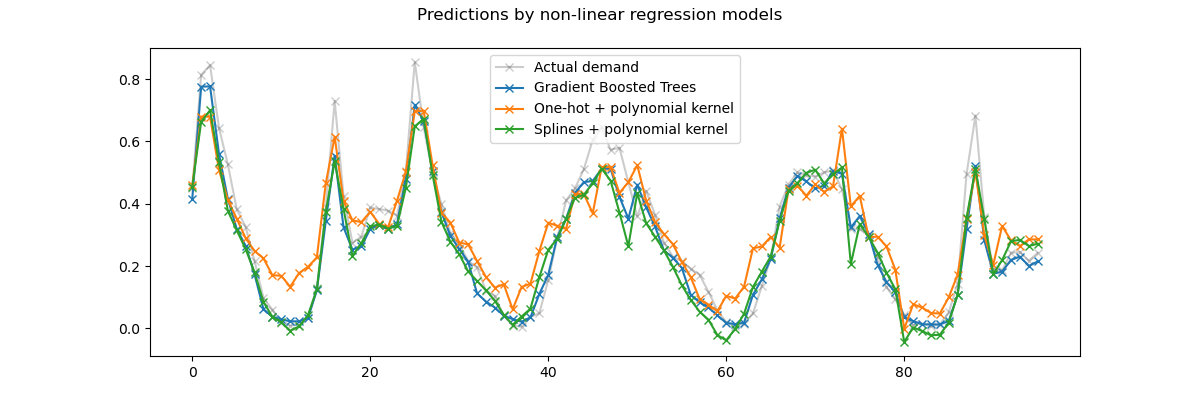
Predictions by non-linear regression models

First, note that trees can naturally model non-linear feature interactions since, by default, decision trees are allowed to grow beyond a depth of 2 levels.

Here, we can observe that the combinations of spline features and non-linear kernels works quite well and can almost rival the accuracy of the gradient boosting regression trees.

On the contrary, one-hot encoded time features do not perform that well with the low rank kernel model. In particular, they significantly over-estimate the low demand hours more than the competing models.

We also observe that none of the models can successfully predict some of the peak rentals at the rush hours during the working days. It is possible that access to additional features would be required to further improve the accuracy of the predictions. For instance, it could be useful to have access to the geographical repartition of the fleet at any point in time or the fraction of bikes that are immobilized because they need servicing.

Let us finally get a more quantitative look at the prediction errors of those three models using the true vs predicted demand scatter plots:

from sklearn.metrics import PredictionErrorDisplay

fig, axes = plt.subplots(nrows=2, ncols=3, figsize=(13, 7), sharex=True, sharey="row")
fig.suptitle("Non-linear regression models", y=1.0)
predictions = [
    one_hot_poly_predictions,
    cyclic_spline_poly_predictions,
    gbrt_predictions,
]
labels = [
    "One hot +\npolynomial kernel",
    "Splines +\npolynomial kernel",
    "Gradient Boosted\nTrees",
]
plot_kinds = ["actual_vs_predicted", "residual_vs_predicted"]
for axis_idx, kind in enumerate(plot_kinds):
    for ax, pred, label in zip(axes[axis_idx], predictions, labels):
        disp = PredictionErrorDisplay.from_predictions(
            y_true=y.iloc[test_0],
            y_pred=pred,
            kind=kind,
            scatter_kwargs={"alpha": 0.3},
            ax=ax,
        )
        ax.set_xticks(np.linspace(0, 1, num=5))
        if axis_idx == 0:
            ax.set_yticks(np.linspace(0, 1, num=5))
            ax.legend(
                ["Best model", label],
                loc="upper center",
                bbox_to_anchor=(0.5, 1.3),
                ncol=2,
            )
        ax.set_aspect("equal", adjustable="box")
plt.show()
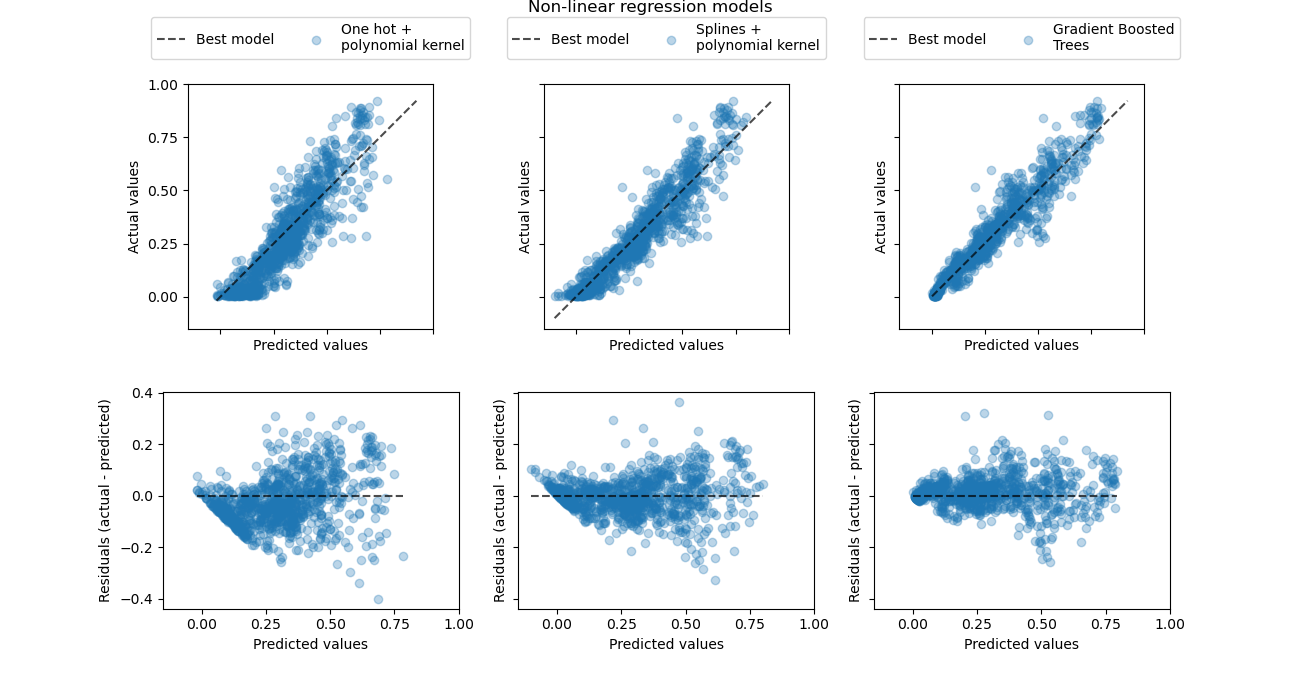
Non-linear regression models

This visualization confirms the conclusions we draw on the previous plot.

All models under-estimate the high demand events (working day rush hours), but gradient boosting a bit less so. The low demand events are well predicted on average by gradient boosting while the one-hot polynomial regression pipeline seems to systematically over-estimate demand in that regime. Overall the predictions of the gradient boosted trees are closer to the diagonal than for the kernel models.

Concluding remarks#

We note that we could have obtained slightly better results for kernel models by using more components (higher rank kernel approximation) at the cost of longer fit and prediction durations. For large values of n_components, the performance of the one-hot encoded features would even match the spline features.

The Nystroem + RidgeCV regressor could also have been replaced by MLPRegressor with one or two hidden layers and we would have obtained quite similar results.

The dataset we used in this case study is sampled on an hourly basis. However cyclic spline-based features could model time-within-day or time-within-week very efficiently with finer-grained time resolutions (for instance with measurements taken every minute instead of every hour) without introducing more features. One-hot encoding time representations would not offer this flexibility.

Finally, in this notebook we used RidgeCV because it is very efficient from a computational point of view. However, it models the target variable as a Gaussian random variable with constant variance. For positive regression problems, it is likely that using a Poisson or Gamma distribution would make more sense. This could be achieved by using GridSearchCV(TweedieRegressor(power=2), param_grid({"alpha": alphas})) instead of RidgeCV.

Total running time of the script: (0 minutes 17.607 seconds)

Launch binder
Launch JupyterLite

Download Jupyter notebook: plot_cyclical_feature_engineering.ipynb

Download Python source code: plot_cyclical_feature_engineering.py

Download zipped: plot_cyclical_feature_engineering.zip

Related examples

Lagged features for time series forecasting

Lagged features for time series forecasting

Categorical Feature Support in Gradient Boosting

Categorical Feature Support in Gradient Boosting

Polynomial and Spline interpolation

Polynomial and Spline interpolation

Comparing Target Encoder with Other Encoders

Comparing Target Encoder with Other Encoders

Gallery generated by Sphinx-Gallery

previous

Species distribution modeling

next

Topic extraction with Non-negative Matrix Factorization and Latent Dirichlet Allocation

On this page
  • Data exploration on the Bike Sharing Demand dataset
  • Time-based cross-validation
  • Gradient Boosting
  • Naive linear regression
  • Time-steps as categories
  • Trigonometric features
  • Periodic spline features
  • Qualitative analysis of the impact of features on linear model predictions
  • Modeling pairwise interactions with splines and polynomial features
  • Modeling non-linear feature interactions with kernels
  • Concluding remarks
Show Source
Download source code
Download Jupyter notebook
Download zipped
Launch JupyterLite
Launch binder

© Copyright 2007 - 2026, scikit-learn developers (BSD License).