1.8. Cross decomposition
The cross decomposition module contains supervised estimators for dimensionality reduction and regression, belonging to the “Partial Least Squares” family.
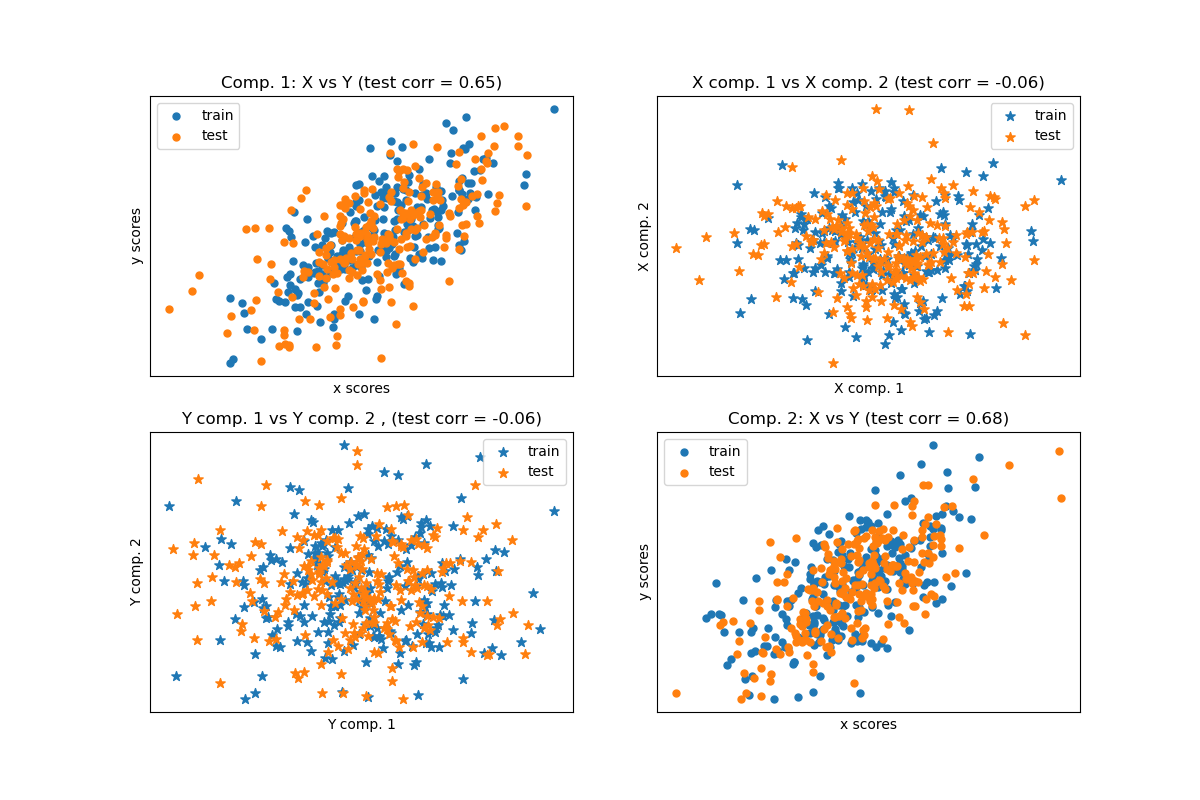
Cross decomposition algorithms find the fundamental relations between two
matrices (X and Y). They are latent variable approaches to modeling the
covariance structures in these two spaces. They will try to find the
multidimensional direction in the X space that explains the maximum
multidimensional variance direction in the Y space. In other words, PLS
projects both X and Y into a lower-dimensional subspace such that the
covariance between transformed(X) and transformed(Y) is maximal.
PLS draws similarities with Principal Component Regression (PCR), where
the samples are first projected into a lower-dimensional subspace, and the
targets y are predicted using transformed(X). One issue with PCR is that
the dimensionality reduction is unsupervised, and may lose some important
variables: PCR would keep the features with the most variance, but it’s
possible that features with a small variances are relevant from predicting
the target. In a way, PLS allows for the same kind of dimensionality
reduction, but by taking into account the targets y. An illustration of
this fact is given in the following example:
* Principal Component Regression vs Partial Least Squares Regression.
Apart from CCA, the PLS estimators are particularly suited when the matrix of predictors has more variables than observations, and when there is multicollinearity among the features. By contrast, standard linear regression would fail in these cases unless it is regularized.
Classes included in this module are PLSRegression,
PLSCanonical, CCA and PLSSVD
1.8.1. PLSCanonical
We here describe the algorithm used in PLSCanonical. The other
estimators use variants of this algorithm, and are detailed below.
We recommend section [1] for more details and comparisons between these
algorithms. In [1], PLSCanonical corresponds to “PLSW2A”.
Given two centered matrices \(X \in \mathbb{R}^{n \times d}\) and
\(Y \in \mathbb{R}^{n \times t}\), and a number of components \(K\),
PLSCanonical proceeds as follows:
Set \(X_1\) to \(X\) and \(Y_1\) to \(Y\). Then, for each \(k \in [1, K]\):
a) compute \(u_k \in \mathbb{R}^d\) and \(v_k \in \mathbb{R}^t\), the first left and right singular vectors of the cross-covariance matrix \(C = X_k^T Y_k\). \(u_k\) and \(v_k\) are called the weights. By definition, \(u_k\) and \(v_k\) are chosen so that they maximize the covariance between the projected \(X_k\) and the projected target, that is \(\text{Cov}(X_k u_k, Y_k v_k)\).
b) Project \(X_k\) and \(Y_k\) on the singular vectors to obtain scores: \(\xi_k = X_k u_k\) and \(\omega_k = Y_k v_k\)
c) Regress \(X_k\) on \(\xi_k\), i.e. find a vector \(\gamma_k \in \mathbb{R}^d\) such that the rank-1 matrix \(\xi_k \gamma_k^T\) is as close as possible to \(X_k\). Do the same on \(Y_k\) with \(\omega_k\) to obtain \(\delta_k\). The vectors \(\gamma_k\) and \(\delta_k\) are called the loadings.
d) deflate \(X_k\) and \(Y_k\), i.e. subtract the rank-1 approximations: \(X_{k+1} = X_k - \xi_k \gamma_k^T\), and \(Y_{k + 1} = Y_k - \omega_k \delta_k^T\).
At the end, we have approximated \(X\) as a sum of rank-1 matrices: \(X = \Xi \Gamma^T\) where \(\Xi \in \mathbb{R}^{n \times K}\) contains the scores in its columns, and \(\Gamma^T \in \mathbb{R}^{K \times d}\) contains the loadings in its rows. Similarly for \(Y\), we have \(Y = \Omega \Delta^T\).
Note that the scores matrices \(\Xi\) and \(\Omega\) correspond to the projections of the training data \(X\) and \(Y\), respectively.
Step a) may be performed in two ways: either by computing the whole SVD of
\(C\) and only retain the singular vectors with the biggest singular
values, or by directly computing the singular vectors using the power method (cf section 11.3 in [1]),
which corresponds to the 'nipals' option of the algorithm parameter.
To transform \(X\) into \(\bar{X}\), we need to find a projection
matrix \(P\) such that \(\bar{X} = XP\). We know that for the
training data, \(\Xi = XP\), and \(X = \Xi \Gamma^T\). Setting
\(P = U(\Gamma^T U)^{-1}\) where \(U\) is the matrix with the
\(u_k\) in the columns, we have \(XP = X U(\Gamma^T U)^{-1} = \Xi
(\Gamma^T U) (\Gamma^T U)^{-1} = \Xi\) as desired. The rotation matrix
\(P\) can be accessed from the Similarly, \(Y\) can be transformed using the rotation matrix
\(V(\Delta^T V)^{-1}\), accessed via the
Transforming data
Click for more details

x_rotations_ attribute.y_rotations_ attribute.
To predict the targets of some data \(X\), we are looking for a
coefficient matrix \(\beta \in R^{d \times t}\) such that \(Y =
X\beta\). The idea is to try to predict the transformed targets \(\Omega\) as a
function of the transformed samples \(\Xi\), by computing \(\alpha
\in \mathbb{R}\) such that \(\Omega = \alpha \Xi\). Then, we have \(Y = \Omega \Delta^T = \alpha \Xi \Delta^T\), and since
\(\Xi\) is the transformed training data we have that \(Y = X \alpha
P \Delta^T\), and as a result the coefficient matrix \(\beta = \alpha P
\Delta^T\). \(\beta\) can be accessed through the
Predicting the targets Y
Click for more details

coef_ attribute.
1.8.2. PLSSVD
PLSSVD is a simplified version of PLSCanonical
described earlier: instead of iteratively deflating the matrices \(X_k\)
and \(Y_k\), PLSSVD computes the SVD of \(C = X^TY\)
only once, and stores the n_components singular vectors corresponding to
the biggest singular values in the matrices U and V, corresponding to the
x_weights_ and y_weights_ attributes. Here, the transformed data is
simply transformed(X) = XU and transformed(Y) = YV.
If n_components == 1, PLSSVD and PLSCanonical are
strictly equivalent.
1.8.3. PLSRegression
The PLSRegression estimator is similar to
PLSCanonical with algorithm='nipals', with 2 significant
differences:
at step a) in the power method to compute \(u_k\) and \(v_k\), \(v_k\) is never normalized.
at step c), the targets \(Y_k\) are approximated using the projection of \(X_k\) (i.e. \(\xi_k\)) instead of the projection of \(Y_k\) (i.e. \(\omega_k\)). In other words, the loadings computation is different. As a result, the deflation in step d) will also be affected.
These two modifications affect the output of predict and transform,
which are not the same as for PLSCanonical. Also, while the number
of components is limited by min(n_samples, n_features, n_targets) in
PLSCanonical, here the limit is the rank of \(X^TX\), i.e.
min(n_samples, n_features).
PLSRegression is also known as PLS1 (single targets) and PLS2
(multiple targets). Much like Lasso,
PLSRegression is a form of regularized linear regression where the
number of components controls the strength of the regularization.
1.8.4. Canonical Correlation Analysis
Canonical Correlation Analysis was developed prior and independently to PLS.
But it turns out that CCA is a special case of PLS, and corresponds
to PLS in “Mode B” in the literature.
CCA differs from PLSCanonical in the way the weights
\(u_k\) and \(v_k\) are computed in the power method of step a).
Details can be found in section 10 of [1].
Since CCA involves the inversion of \(X_k^TX_k\) and
\(Y_k^TY_k\), this estimator can be unstable if the number of features or
targets is greater than the number of samples.
Reference
Click for more details
